

History, Foundation & the Sacred Heart of Ancient Memphis
The Temple of Ptah was one of the most important religious monuments in Ancient Egypt and served as the spiritual heart of Memphis, Egypt’s first capital. Dedicated to Ptah, the creator god and patron of craftsmen, architects, and artists, the temple remained a major center of worship for more than two thousand years.
Although only fragments of the once-magnificent complex survive today, archaeological discoveries reveal that it was among the largest and most influential temples in Egypt. Kings from the Old Kingdom through the Late Period expanded, restored, and enriched the sanctuary, making it a symbol of royal authority and religious devotion.
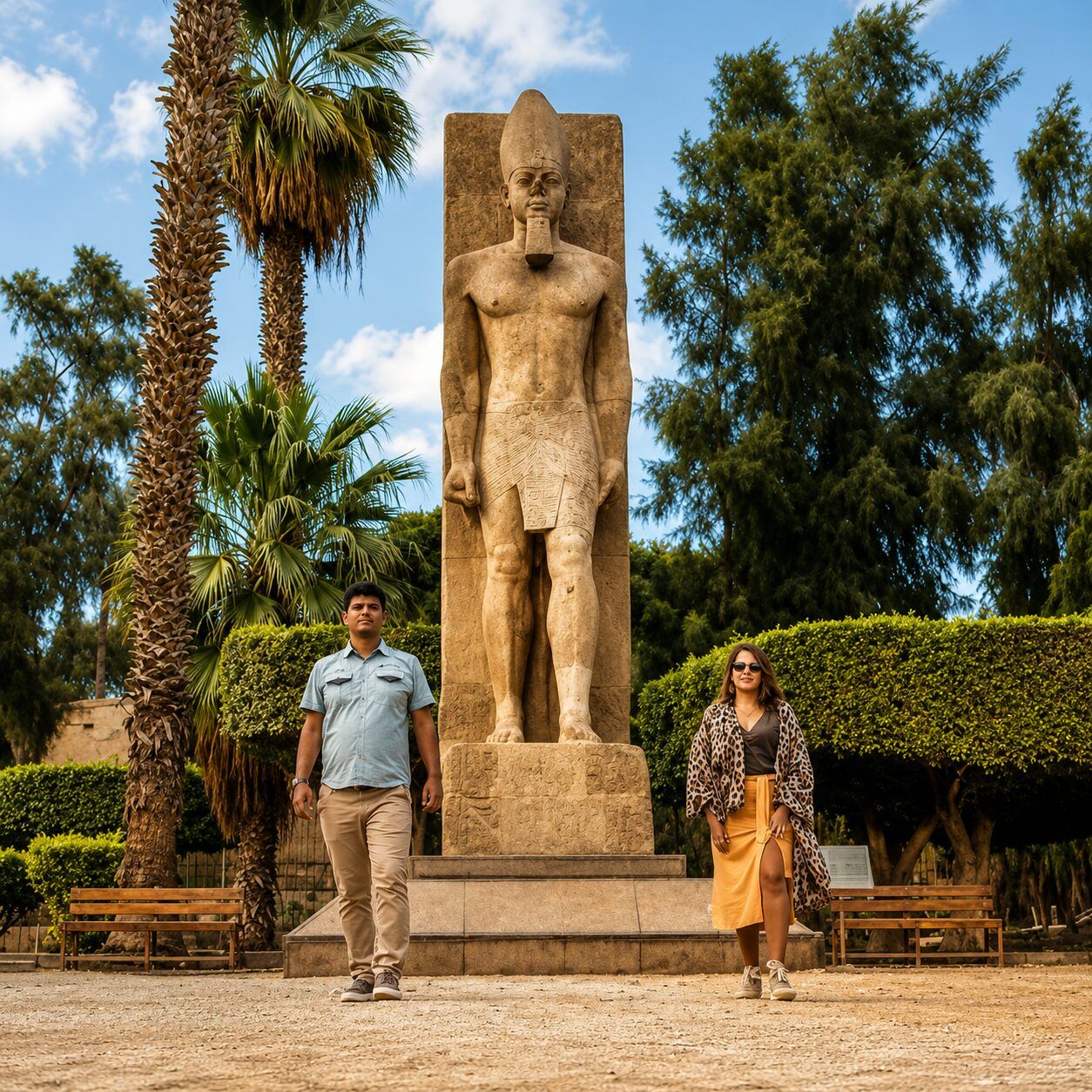
Today, visitors to the Memphis Open-Air Museum can explore the remains of the Temple of Ptah while discovering the nearby Colossus of Ramses II and the Alabaster Sphinx of Memphis, two of the site’s greatest treasures.
Table 1: Temple of Ptah at a Glance
| Feature | Details |
|---|---|
| Name | Temple of Ptah |
| Ancient City | Memphis |
| Main Deity | Ptah |
| Founded | Early Dynastic Period |
| Location | Mit Rahina, Giza Governorate |
| UNESCO Site | Memphis and its Necropolis |
| Famous For | Main temple of Ptah and one of Egypt’s oldest religious centers |
Who Was Ptah?
Ptah was one of the most revered gods in Ancient Egypt and played a central role in the religious beliefs of Memphis.
According to the Memphite Theology, Ptah created the universe through the power of his heart (thought) and tongue (speech). Rather than creating through physical action, he brought the world into existence by imagining it and speaking it into being.
Ptah was worshipped as:
- Creator of the universe
- Patron of craftsmen
- Protector of architects
- Guardian of sculptors
- God of builders
- Divine master artisan
Because Memphis was Egypt’s center for skilled craftsmen and monumental construction, Ptah became one of the kingdom’s most influential deities.
Table 2: Ptah’s Roles
| Title | Meaning |
|---|---|
| Creator God | Creator of the universe |
| Patron of Craftsmen | Protector of artisans |
| Divine Architect | Master builder |
| Lord of Memphis | Principal deity of the city |
| God of Creation | Source of life and order |
The Foundation of the Temple
The origins of the Temple of Ptah date back to the Early Dynastic Period, shortly after the unification of Upper and Lower Egypt around 3100 BCE.
As Memphis became the political capital of the newly unified kingdom, the temple grew into the city’s most important religious institution.
Over the centuries, successive pharaohs expanded the sanctuary with:
- Massive gateways
- Courtyards
- Shrines
- Processional avenues
- Sacred halls
- Monumental statues
By the New Kingdom, the Temple of Ptah ranked among Egypt’s greatest religious complexes.
Table 3: Development of the Temple
| Period | Major Development |
|---|---|
| Early Dynastic Period | Original sanctuary established |
| Old Kingdom | Expansion of temple buildings |
| Middle Kingdom | Restoration and additions |
| New Kingdom | Major enlargement by royal builders |
| Late Period | Continued restoration |
Memphis: Egypt’s First Capital
The Temple of Ptah cannot be separated from the history of Memphis, one of the world’s oldest continuously occupied cities.
Founded around 3100 BCE, Memphis served as:
- Egypt’s political capital
- Royal residence
- Religious center
- Military headquarters
- Commercial hub
Its strategic location between Upper and Lower Egypt made it an ideal administrative center, while the Temple of Ptah became the city’s spiritual heart.
Table 4: Ancient Memphis
| Feature | Information |
|---|---|
| Founder | Traditionally King Menes (Narmer) |
| Date | Around 3100 BCE |
| Role | First capital of Egypt |
| Main God | Ptah |
| UNESCO Status | World Heritage Site |
Kings Who Expanded the Temple
Many of Egypt’s greatest pharaohs contributed to the Temple of Ptah.
Notable builders included:
- Amenemhat I
- Thutmose III
- Amenhotep III
- Ramses II
- Merneptah
- Shoshenq I
Each ruler added monuments, statues, or architectural elements, reflecting the temple’s enduring importance.
Among these kings, Ramses II carried out some of the most ambitious building projects, commissioning monumental statues and expanding Memphis’s sacred precinct.
Table 5: Important Royal Builders
| Pharaoh | Contribution |
|---|---|
| Amenemhat I | Temple restoration |
| Thutmose III | New monuments |
| Amenhotep III | Architectural additions |
| Ramses II | Colossal statues and expansions |
| Merneptah | Temple improvements |
| Shoshenq I | Restoration work |
The Temple During the New Kingdom
The New Kingdom (c. 1550–1070 BCE) marked one of the temple’s greatest periods of prosperity.
During this era, Memphis became an important military and administrative center, while the Temple of Ptah attracted pilgrims, priests, craftsmen, and royal officials from across Egypt.
Grand ceremonies, festivals, and religious processions were regularly held within its walls, strengthening the connection between the pharaoh, the gods, and the people.
Table 6: The New Kingdom Temple
| Feature | Importance |
|---|---|
| Religious Center | National importance |
| Royal Patronage | Supported by pharaohs |
| Festivals | Major public ceremonies |
| Workshops | Craftsmen attached to the temple |
| Pilgrimage | Sacred destination |
Rediscovery by Archaeologists
Following the decline of Memphis, many temple buildings gradually collapsed and became buried beneath layers of mud, sand, and debris.
Modern archaeological excavations uncovered:
- Temple foundations
- Stone gateways
- Massive columns
- Sculptures
- Relief fragments
- Royal inscriptions
- Ceremonial courtyards
These discoveries have allowed historians to reconstruct much of the temple’s original appearance.
Table 7: Archaeological Discoveries
| Discovery | Importance |
|---|---|
| Temple Foundations | Original layout |
| Stone Columns | Architectural evidence |
| Royal Statues | Political history |
| Relief Fragments | Religious scenes |
| Inscriptions | Historical records |
UNESCO World Heritage Site
The Temple of Ptah forms part of the UNESCO World Heritage Site “Memphis and its Necropolis – the Pyramid Fields from Giza to Dahshur.”
This extraordinary archaeological landscape includes:
- Memphis
- Saqqara
- Dahshur
- Giza
Together, these sites illustrate the political, religious, and architectural development of Ancient Egypt over thousands of years.
Table 8: UNESCO Facts
| Feature | Information |
|---|---|
| Heritage Site | Memphis and its Necropolis |
| UNESCO Listing | 1979 |
| Country | Egypt |
| Category | Cultural Heritage |
| Includes | Memphis, Saqqara, Dahshur & Giza |
Amazing Facts About the Temple of Ptah
- It was the principal temple of Memphis, Egypt’s first capital.
- Ptah was regarded as the creator god in the Memphite Theology.
- The temple remained an important place of worship for more than 2,000 years.
- Ramses II expanded the temple and erected monumental statues nearby.
- The nearby Colossus of Ramses II and Alabaster Sphinx are closely associated with the temple complex.
- The site forms part of a UNESCO World Heritage Site.
Table 9: Quick Facts
| Fact | Information |
|---|---|
| Age | Over 5,000 years (origins) |
| Main Deity | Ptah |
| Ancient City | Memphis |
| Famous Nearby Monument | Colossus of Ramses II |
| UNESCO Site | Yes |
Why the Temple of Ptah Matters Today
The Temple of Ptah is one of the most significant religious sites in Ancient Egyptian history. Although much of its grandeur has disappeared, the surviving remains reveal the importance of Memphis as a political, cultural, and spiritual center.
For visitors exploring Memphis, the temple provides essential context for understanding the nearby monuments, including the Colossus of Ramses II and the Alabaster Sphinx, while offering a deeper appreciation of the beliefs that shaped one of the world’s greatest civilizations.
Architecture, Archaeology & Engineering of the Temple of Ptah
The Architectural Heart of Ancient Memphis
The Temple of Ptah was one of the largest and most influential religious complexes in Ancient Egypt. Located at the center of Memphis, Egypt’s first capital, it served as the principal sanctuary dedicated to Ptah, the creator god and patron of craftsmen.
Although only sections of the original temple survive today, archaeological excavations have revealed an enormous complex of gateways, courtyards, sanctuaries, workshops, and ceremonial halls that once dominated the sacred landscape of Memphis.
At its height, the Temple of Ptah rivaled the great temples of Karnak, Luxor, and Abydos, reflecting the political and religious importance of Memphis for thousands of years.
Table 1: Temple Overview
| Feature | Details |
|---|---|
| Temple Name | Temple of Ptah |
| Location | Memphis, Egypt |
| Main Deity | Ptah |
| Primary Function | Religious worship |
| Period | Early Dynastic to Late Period |
| Construction Material | Limestone, sandstone and granite |
| Current Condition | Archaeological ruins |
Temple Layout
Like most major Egyptian temples, the Temple of Ptah followed a carefully planned layout that symbolized the journey from the human world into the sacred realm of the gods.
Visitors would have entered through monumental gateways before passing into increasingly restricted spaces reserved for priests and the pharaoh.
The main sections included:
- Monumental entrance
- Processional avenue
- Open courtyards
- Hypostyle halls
- Inner sanctuary
- Sacred storerooms
- Priestly quarters
- Workshops
Each section served a specific ceremonial or administrative purpose.
Table 2: Main Areas of the Temple
| Section | Purpose |
|---|---|
| Entrance Gate | Formal arrival |
| Courtyard | Public ceremonies |
| Hypostyle Hall | Religious gatherings |
| Sanctuary | Statue of Ptah |
| Priests’ Rooms | Temple administration |
| Workshops | Sacred craftsmanship |
Monumental Gateways
Ancient Egyptian temples often featured massive gateways known as pylons, and although only fragments survive at Memphis, archaeological evidence suggests that the Temple of Ptah possessed impressive entrances decorated with reliefs and royal inscriptions.
These gateways proclaimed the authority of the reigning pharaoh while marking the transition from the ordinary world into sacred space.
Many gateways displayed:
- Royal cartouches
- Victory scenes
- Offerings to the gods
- Religious inscriptions
Table 3: Gateway Features
| Feature | Importance |
|---|---|
| Monumental Entrance | Sacred boundary |
| Royal Cartouches | Identify the king |
| Relief Decorations | Religious symbolism |
| Stone Inscriptions | Historical record |
| Flagstaff Bases | Ceremonial appearance |
Hypostyle Halls and Courtyards
Large courtyards welcomed worshippers during festivals, while roofed hypostyle halls supported by rows of stone columns created dramatic ceremonial spaces.
These halls were used for:
- Religious festivals
- Royal ceremonies
- Temple processions
- Ritual offerings
- Priestly gatherings
The columns themselves were often decorated with hieroglyphs, floral capitals, and scenes honoring Ptah.
Table 4: Ceremonial Spaces
| Area | Function |
|---|---|
| Open Courtyard | Public worship |
| Hypostyle Hall | Religious ceremonies |
| Processional Route | Festival processions |
| Offering Hall | Gifts to the gods |
| Sanctuary Entrance | Restricted access |
The Inner Sanctuary
At the heart of the Temple of Ptah stood the sanctuary, the most sacred space within the complex.
Only high priests and the pharaoh were permitted to enter this chamber.
The sanctuary housed the cult statue of Ptah, where daily rituals included:
- Washing the divine image
- Dressing the statue
- Presenting food offerings
- Burning incense
- Reciting sacred prayers
These ceremonies were believed to maintain harmony between the gods and Egypt.
Table 5: Sanctuary Rituals
| Ritual | Purpose |
|---|---|
| Washing the Statue | Ritual purification |
| Dressing the God | Divine honor |
| Food Offerings | Sacred nourishment |
| Incense | Spiritual purification |
| Hymns and Prayers | Religious devotion |
Building Materials
The Temple of Ptah was constructed using a combination of durable stones chosen for both structural strength and symbolic importance.
Builders used:
- Limestone for walls
- Sandstone for architectural elements
- Granite for statues and gateways
- Basalt for floors
- Alabaster for decorative objects
Many of these materials were transported hundreds of kilometers from quarries across Egypt.
Table 6: Construction Materials
| Material | Main Use |
|---|---|
| Limestone | Walls and foundations |
| Sandstone | Columns and halls |
| Granite | Statues and gateways |
| Basalt | Flooring |
| Egyptian Calcite (Alabaster) | Ritual vessels and decorative pieces |
Archaeological Excavations
Excavations conducted over the past two centuries have revealed important evidence about the temple’s original appearance.
Archaeologists have uncovered:
- Foundation walls
- Granite statues
- Column bases
- Stone blocks
- Hieroglyphic inscriptions
- Temple courtyards
- Sacred gateways
These discoveries continue to improve our understanding of one of Egypt’s greatest religious complexes.
Table 7: Major Archaeological Discoveries
| Discovery | Importance |
|---|---|
| Temple Foundations | Original layout |
| Granite Statues | Royal history |
| Column Bases | Architectural design |
| Inscriptions | Religious records |
| Courtyard Walls | Temple organization |
Comparison with Other Egyptian Temples
Although the Temple of Ptah is less well preserved than some later temples, it was one of the most influential sanctuaries in Egyptian history.
Table 8: Temple Comparison
| Temple | Main Deity | Location | Famous For |
|---|---|---|---|
| Temple of Ptah | Ptah | Memphis | Creator god and craftsmen |
| Karnak Temple | Amun | Luxor | Largest temple complex |
| Luxor Temple | Amun | Luxor | Royal ceremonies |
| Temple of Horus | Horus | Edfu | Best-preserved temple |
| Temple of Seti I | Osiris | Abydos | Beautiful reliefs |
Conservation and Preservation
Today, archaeologists continue to preserve the Temple of Ptah through careful conservation projects.
Current efforts include:
- Structural stabilization
- Stone cleaning
- Digital documentation
- Environmental monitoring
- Visitor management
- Archaeological recording
These initiatives protect the surviving remains while supporting ongoing research into the history of Memphis.
Table 9: Conservation Projects
| Project | Objective |
|---|---|
| Structural Monitoring | Preserve stability |
| Stone Conservation | Protect remaining blocks |
| Digital Recording | Create permanent records |
| Visitor Management | Reduce site impact |
| Environmental Monitoring | Limit weathering |
Why the Temple of Ptah Was an Architectural Masterpiece
The Temple of Ptah combined monumental architecture, religious symbolism, and advanced engineering into one of the most important sacred complexes in Ancient Egypt.
Its impressive gateways, spacious courtyards, towering columns, and carefully designed sanctuary reflected both the political importance of Memphis and the deep religious beliefs of its people.
Although only ruins remain today, the archaeological evidence demonstrates that this temple once ranked among the greatest monuments of Ancient Egypt.
Table 10: Why the Temple of Ptah Is Unique
| Feature | Rating |
|---|---|
| Historical Importance | ⭐⭐⭐⭐⭐ |
| Religious Significance | ⭐⭐⭐⭐⭐ |
| Architecture | ⭐⭐⭐⭐⭐ |
| Archaeology | ⭐⭐⭐⭐⭐ |
| Educational Value | ⭐⭐⭐⭐⭐ |
| Overall Experience | ⭐⭐⭐⭐⭐ |
A Monument to Faith and Royal Power
The Temple of Ptah stood at the center of Ancient Memphis for centuries, serving as a place of worship, royal ceremony, and artistic excellence. It reflected the importance of Ptah as creator god and the central role of Memphis in Egypt’s political and religious life.
Today, the surviving ruins continue to inspire archaeologists and travelers, offering a fascinating glimpse into one of the oldest and most influential temple complexes ever built.
Religion, the Cult of Ptah, Archaeology & the Lasting Legacy of the Temple
The Spiritual Heart of Ancient Memphis
For more than two thousand years, the Temple of Ptah stood at the center of religious life in Ancient Memphis. It was not only the principal sanctuary dedicated to the creator god Ptah, but also one of Egypt’s most influential centers of theology, craftsmanship, and royal ceremonies.
Kings visited the temple to honor the gods, priests performed sacred rituals every day, and skilled artisans worked under Ptah’s divine protection. The temple became a place where religion, politics, and artistic excellence came together, helping shape Ancient Egyptian civilization for generations.
Even today, the archaeological remains of the Temple of Ptah continue to reveal the extraordinary importance of Memphis during Egypt’s earliest dynasties and beyond.
Table 1: Religious Importance
| Feature | Significance |
|---|---|
| Main Deity | Ptah |
| Religious Center | Memphis |
| Main Function | Worship and royal ceremonies |
| Associated Cult | Apis Bull |
| Historical Importance | One of Egypt’s oldest temples |
| UNESCO Site | Memphis and its Necropolis |
Ptah: The Creator God
Ptah occupied a unique position within Ancient Egyptian religion.
According to the Memphite Theology, Ptah created the universe through the power of thought and speech. He imagined creation in his heart and brought it into existence simply by speaking.
Unlike many creator gods associated with physical actions, Ptah represented intellectual creation, wisdom, and craftsmanship.
He became the patron deity of:
- Architects
- Sculptors
- Builders
- Metalworkers
- Craftsmen
- Artists
His influence extended throughout Egypt, making the Temple of Ptah one of the kingdom’s most respected religious institutions.
Table 2: Titles of Ptah
| Title | Meaning |
|---|---|
| Creator God | Origin of the universe |
| Lord of Memphis | Patron deity of the city |
| Divine Craftsman | Protector of artisans |
| Master Builder | Guardian of architecture |
| Lord of Truth | Symbol of cosmic order |
Memphis Theology
The Memphite Theology is one of the oldest surviving theological systems from Ancient Egypt.
Its central belief was that:
- Creation began with Ptah.
- Thought came before action.
- Speech transformed ideas into reality.
- The gods themselves emerged through Ptah’s creative power.
These beliefs influenced Egyptian religious philosophy for centuries and demonstrate the sophisticated spiritual thinking developed in Memphis.
Table 3: Principles of the Memphite Theology
| Principle | Explanation |
|---|---|
| Heart | Source of thought |
| Tongue | Instrument of creation |
| Ptah | Supreme creator |
| Order (Ma’at) | Balance of the universe |
| Divine Speech | Creation through words |
Daily Rituals in the Temple
Every day, priests performed elaborate ceremonies inside the sanctuary of Ptah.
These rituals included:
- Washing the cult statue
- Dressing the divine image
- Offering food and drink
- Burning incense
- Singing hymns
- Presenting flowers
- Reciting sacred prayers
Only specially trained priests were permitted to enter the innermost sanctuary, ensuring the purity of the sacred space.
Table 4: Daily Temple Rituals
| Ritual | Purpose |
|---|---|
| Washing the Statue | Ritual purification |
| Dressing the God | Honor the deity |
| Food Offerings | Sustain divine order |
| Burning Incense | Purify the sanctuary |
| Hymns | Praise Ptah |
The High Priests of Ptah
The High Priest of Ptah ranked among the most powerful religious officials in Ancient Egypt.
His responsibilities included:
- Supervising temple rituals
- Managing temple estates
- Advising the pharaoh
- Leading major religious festivals
- Overseeing craftsmen and workshops
- Protecting sacred traditions
Many High Priests held significant political influence, especially during periods when Memphis remained a major administrative center.
Table 5: Responsibilities of the High Priest
| Responsibility | Importance |
|---|---|
| Religious Leadership | Worship of Ptah |
| Temple Administration | Manage temple resources |
| Royal Advisor | Counsel the pharaoh |
| Festival Organization | Lead public ceremonies |
| Supervision of Workshops | Support sacred craftsmanship |
The Sacred Apis Bull
One of the most famous traditions connected with the Temple of Ptah was the worship of the Apis Bull.
The Apis Bull was regarded as the living manifestation of Ptah on earth.
After the death of each sacred bull:
- The animal was carefully mummified.
- Elaborate funeral ceremonies were held.
- The bull was buried in the nearby Serapeum of Saqqara.
- Priests searched for the next sacred Apis Bull.
This remarkable tradition continued for centuries and became one of the best-known religious cults of Ancient Egypt.
Table 6: The Apis Bull Cult
| Feature | Information |
|---|---|
| Sacred Animal | Apis Bull |
| Associated God | Ptah |
| Burial Place | Serapeum of Saqqara |
| Religious Role | Living manifestation of Ptah |
| Importance | National religious cult |
Ramses II and the Temple
Few pharaohs contributed more to the Temple of Ptah than Ramses II.
During his reign, he:
- Expanded the temple precinct.
- Commissioned colossal statues.
- Built monumental gateways.
- Added inscriptions celebrating his achievements.
- Strengthened Memphis as a royal center.
The nearby Colossus of Ramses II remains one of the greatest reminders of his extensive building program.
Table 7: Contributions of Ramses II
| Project | Contribution |
|---|---|
| Temple Expansion | Enlarged sacred complex |
| Colossal Statues | Celebrated royal authority |
| Gateways | Monumental entrances |
| Inscriptions | Recorded royal achievements |
| Religious Patronage | Honored Ptah |
Myths vs. Historical Facts
Many legends surround the Temple of Ptah, but archaeological evidence helps separate tradition from historical reality.
Table 8: Myths vs. Facts
| Myth | Historical Fact |
|---|---|
| The temple was built by Ramses II | The sanctuary originated long before his reign and was expanded by many pharaohs |
| Ptah was worshipped only in Memphis | Ptah was honored throughout Egypt, though Memphis remained his principal cult center |
| The Apis Bull was worshipped as an ordinary animal | The Apis Bull represented the living manifestation of Ptah and held profound religious significance |
| Nothing survives of the temple | Archaeologists have uncovered important foundations, statues, gateways, and inscriptions |
UNESCO World Heritage Site
The Temple of Ptah is part of the UNESCO World Heritage Site “Memphis and its Necropolis – the Pyramid Fields from Giza to Dahshur.”
This extraordinary cultural landscape includes:
- Memphis
- Saqqara
- Dahshur
- Giza
Together, these archaeological sites preserve thousands of years of Egyptian religious, political, and architectural history.
Table 9: UNESCO Facts
| Feature | Information |
|---|---|
| Heritage Site | Memphis and its Necropolis |
| UNESCO Listing | 1979 |
| Country | Egypt |
| Category | Cultural Heritage |
| Includes | Memphis, Saqqara, Dahshur & Giza |
The Enduring Legacy of the Temple of Ptah
Although only fragments of the Temple of Ptah remain today, its influence on Ancient Egyptian civilization cannot be overstated.
The temple shaped:
- Egyptian religious thought
- Royal ceremonies
- Monumental architecture
- Artistic traditions
- Sacred craftsmanship
Its teachings, particularly the Memphite Theology, continue to fascinate historians and archaeologists as one of the earliest recorded philosophies of creation.
Table 10: Why the Temple of Ptah Matters
| Experience | Rating |
|---|---|
| Religious Importance | ⭐⭐⭐⭐⭐ |
| Historical Significance | ⭐⭐⭐⭐⭐ |
| Archaeology | ⭐⭐⭐⭐⭐ |
| Educational Value | ⭐⭐⭐⭐⭐ |
| Cultural Heritage | ⭐⭐⭐⭐⭐ |
| Overall Experience | ⭐⭐⭐⭐⭐ |
A Lasting Symbol of Ancient Egyptian Faith
The Temple of Ptah was more than a place of worship—it was the spiritual foundation of Ancient Memphis and one of Egypt’s greatest centers of religion, craftsmanship, and royal power.
Its connection to the creator god Ptah, the sacred Apis Bull, and some of Egypt’s greatest pharaohs makes it an essential destination for anyone seeking to understand the beliefs and achievements of one of the world’s oldest civilizations.
4: Visitor Guide, Travel Tips, FAQs & Planning Your Visit
Planning Your Visit to the Temple of Ptah
The Temple of Ptah is one of the most historically significant sites in Memphis, Egypt’s first ancient capital. Although much of the original temple has been lost over thousands of years, the surviving ruins offer visitors a fascinating glimpse into one of the oldest religious centers in the world.
Walking through the archaeological remains, it’s easy to imagine the temple during its height, when priests performed daily rituals, pharaohs celebrated grand ceremonies, and pilgrims gathered to honor Ptah, the creator god and patron of craftsmen.
A visit to the Temple of Ptah is best combined with the nearby Colossus of Ramses II, Alabaster Sphinx of Memphis, Saqqara, and Dahshur, creating an unforgettable journey through the origins of Ancient Egyptian civilization.
Table 1: Visitor Information
| Feature | Details |
|---|---|
| Location | Memphis Archaeological Site, Mit Rahina |
| Monument Type | Ancient Egyptian Temple |
| Main Deity | Ptah |
| Estimated Foundation | Early Dynastic Period |
| Average Visit Time | 30–45 minutes |
| Guided Tour | Highly Recommended |
Best Time to Visit
The Temple of Ptah can be visited throughout the year, but the cooler months offer the most comfortable experience.
Best months:
- October
- November
- December
- January
- February
- March
- April
For the best experience, arrive early in the morning when temperatures are pleasant and the archaeological site is quieter.
Table 2: Best Seasons
| Season | Weather | Recommendation |
|---|---|---|
| October–November | Pleasant | ⭐⭐⭐⭐⭐ |
| December–February | Cool | ⭐⭐⭐⭐⭐ |
| March–April | Warm | ⭐⭐⭐⭐☆ |
| May–September | Very Hot | ⭐⭐⭐☆☆ |
Opening Hours
The Temple of Ptah is part of the Memphis Archaeological Site, which generally follows the official operating hours of the Memphis Open-Air Museum and surrounding archaeological area.
Opening hours may vary because of conservation projects, public holidays, or special events, so checking current visitor information before traveling is recommended.
Table 3: Suggested Visiting Schedule
| Time | Activity |
|---|---|
| 8:00 AM | Arrive at Memphis |
| 8:15 AM | Colossus of Ramses II |
| 9:00 AM | Temple of Ptah |
| 9:45 AM | Alabaster Sphinx |
| 10:30 AM | Continue to Saqqara |
How to Get There
The Temple of Ptah is located approximately 30 kilometers (19 miles) south of downtown Cairo in Mit Rahina, close to Saqqara.
Transportation options include:
- Private guided tour
- Private driver
- Taxi
- Ride-hailing services
Many visitors include Memphis as part of a full-day tour covering Saqqara, Dahshur, and the Giza Pyramids.
Table 4: Transportation Options
| Option | Comfort | Best For |
|---|---|---|
| Private Tour | ⭐⭐⭐⭐⭐ | First-time visitors |
| Private Driver | ⭐⭐⭐⭐⭐ | Flexible itineraries |
| Taxi | ⭐⭐⭐⭐☆ | Independent travelers |
| Ride-Hailing App | ⭐⭐⭐⭐☆ | Budget-conscious visitors |
Nearby Attractions
The Temple of Ptah is surrounded by some of Egypt’s most famous archaeological landmarks.
Nearby attractions include:
- Colossus of Ramses II
- Alabaster Sphinx of Memphis
- Memphis Open-Air Museum
- Saqqara Necropolis
- Step Pyramid of Djoser
- Imhotep Museum
- Serapeum of Saqqara
- Bent Pyramid
Together, these monuments tell the story of Ancient Egypt from its earliest dynasties through the age of the great pyramid builders.
Table 5: Nearby Attractions
| Attraction | Approximate Distance | Suggested Visit |
|---|---|---|
| Colossus of Ramses II | Within the archaeological site | 20–30 min |
| Alabaster Sphinx | Within the archaeological site | 20 min |
| Saqqara Necropolis | About 4 km | 2–3 hours |
| Step Pyramid of Djoser | About 5 km | 60–90 min |
| Imhotep Museum | About 5 km | 45–60 min |
| Bent Pyramid | About 16 km | 60–90 min |
| Red Pyramid | About 18 km | 60–90 min |
Photography Tips
Although much of the temple survives only as ruins, it remains an excellent location for photography.
For the best results:
- Visit during the early morning.
- Capture wide views showing the temple foundations.
- Photograph nearby statues to provide historical context.
- Include architectural fragments and columns in your images.
- Follow current site regulations regarding photography.
Table 6: Best Photography Locations
| Location | Best Time |
|---|---|
| Temple Foundations | Morning |
| Stone Gateways | Morning |
| Column Remains | Morning |
| Wide Archaeological View | Early Morning |
| Memphis Panorama | Morning |
Frequently Asked Questions
Why is the Temple of Ptah famous?
It was the principal temple of Ptah, the creator god and patron of craftsmen, and one of the most important religious centers in Ancient Egypt.
Can visitors enter the temple?
Visitors can explore the archaeological remains of the temple complex, although only portions of the original structure survive today.
Who built the Temple of Ptah?
The temple originated during the Early Dynastic Period and was expanded by numerous pharaohs over many centuries, including Ramses II.
Is a guide recommended?
Yes. A licensed Egyptologist guide can explain the temple’s religious significance, the Memphite Theology, and its connection to nearby monuments such as the Colossus of Ramses II and the Alabaster Sphinx.
Table 7: Quick Answers
| Question | Answer |
|---|---|
| Worth Visiting? | ⭐ Absolutely |
| Guided Tour | Highly Recommended |
| Family Friendly | Yes |
| Photography | Excellent |
| Educational Value | Outstanding |
Visitor Checklist
For a comfortable visit, bring:
- Comfortable walking shoes
- Camera or smartphone
- Portable charger
- Water bottle
- Hat
- Sunglasses
- Sunscreen
- Small backpack
Table 8: Packing Checklist
| Item | Bring? |
|---|---|
| Comfortable Shoes | ✅ |
| Camera | ✅ |
| Portable Charger | ✅ |
| Water Bottle | ✅ |
| Hat | ✅ |
| Sunglasses | ✅ |
| Sunscreen | ✅ |
| Backpack | ✅ |
Suggested One-Day Memphis, Saqqara & Dahshur Itinerary
The Temple of Ptah is best experienced as part of a full-day archaeological tour.
Table 9: Suggested Itinerary
| Time | Activity |
|---|---|
| 8:00 AM | Arrive at Memphis |
| 8:15 AM | Colossus of Ramses II |
| 9:00 AM | Temple of Ptah |
| 9:45 AM | Alabaster Sphinx |
| 10:30 AM | Saqqara Necropolis |
| 11:00 AM | Step Pyramid of Djoser |
| 12:00 PM | Imhotep Museum |
| 1:00 PM | Lunch |
| 2:30 PM | Bent Pyramid |
| 3:45 PM | Red Pyramid |
Table 10: Why Visit the Temple of Ptah?
| Experience | Rating |
|---|---|
| Religious Importance | ⭐⭐⭐⭐⭐ |
| Historical Significance | ⭐⭐⭐⭐⭐ |
| Archaeology | ⭐⭐⭐⭐⭐ |
| Photography | ⭐⭐⭐⭐⭐ |
| Educational Value | ⭐⭐⭐⭐⭐ |
| Overall Experience | ⭐⭐⭐⭐⭐ |
Final Thoughts
The Temple of Ptah is one of the most important religious sites in Ancient Egypt and an essential stop for anyone exploring Memphis. Although only ruins remain, the temple’s history, spiritual significance, and connection to the creator god Ptah make it one of the country’s most fascinating archaeological destinations.
Combined with the Colossus of Ramses II, the Alabaster Sphinx, Saqqara, and Dahshur, the Temple of Ptah offers visitors a deeper understanding of Ancient Egypt’s religion, architecture, and royal traditions—making it an unforgettable part of any journey through the land of the pharaohs.
Discover the Temple of Ptah with Let’s Explore Egypt
Step into the sacred heart of Ancient Memphis, Egypt’s first capital, and explore the legendary Temple of Ptah, one of the oldest and most influential religious sites in Egyptian history. Dedicated to Ptah, the creator god and patron of craftsmen, architects, and artists, this remarkable temple played a central role in Egypt’s spiritual and political life for more than two thousand years.
With Let’s Explore Egypt, you’ll enjoy a 100% private guided tour led by a licensed Egyptologist who will bring the ruins to life, revealing the fascinating stories of pharaohs, priests, and master builders who shaped one of the world’s greatest civilizations.
Why Book with Let’s Explore Egypt?
- 🏛️ Licensed Egyptian Tour Operator
- 👨🏫 Professional English-Speaking Egyptologist Guides
- 🚗 Private Air-Conditioned Transportation
- 🏛️ Explore the Temple of Ptah
- 👑 Visit the Colossus of Ramses II
- 🦁 Discover the Alabaster Sphinx of Memphis
- 🔺 Explore the Step Pyramid of Djoser
- 🏺 Visit the Imhotep Museum
- 🐂 Descend into the Serapeum of Saqqara
- 📜 Discover the Pyramid of Unas
- 🏛️ Visit the Tomb of Ti
- 🏺 Explore the Mastaba of Mereruka
- 🔺 Visit the Bent Pyramid
- 🔺 Step Inside the Red Pyramid
- 📸 Plenty of Time for Photography
- 🌅 Flexible Departure Times
- 👨👩👧 100% Private & Tailor-Made Tours
- 💬 24/7 WhatsApp Support
- ⭐ Top-Rated by Travelers Worldwide
- 💳 Transparent Pricing – No Hidden Fees
Explore the Birthplace of Ancient Egyptian Civilization
Our private tours are designed to help you discover the evolution of Ancient Egypt through its most important monuments.
Your journey can include:
- 🏛️ Temple of Ptah – Explore the sacred sanctuary dedicated to Egypt’s creator god and patron of craftsmen.
- 👑 Colossus of Ramses II – Admire one of the largest surviving royal statues in Ancient Egypt.
- 🦁 Alabaster Sphinx of Memphis – See one of Egypt’s finest sphinxes carved from a single block of Egyptian calcite.
- 🔺 Step Pyramid of Djoser – Visit the world’s first pyramid and the masterpiece of Imhotep.
- 🐂 Serapeum of Saqqara – Discover the underground burial chambers of the sacred Apis Bulls.
- 📜 Pyramid of Unas – Explore the first pyramid decorated with the famous Pyramid Texts.
- 🏛️ Tomb of Ti – Admire beautifully preserved scenes of daily life from the Old Kingdom.
- 🏺 Mastaba of Mereruka – Visit the largest private tomb in Ancient Egypt.
- 🔺 Bent Pyramid – Witness the unique transition in pyramid engineering.
- 🔺 Red Pyramid – Enter Egypt’s first successful true smooth-sided pyramid.
This carefully planned itinerary gives you a complete picture of Ancient Egypt’s religion, architecture, engineering, and royal history—all in one unforgettable day.
Book Your Private Memphis & Saqqara Tour Today
Walk through the ruins of the Temple of Ptah, uncover the mysteries of Ancient Memphis, and discover the monuments that laid the foundation for one of history’s greatest civilizations.
Whether you’re passionate about archaeology, history, photography, or simply looking for an authentic experience beyond the Giza Pyramids, Let’s Explore Egypt will create a personalized private tour designed around your interests.
📞 Contact Let’s Explore Egypt
📱 WhatsApp: +20 120 323 3365
📧 Email: info@lets-explore-egypt.com
Why Travelers Choose Let’s Explore Egypt
✅ 100% Private & Personalized Tours
✅ Licensed Egyptologist Guides
✅ Modern Air-Conditioned Vehicles
✅ Flexible Pickup from Cairo, Giza & Cairo Airport
✅ Family-Friendly Experiences
✅ Easy WhatsApp Booking
✅ Excellent Reviews from International Travelers
✅ Safe, Reliable & Hassle-Free Service
Let’s Explore Egypt – Explore the Temple of Ptah and Discover the Spiritual Heart of Ancient Memphis.
Contact us today for a free personalized itinerary and experience the Temple of Ptah, the Colossus of Ramses II, the Alabaster Sphinx of Memphis, the Step Pyramid of Djoser, the Serapeum of Saqqara, the Imhotep Museum, the Pyramid of Unas, the Tomb of Ti, the Mastaba of Mereruka, the Bent Pyramid, and the Red Pyramid with Egypt’s trusted local experts.
Recommended Egypt Tours

Why You Can Trust Let's Explore Egypt
This article was written and reviewed by the Let's Explore Egypt Editorial Team, a licensed Egyptian tour operator specializing in private Egypt tours, Nile cruises, and tailor-made travel experiences since 2009.
- 🏛 Licensed Egyptian Tour Operator Since 2009
- ⭐ Trusted by Thousands of Travelers Worldwide
- 👨🏫 Written & Reviewed by Local Egypt Travel Experts
- 🚐 Private Tours & Tailor-Made Travel Experiences
- 📞 24/7 Customer Support