

History, Discovery & the Life of Ancient Egypt’s Most Powerful Vizier
Welcome to the Mastaba of Mereruka
Located within the world-famous Saqqara Necropolis, the Mastaba of Mereruka is the largest and most elaborate private tomb ever built in Ancient Egypt. While the pyramids were reserved for pharaohs, high-ranking officials could construct richly decorated mastabas that reflected their wealth, status, and influence. Among them all, none rivals the grandeur of Mereruka’s magnificent tomb.
Built more than 4,300 years ago during Egypt’s Sixth Dynasty, the mastaba contains over 30 beautifully decorated chambers, making it one of the finest masterpieces of Old Kingdom architecture. Every room is covered with exquisitely carved reliefs depicting daily life, religious rituals, hunting expeditions, agriculture, craftsmen, musicians, and family scenes.
Unlike royal monuments that focus primarily on kings and gods, the Mastaba of Mereruka offers visitors an intimate look at the lives of Egypt’s elite and the society they governed. It is an essential stop for anyone exploring Saqqara beyond the famous Step Pyramid.
Table 1: Mastaba of Mereruka at a Glance
| Feature | Details |
|---|---|
| Official Name | Mastaba of Mereruka |
| Tomb Owner | Mereruka |
| Tomb Type | Mastaba |
| Dynasty | Sixth Dynasty |
| Reign | Pharaoh Teti |
| Location | Saqqara Necropolis |
| Number of Chambers | More than 30 |
| Famous For | Largest private tomb in Ancient Egypt |
| UNESCO Site | Memphis and its Necropolis |
Who Was Mereruka?
Mereruka was one of the most powerful officials of the Old Kingdom, serving during the reign of Pharaoh Teti, the founder of the Sixth Dynasty.
He held the prestigious position of Vizier, making him the king’s chief minister and the highest-ranking official after the pharaoh himself.
His responsibilities included supervising:
- Royal administration
- Tax collection
- Agriculture
- Justice
- Construction projects
- Government officials
- Religious institutions
His enormous wealth and influence allowed him to commission the largest private tomb ever constructed in Ancient Egypt.
Table 2: Biography of Mereruka
| Feature | Information |
|---|---|
| Name | Mereruka |
| Position | Vizier |
| Dynasty | Sixth Dynasty |
| Pharaoh Served | Teti |
| Residence | Memphis |
| Burial Place | Saqqara |
| Historical Importance | Highest-ranking official of his time |
Mereruka’s Family
Mereruka strengthened his political position by marrying Princess Seshseshet Waatetkhethor, a daughter of Pharaoh Teti.
This royal marriage elevated his status even further and explains the extraordinary scale and lavish decoration of his mastaba.
The tomb complex also includes burial chambers dedicated to members of his family, reflecting the importance of family relationships in Ancient Egyptian beliefs about the afterlife.
Table 3: Mereruka’s Family
| Family Member | Relationship |
|---|---|
| Mereruka | Tomb owner |
| Pharaoh Teti | Father-in-law |
| Seshseshet Waatetkhethor | Wife |
| Family Members | Buried within the complex |
Why Was the Mastaba Built?
Like other elite Egyptians, Mereruka believed that death marked the beginning of eternal life.
His mastaba served several important purposes:
- Protecting his burial.
- Providing a place for religious ceremonies.
- Receiving offerings from priests and family.
- Preserving his achievements.
- Ensuring eternal comfort in the afterlife.
The beautifully carved reliefs were believed to magically provide food, servants, entertainment, and prosperity forever.
Table 4: Purpose of the Mastaba
| Purpose | Meaning |
|---|---|
| Burial Place | Final resting place |
| Offering Chapel | Religious rituals |
| Memorial | Preserve Mereruka’s legacy |
| Eternal Home | Life after death |
| Symbol of Status | Display of wealth and influence |
The Sixth Dynasty
The Mastaba of Mereruka was built during the early Sixth Dynasty, a period when powerful officials enjoyed increasing influence within the Egyptian government.
During this era:
- Administration expanded significantly.
- Private tombs became larger.
- Artistic quality reached exceptional levels.
- Religious traditions continued to evolve.
- Officials gained greater prestige.
The mastaba reflects this prosperity through its size, architecture, and artistic sophistication.
Table 5: Sixth Dynasty Timeline
| Pharaoh | Historical Importance |
|---|---|
| Teti | Founder of the Sixth Dynasty |
| Pepi I | Long and prosperous reign |
| Merenre I | Expansion of trade |
| Pepi II | One of the longest reigns in history |
Discovery and Exploration
Although known to local communities for centuries, systematic archaeological exploration of the Mastaba of Mereruka began in the late nineteenth and early twentieth centuries.
Researchers uncovered:
- More than thirty decorated rooms.
- Beautiful limestone reliefs.
- Family chapels.
- Burial shafts.
- False doors.
- Hieroglyphic inscriptions.
- Offering chambers.
Today, the monument is recognized as one of the finest preserved private tombs in Egypt.
Table 6: Discovery Timeline
| Period | Event |
|---|---|
| Ancient Egypt | Mastaba constructed |
| Medieval Period | Partially buried beneath desert sands |
| 19th Century | Archaeological surveys |
| 20th Century | Conservation and restoration |
| Today | Open to visitors |
A Monument to Power and Prestige
Unlike the tombs of ordinary officials, the Mastaba of Mereruka demonstrates the enormous influence held by the vizier.
Its impressive scale, elaborate decoration, and complex layout symbolize his close relationship with the royal family and his central role in governing Egypt.
Every chamber reflects the wealth, authority, and responsibilities of one of the most powerful men in the kingdom.
Table 7: Why the Mastaba Is Exceptional
| Feature | Importance |
|---|---|
| Largest Private Tomb | Unique in Ancient Egypt |
| More Than 30 Rooms | Exceptional architectural complexity |
| Fine Wall Reliefs | Outstanding artistic achievement |
| Royal Family Connections | Marriage to Pharaoh Teti’s daughter |
| Historical Importance | Insight into government and society |
UNESCO World Heritage Site
The Mastaba of Mereruka forms part of the UNESCO World Heritage Site “Memphis and its Necropolis – the Pyramid Fields from Giza to Dahshur.”
Together with the Step Pyramid of Djoser, the Serapeum of Saqqara, the Pyramid of Unas, and the Tomb of Ti, it illustrates the remarkable development of architecture, religion, and administration during the Old Kingdom.
Table 8: UNESCO Facts
| Feature | Information |
|---|---|
| Heritage Site | Memphis and its Necropolis |
| UNESCO Listing | 1979 |
| Country | Egypt |
| Category | Cultural Heritage |
| Includes | Saqqara, Giza, Dahshur & Memphis |
Amazing Facts About the Mastaba of Mereruka
- It is the largest private tomb ever discovered in Ancient Egypt.
- The complex contains more than 30 decorated chambers.
- Mereruka served as Vizier, the highest official after the pharaoh.
- He married Princess Seshseshet Waatetkhethor, linking him directly to the royal family.
- The reliefs depict everyday life, religion, agriculture, hunting, music, and administration with exceptional detail.
- Many carvings still retain remarkable clarity after more than 4,300 years.
Table 9: Fast Facts
| Fact | Information |
|---|---|
| Age | Over 4,300 years |
| Owner | Mereruka |
| Position | Vizier |
| Dynasty | Sixth Dynasty |
| Number of Rooms | 30+ |
| Famous For | Largest private mastaba in Egypt |
Why Every Visitor Should Explore the Mastaba of Mereruka
While the pyramids showcase the grandeur of Egypt’s kings, the Mastaba of Mereruka reveals the world of the officials who helped govern one of history’s greatest civilizations.
Its impressive architecture, exceptional reliefs, and fascinating historical context make it one of the most rewarding monuments in the Saqqara Necropolis. Visitors leave with a deeper understanding of Ancient Egyptian society, administration, art, and daily life—making the mastaba an essential addition to any Saqqara itinerary.
Architecture, Interior Chambers & Masterpieces of Ancient Egyptian Art
The Largest Private Tomb in Ancient Egypt
The Mastaba of Mereruka is considered the largest and most sophisticated private tomb ever constructed in Ancient Egypt. Covering an impressive area within the Saqqara Necropolis, the monument contains more than 30 interconnected rooms, each carefully designed for religious rituals, family burials, and the eternal comfort of its owner.
Unlike the royal pyramids, which focused on the divine status of the pharaoh, Mereruka’s mastaba celebrates the achievements of one of Egypt’s most powerful officials. Every chamber is filled with detailed reliefs that document administration, agriculture, hunting, music, craftsmanship, and family life.
Walking through the tomb feels like entering a beautifully preserved museum of Old Kingdom civilization.
Table 1: Architecture at a Glance
| Feature | Details |
|---|---|
| Tomb Type | Mastaba |
| Dynasty | Sixth Dynasty |
| Builder | Mereruka |
| Number of Chambers | More than 30 |
| Main Material | Fine limestone |
| Famous Feature | Extensive decorated rooms |
Overall Layout
The mastaba was designed as a complex funerary monument rather than a simple burial place.
The structure is divided into several functional sections, including:
- Main entrance
- Reception hall
- Offering chapel
- Family apartments
- Burial shafts
- Storage rooms
- Serdab (statue chamber)
- Private chambers for Mereruka’s wife and son
Each area served a specific religious or ceremonial purpose.
Table 2: Mastaba Layout
| Section | Function |
|---|---|
| Entrance Hall | Welcomes visitors and priests |
| Main Corridor | Connects the chambers |
| Offering Chapel | Religious ceremonies |
| Serdab | Statue of the deceased |
| Burial Shaft | Access to underground burial |
| Family Chambers | Tombs of relatives |
The Entrance Hall
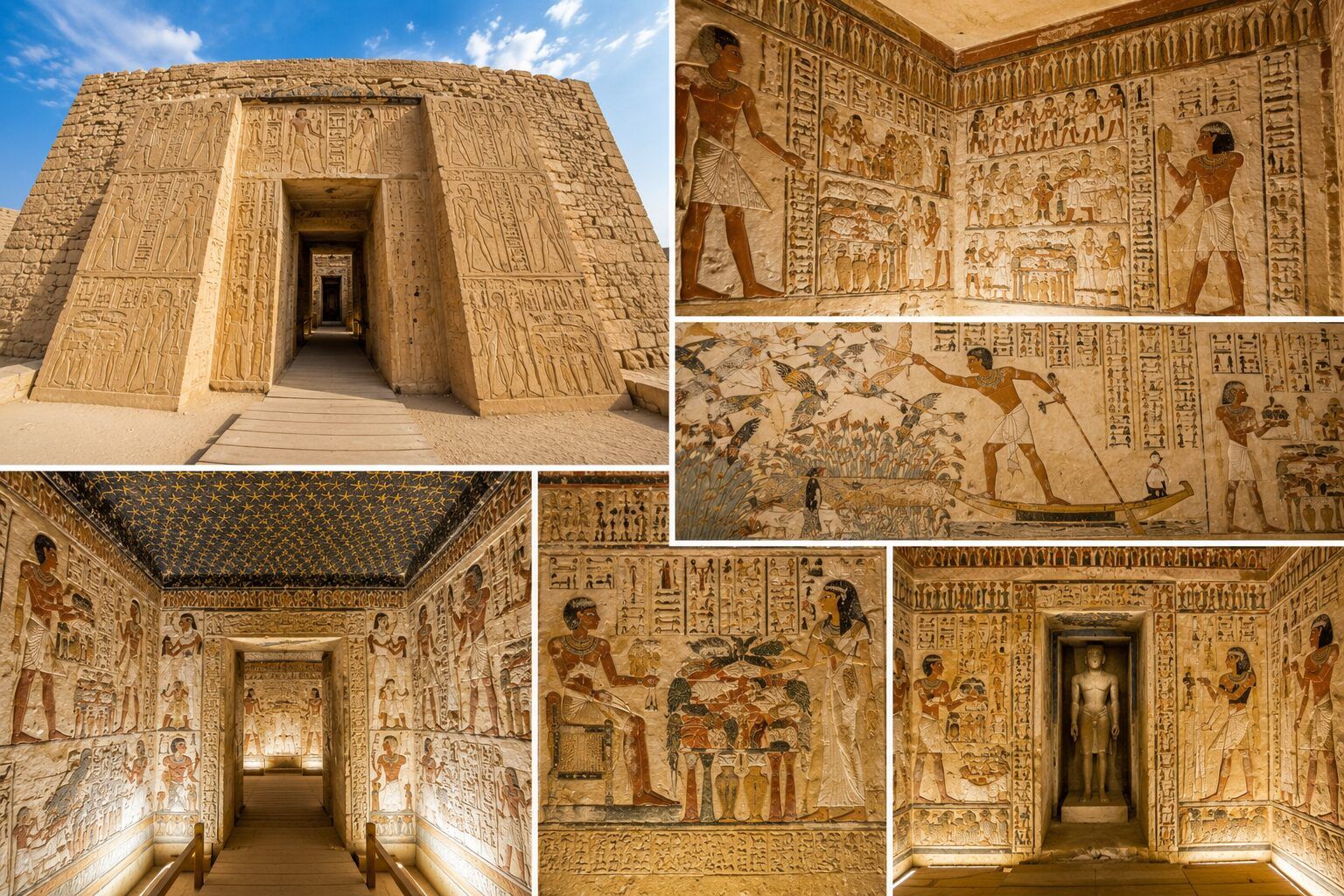
Visitors enter through a beautifully decorated entrance hall where carved scenes introduce Mereruka’s wealth and authority.
The walls depict:
- Servants bringing offerings
- Religious ceremonies
- Agricultural products
- Livestock
- Noble visitors
- Hieroglyphic inscriptions
These scenes symbolized eternal prosperity and guaranteed that Mereruka would continue receiving provisions in the afterlife.
Table 3: Entrance Hall Features
| Feature | Description |
|---|---|
| Decoration | Raised limestone reliefs |
| Main Theme | Offerings and prosperity |
| Material | Limestone |
| Artistic Style | Old Kingdom relief carving |
| Religious Purpose | Eternal nourishment |
The Offering Chapel
The offering chapel formed the spiritual heart of the mastaba.
Here, priests and family members performed rituals and presented food, incense, flowers, wine, beer, and meat to sustain Mereruka’s spirit.
The beautifully carved walls show long processions carrying:
- Bread
- Beer
- Fruit
- Vegetables
- Livestock
- Fish
- Birds
- Luxury goods
The Egyptians believed these images magically transformed into real offerings for eternity.
Table 4: Offerings Depicted
| Offering | Symbolism |
|---|---|
| Bread | Daily sustenance |
| Beer | Prosperity |
| Meat | Wealth |
| Fish | Abundance |
| Birds | Regeneration |
| Flowers | Eternal rebirth |
Family Chambers
One of the unique features of the Mastaba of Mereruka is its inclusion of separate apartments for family members.
His wife, Princess Seshseshet Waatetkhethor, and his son each had their own decorated spaces within the complex.
These chambers demonstrate the importance of family in Ancient Egyptian beliefs about the afterlife and emphasize Mereruka’s close relationship with the royal family.
Table 5: Family Apartments
| Chamber | Occupant |
|---|---|
| Main Chambers | Mereruka |
| Northern Apartments | Wife |
| Additional Rooms | Son |
| Offering Areas | Family rituals |
The Burial Shaft
Deep vertical shafts connect the mastaba to the underground burial chambers.
After Mereruka’s burial, these shafts were sealed with large limestone blocks to prevent unauthorized access.
Although tomb robbers removed many valuable objects in antiquity, the architecture remains remarkably intact.
Table 6: Burial Shaft
| Feature | Details |
|---|---|
| Type | Vertical shaft |
| Purpose | Protect the burial |
| Material | Limestone |
| Destination | Burial chamber |
| Original Security | Sealed entrance |
The False Door
The false door is one of the most important architectural elements inside the mastaba.
Although it does not open physically, Ancient Egyptians believed it allowed the spirit (ka) of the deceased to move between the world of the living and the afterlife.
Offerings were traditionally placed in front of the false door during religious ceremonies.
Table 7: False Door Symbolism
| Element | Meaning |
|---|---|
| False Door | Gateway for the spirit |
| Offering Table | Food for eternity |
| Hieroglyphs | Sacred prayers |
| Relief Portrait | Identity of the deceased |
Magnificent Wall Reliefs
The walls of the Mastaba of Mereruka are among the finest artistic achievements of the Old Kingdom.
They depict scenes including:
- Agricultural work
- Hunting in marshes
- Fishing
- Boat building
- Metalworking
- Carpentry
- Textile production
- Music and dancing
- Religious ceremonies
- Family gatherings
The quality of these carvings rivals that of the nearby Tomb of Ti, while the larger scale of Mereruka’s mastaba allows for an even greater variety of subjects.
Table 8: Wall Relief Themes
| Theme | Examples |
|---|---|
| Agriculture | Harvesting and plowing |
| Fishing | Nile boats and nets |
| Hunting | Birds and marsh animals |
| Crafts | Pottery and carpentry |
| Religion | Offering rituals |
| Family Life | Banquets and celebrations |
Artistic Techniques
The reliefs demonstrate the remarkable skills of Sixth Dynasty artists.
Techniques include:
- Raised relief carving
- Fine incised hieroglyphs
- Balanced compositions
- Realistic animal anatomy
- Detailed facial expressions
- Natural movement
Many carvings remain exceptionally sharp despite more than four millennia of exposure.
Table 9: Artistic Achievements
| Technique | Importance |
|---|---|
| Raised Relief | Outstanding craftsmanship |
| Hieroglyphic Inscriptions | Historical documentation |
| Realistic Figures | Artistic excellence |
| Balanced Composition | Visual harmony |
| Fine Detail | Exceptional preservation |
Comparison with the Tomb of Ti
Although both monuments are masterpieces of private funerary architecture, they highlight different aspects of elite life during the Old Kingdom.
Table 10: Mastaba of Mereruka vs. Tomb of Ti
| Feature | Mastaba of Mereruka | Tomb of Ti |
|---|---|---|
| Dynasty | Sixth Dynasty | Fifth Dynasty |
| Owner | Vizier Mereruka | Official Ti |
| Number of Rooms | 30+ | Approximately 12 |
| Family Apartments | Yes | Limited |
| Size | Largest private tomb in Egypt | Smaller but highly decorated |
| Famous For | Monumental architecture | Daily life reliefs |
| Royal Connection | Married Pharaoh Teti’s daughter | Senior royal official |
Why the Mastaba of Mereruka Is an Architectural Masterpiece
The Mastaba of Mereruka represents the pinnacle of private tomb design during the Old Kingdom. Its immense size, carefully planned layout, beautifully carved reliefs, and sophisticated architectural features demonstrate the wealth, influence, and artistic achievements of Egypt’s highest-ranking officials.
Visitors who explore its chambers gain a deeper appreciation of Ancient Egyptian society beyond the royal pyramids, discovering the lives, beliefs, and accomplishments of the people who helped shape one of history’s greatest civilizations.
Archaeology, Daily Life, Religion & the Legacy of Egypt’s Greatest Private Tomb
A Remarkable Record of Old Kingdom Society
The Mastaba of Mereruka is far more than the burial place of an influential vizier—it is one of the most important historical records of everyday life in Ancient Egypt. Its extensive reliefs document the people, professions, beliefs, and traditions that shaped Egyptian civilization during the Sixth Dynasty.
Unlike royal pyramids, which focus primarily on the divine role of the king, Mereruka’s tomb celebrates the individuals who managed farms, built boats, raised livestock, crafted furniture, performed religious rituals, and maintained one of the world’s most advanced ancient societies.
For archaeologists, the mastaba serves as an illustrated archive of Old Kingdom life.
Table 1: Archaeological Importance
| Feature | Significance |
|---|---|
| Tomb Type | Private Mastaba |
| Dynasty | Sixth Dynasty |
| Historical Value | Largest private tomb in Egypt |
| Main Evidence | Daily life reliefs |
| UNESCO Site | Memphis and its Necropolis |
Archaeological Excavations
Systematic excavations of the Mastaba of Mereruka revealed an extraordinary monument with dozens of decorated chambers and thousands of finely carved reliefs.
Archaeologists uncovered:
- Limestone relief panels
- Offering chapels
- Family burial chambers
- False doors
- Hieroglyphic inscriptions
- Statues and statue niches
- Burial shafts
Each discovery has expanded our understanding of elite society during the late Old Kingdom.
Table 2: Major Archaeological Finds
| Discovery | Importance |
|---|---|
| Wall Reliefs | Daily life documentation |
| False Doors | Religious symbolism |
| Burial Chambers | Funerary practices |
| Hieroglyphs | Historical records |
| Offering Areas | Religious ceremonies |
Daily Life in Ancient Egypt
The reliefs inside Mereruka’s mastaba vividly illustrate how people lived and worked over 4,300 years ago.
Visitors can observe scenes showing:
- Farmers cultivating fields
- Fishermen catching Nile fish
- Hunters pursuing birds
- Herdsmen caring for cattle
- Boat builders constructing vessels
- Craftsmen carving wood and stone
- Bakers preparing bread
- Brewers producing beer
These scenes provide one of the most complete visual records of Ancient Egyptian society.
Table 3: Daily Activities
| Activity | Historical Importance |
|---|---|
| Farming | Food production |
| Fishing | Nile economy |
| Hunting | Food and symbolism |
| Boat Building | Transportation |
| Carpentry | Skilled craftsmanship |
| Brewing | Daily nutrition |
Religion and the Afterlife
Mereruka’s tomb reflects the Ancient Egyptian belief that life continued after death.
The beautifully carved reliefs were more than artistic decorations—they were believed to possess magical power.
According to Egyptian religious beliefs, the images could provide the deceased with:
- Food
- Clothing
- Servants
- Livestock
- Entertainment
- Prosperity
These scenes ensured that Mereruka would continue to enjoy the comforts of earthly life for eternity.
Table 4: Religious Symbolism
| Symbol | Meaning |
|---|---|
| False Door | Passage for the spirit (ka) |
| Offering Table | Eternal nourishment |
| Lotus Flower | Rebirth |
| Birds | Freedom and renewal |
| Hieroglyphs | Sacred prayers |
Agriculture and Food Production
Agriculture formed the foundation of Egypt’s prosperity, and Mereruka’s reliefs preserve remarkable evidence of farming techniques.
The scenes depict workers:
- Plowing fertile fields
- Sowing grain
- Harvesting crops
- Herding cattle
- Milking cows
- Transporting harvests
- Filling granaries
These carvings demonstrate the close relationship between the Nile’s annual floods and Egypt’s agricultural success.
Table 5: Agricultural Activities
| Activity | Purpose |
|---|---|
| Plowing | Preparing fields |
| Sowing | Planting crops |
| Harvesting | Food production |
| Grain Storage | Long-term supply |
| Livestock Care | Agriculture and trade |
Craftsmen and Skilled Workers
The Mastaba of Mereruka also celebrates the skilled craftsmen who contributed to Egypt’s economy.
The reliefs portray specialists engaged in:
- Carpentry
- Furniture making
- Pottery
- Jewelry production
- Metalworking
- Stone carving
- Textile weaving
These detailed scenes reveal the high level of craftsmanship achieved during the Old Kingdom.
Table 6: Ancient Egyptian Industries
| Craft | Products |
|---|---|
| Carpentry | Furniture and doors |
| Pottery | Storage jars |
| Metalworking | Tools and ornaments |
| Stone Carving | Statues and monuments |
| Textile Weaving | Linen clothing |
Hunting and River Life
Several chambers feature lively scenes of hunting in the Nile marshes.
Mereruka is shown:
- Hunting birds with throw sticks
- Fishing with nets and harpoons
- Traveling by papyrus boat
- Supervising workers
These activities carried both practical and symbolic meanings, representing abundance, order, and triumph over chaos.
Table 7: Marsh Life
| Scene | Meaning |
|---|---|
| Bird Hunting | Skill and abundance |
| Fishing | Food supply |
| Papyrus Boats | Transportation |
| Marsh Plants | Fertility |
| Nile Wildlife | Natural environment |
Restoration and Conservation
Because the mastaba contains delicate limestone carvings, conservation efforts continue to protect the monument.
Modern projects include:
- Cleaning reliefs
- Stabilizing stone blocks
- Environmental monitoring
- Digital documentation
- Visitor management
These measures help preserve the monument for future generations while allowing public access.
Table 8: Conservation Projects
| Project | Objective |
|---|---|
| Stone Cleaning | Preserve reliefs |
| Structural Stabilization | Protect the architecture |
| Digital Scanning | Long-term documentation |
| Environmental Monitoring | Reduce deterioration |
| Visitor Management | Protect fragile surfaces |
Myths vs. Historical Facts
The grandeur of Mereruka’s tomb has inspired many popular stories.
Archaeological research provides a clearer understanding of its history and purpose.
Table 9: Myths vs. Facts
| Myth | Historical Fact |
|---|---|
| Mereruka was a pharaoh | He was Egypt’s powerful vizier |
| The tomb was built for royalty | It belonged to a private official |
| The reliefs are purely decorative | They had religious and symbolic purposes |
| The mastaba is larger than all pyramids | It is the largest private tomb, not a royal pyramid |
Why Historians Value the Mastaba of Mereruka
Few monuments provide such a detailed picture of life during the Old Kingdom.
Historians study the mastaba to understand:
- Government administration
- Agriculture
- Religion
- Family life
- Ancient industries
- Artistic techniques
- Social hierarchy
- Funerary customs
Its extensive decoration makes it one of the most important archaeological resources from the Sixth Dynasty.
Table 10: Why the Mastaba Matters
| Category | Importance |
|---|---|
| Archaeology | ⭐⭐⭐⭐⭐ |
| Ancient Egyptian Art | ⭐⭐⭐⭐⭐ |
| Daily Life | ⭐⭐⭐⭐⭐ |
| Religious History | ⭐⭐⭐⭐⭐ |
| Educational Value | ⭐⭐⭐⭐⭐ |
| UNESCO Heritage | ⭐⭐⭐⭐⭐ |
The Enduring Legacy of Mereruka
More than four millennia after his death, Mereruka remains one of the best-known officials of Ancient Egypt—not because of written records alone, but because his extraordinary mastaba preserves a vivid visual history of an entire civilization.
Its magnificent reliefs, spacious chambers, and sophisticated architecture reveal the wealth, authority, and responsibilities of Egypt’s most powerful non-royal official. Today, the Mastaba of Mereruka stands as one of the greatest masterpieces of Old Kingdom art and one of the most rewarding sites to explore in the Saqqara Necropolis.
Visitor Guide, Travel Tips, FAQs & Everything You Need to Know
Planning Your Visit to the Mastaba of Mereruka
The Mastaba of Mereruka is one of the finest hidden treasures of the Saqqara Necropolis. While many visitors come to Saqqara to admire the Step Pyramid of Djoser, those who take time to explore Mereruka’s tomb discover one of the most beautifully decorated monuments of the Old Kingdom.
With more than 30 chambers, exceptional limestone reliefs, and vivid scenes of daily life, religion, agriculture, hunting, music, and craftsmanship, the mastaba offers an unforgettable journey into the world of Ancient Egypt’s highest-ranking officials.
Whether you’re passionate about archaeology, photography, or history, this remarkable monument deserves a place on your Egypt itinerary.
Table 1: Visitor Information
| Feature | Details |
|---|---|
| Location | Saqqara Necropolis, Giza Governorate |
| Tomb Type | Mastaba |
| Dynasty | Sixth Dynasty |
| Average Visit Time | 45–60 minutes |
| Guided Tour | Highly Recommended |
| Interior Access | Usually available (subject to current regulations) |
Best Time to Visit
The Mastaba of Mereruka is open throughout the year, but the cooler months offer the most comfortable conditions for exploring the Saqqara plateau.
Best months:
- October
- November
- December
- January
- February
- March
- April
Arriving early in the morning provides cooler temperatures, softer natural light, and a quieter atmosphere inside the decorated chambers.
Table 2: Best Seasons
| Season | Weather | Recommendation |
|---|---|---|
| October–November | Pleasant | ⭐⭐⭐⭐⭐ |
| December–February | Cool | ⭐⭐⭐⭐⭐ |
| March–April | Warm | ⭐⭐⭐⭐☆ |
| May–September | Hot | ⭐⭐⭐☆☆ |
Opening Hours
The Mastaba of Mereruka is located inside the Saqqara archaeological complex and generally follows the site’s official operating hours.
Opening times may occasionally change due to archaeological excavations, conservation work, or public holidays.
Checking the latest visitor information before your trip is always recommended.
Table 3: Suggested Visiting Schedule
| Time | Activity |
|---|---|
| 8:00 AM | Arrive at Saqqara |
| 8:15 AM | Step Pyramid of Djoser |
| 9:15 AM | Mastaba of Mereruka |
| 10:30 AM | Tomb of Ti |
| 11:15 AM | Pyramid of Unas |
| Afternoon | Serapeum, Memphis & Dahshur |
How to Get There
The Mastaba of Mereruka is situated within the Saqqara archaeological zone, approximately 30 kilometers (19 miles) south of downtown Cairo.
The most convenient transportation options include:
- Private guided tour
- Private driver
- Taxi
- Ride-hailing services
Because it is located near several major monuments, the mastaba is commonly included in full-day tours of Saqqara.
Table 4: Transportation Options
| Option | Comfort | Best For |
|---|---|---|
| Private Tour | ⭐⭐⭐⭐⭐ | First-time visitors |
| Private Driver | ⭐⭐⭐⭐⭐ | Flexible itineraries |
| Taxi | ⭐⭐⭐⭐☆ | Independent travelers |
| Ride-Hailing App | ⭐⭐⭐⭐☆ | Budget-conscious visitors |
Nearby Attractions
The Mastaba of Mereruka is surrounded by some of Egypt’s most famous archaeological landmarks.
Nearby attractions include:
- Step Pyramid of Djoser
- Tomb of Ti
- Pyramid of Unas
- Serapeum of Saqqara
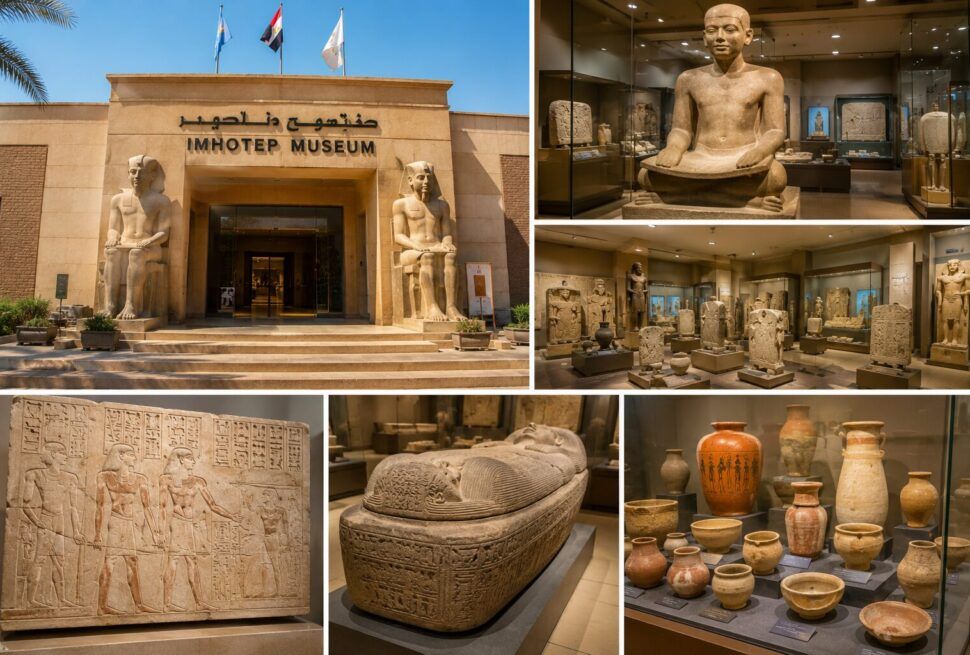
- Imhotep Museum
- Saqqara Necropolis
- Memphis Open-Air Museum
- Bent Pyramid
- Red Pyramid
Together, these monuments create one of Egypt’s finest archaeological day trips.
Table 5: Nearby Attractions
| Attraction | Approximate Distance | Suggested Visit |
|---|---|---|
| Step Pyramid of Djoser | Short walk | 60–90 min |
| Tomb of Ti | Nearby | 30–45 min |
| Pyramid of Unas | Nearby | 30–45 min |
| Serapeum | Nearby | 45–60 min |
| Imhotep Museum | Nearby | 30–45 min |
| Memphis Museum | About 6 km | 45–60 min |
| Bent Pyramid | About 10 km | 45 min |
| Red Pyramid | About 10 km | 45 min |
Photography Tips
The Mastaba of Mereruka is one of the best places in Egypt to photograph Old Kingdom relief carvings.
For the best images:
- Visit early in the day.
- Photograph complete wall compositions before taking close-up details.
- Use natural light whenever possible.
- Capture the entrance and decorated chambers.
- Respect the latest photography regulations and avoid using flash where prohibited.
Table 6: Best Photography Locations
| Location | Best Time |
|---|---|
| Entrance | Morning |
| Main Hall | During your visit |
| Wall Reliefs | Morning light |
| Exterior Mastaba | Early morning or late afternoon |
Frequently Asked Questions
Why is the Mastaba of Mereruka famous?
It is the largest private tomb in Ancient Egypt, renowned for its magnificent relief carvings and more than 30 decorated chambers.
How long should I spend here?
Most visitors spend 45–60 minutes, while archaeology enthusiasts may spend longer studying the reliefs.
Can I visit Mereruka and the Tomb of Ti on the same day?
Yes. These two masterpieces are located close to one another within the Saqqara Necropolis and are commonly included in the same itinerary.
Is the Mastaba suitable for families?
Yes. Families and children often enjoy the lively scenes of animals, farming, music, and daily life carved throughout the tomb.
Is a guide recommended?
Absolutely. A licensed Egyptologist guide can explain the symbolism, hieroglyphs, and historical significance of the reliefs, making your visit much more meaningful.
Table 7: Quick Answers
| Question | Answer |
|---|---|
| Worth Visiting? | ⭐ Absolutely |
| Guided Tour | Highly Recommended |
| Average Visit | 45–60 minutes |
| Photography | Excellent (subject to regulations) |
| Family Friendly | Yes |
Visitor Checklist
Before exploring the mastaba, remember to bring:
- Comfortable walking shoes
- Camera or smartphone
- Portable charger
- Hat
- Sunglasses
- Sunscreen
- Water bottle
- Small backpack
Table 8: Packing Checklist
| Item | Bring? |
|---|---|
| Comfortable Shoes | ✅ |
| Camera | ✅ |
| Portable Charger | ✅ |
| Water Bottle | ✅ |
| Hat | ✅ |
| Sunglasses | ✅ |
| Sunscreen | ✅ |
| Backpack | ✅ |
Suggested One-Day Itinerary
Combine the Mastaba of Mereruka with Saqqara’s most important monuments for a full day of exploration.
Table 9: Suggested Itinerary
| Time | Activity |
|---|---|
| 8:00 AM | Arrive at Saqqara |
| 8:15 AM | Step Pyramid of Djoser |
| 9:15 AM | Mastaba of Mereruka |
| 10:15 AM | Tomb of Ti |
| 11:15 AM | Pyramid of Unas |
| 12:00 PM | Serapeum of Saqqara |
| 1:00 PM | Lunch |
| 2:30 PM | Imhotep Museum |
| 4:00 PM | Memphis or Dahshur |
Table 10: Why Visit the Mastaba of Mereruka?
| Experience | Rating |
|---|---|
| Ancient Egyptian Art | ⭐⭐⭐⭐⭐ |
| Archaeology | ⭐⭐⭐⭐⭐ |
| Daily Life Reliefs | ⭐⭐⭐⭐⭐ |
| Photography | ⭐⭐⭐⭐⭐ |
| Educational Value | ⭐⭐⭐⭐⭐ |
| Overall Experience | ⭐⭐⭐⭐⭐ |
Final Thoughts
The Mastaba of Mereruka is one of the greatest masterpieces of private funerary architecture in Ancient Egypt. Its vast network of chambers, exceptional relief carvings, and fascinating scenes of daily life provide an unparalleled insight into the wealth, authority, and culture of the Old Kingdom.
For travelers seeking to explore beyond the famous pyramids, Mereruka’s tomb offers a richer understanding of the people who governed, built, and sustained one of history’s most remarkable civilizations. A visit to this extraordinary monument is an unforgettable highlight of any journey through the Saqqara Necropolis.
Explore the Mastaba of Mereruka with Let’s Explore Egypt
Step inside the largest private tomb in Ancient Egypt and discover the remarkable world of Mereruka, the powerful vizier of Pharaoh Teti. Located in the heart of the Saqqara Necropolis, the Mastaba of Mereruka is a masterpiece of Old Kingdom architecture, featuring more than 30 beautifully decorated chambers filled with magnificent reliefs that depict daily life, religious ceremonies, agriculture, hunting, music, and family life.
With Let’s Explore Egypt, you’ll enjoy a 100% private tour led by a licensed Egyptologist guide who will reveal the stories behind every carving, hieroglyph, and chamber, transforming your visit into an unforgettable journey through Ancient Egypt.
Some Trips you might like:
Private Giza Pyramids, Saqqara & Memphis Full-Day Tour with Egyptologist Guide
Saqqara, Memphis & Dahshur Tour from Cairo
Why Book with Let’s Explore Egypt?
- 🏛️ Licensed Egyptian Tour Operator
- 👨🏫 Professional English-Speaking Egyptologist Guides
- 🚗 Private Air-Conditioned Transportation
- 🏺 Explore the Largest Private Tomb in Ancient Egypt
- 🎨 Admire Outstanding Old Kingdom Wall Reliefs
- 🔺 Visit the Step Pyramid of Djoser
- 📜 Discover the Pyramid of Unas and the World’s Oldest Pyramid Texts
- 🐂 Explore the Serapeum of Saqqara
- 🏛️ Visit the Tomb of Ti and Imhotep Museum
- 📸 Plenty of Time for Photography
- 🌅 Flexible Departure Times
- 👨👩👧 100% Private & Tailor-Made Tours
- 💬 24/7 WhatsApp Support
- ⭐ Highly Rated by Travelers from Around the World
- 💳 Transparent Pricing – No Hidden Fees
- ❌ No Forced Shopping Stops
Complete Your Saqqara Experience
Make the most of your visit by combining the Mastaba of Mereruka with the most important archaeological sites in Saqqara:
- 🔺 Step Pyramid of Djoser
- 🏛️ Saqqara Necropolis
- 🏺 Tomb of Ti
- 📜 Pyramid of Unas
- 🐂 Serapeum of Saqqara
- 🏛️ Imhotep Museum
- 🌴 Memphis Open-Air Museum
- 🔺 Bent Pyramid
- 🔺 Red Pyramid
Our expertly planned private tours allow you to experience the complete story of Ancient Egypt—from the world’s first pyramid to the magnificent tombs of Egypt’s most influential officials—all in one unforgettable day.
Book Your Private Mastaba of Mereruka Tour Today
Walk through one of the finest examples of Old Kingdom architecture and admire beautifully preserved reliefs that have survived for more than 4,300 years. Discover how Egypt’s most powerful vizier lived, governed, and prepared for eternity in one of the country’s most extraordinary archaeological sites.
Whether you’re an archaeology enthusiast, history lover, photographer, or first-time visitor to Egypt, Let’s Explore Egypt will create a personalized private experience tailored to your interests.
📞 Contact Let’s Explore Egypt
📱 WhatsApp: +20 120 323 3365
📧 Email: info@lets-explore-egypt.com
Why Travelers Choose Let’s Explore Egypt
✅ 100% Private & Personalized Tours
✅ Licensed Egyptologist Guides
✅ Comfortable Air-Conditioned Vehicles
✅ Flexible Pickup from Cairo, Giza & Cairo Airport
✅ Family-Friendly Experiences
✅ Easy WhatsApp Booking
✅ Excellent Reviews from International Travelers
✅ Safe, Reliable & Hassle-Free Service
Let’s Explore Egypt – Discover the Largest Private Tomb in Ancient Egypt and Experience the Extraordinary Legacy of Vizier Mereruka.
Contact us today for a free personalized itinerary and explore the Mastaba of Mereruka, the Step Pyramid of Djoser, the Tomb of Ti, the Pyramid of Unas, the Serapeum of Saqqara, Memphis, and Dahshur with Egypt’s trusted local experts.
Recommended Egypt Tours
Why You Can Trust Let's Explore Egypt
This article was written and reviewed by the Let's Explore Egypt Editorial Team, a licensed Egyptian tour operator specializing in private Egypt tours, Nile cruises, and tailor-made travel experiences since 2009.
- 🏛 Licensed Egyptian Tour Operator Since 2009
- ⭐ Trusted by Thousands of Travelers Worldwide
- 👨🏫 Written & Reviewed by Local Egypt Travel Experts
- 🚐 Private Tours & Tailor-Made Travel Experiences
- 📞 24/7 Customer Support