

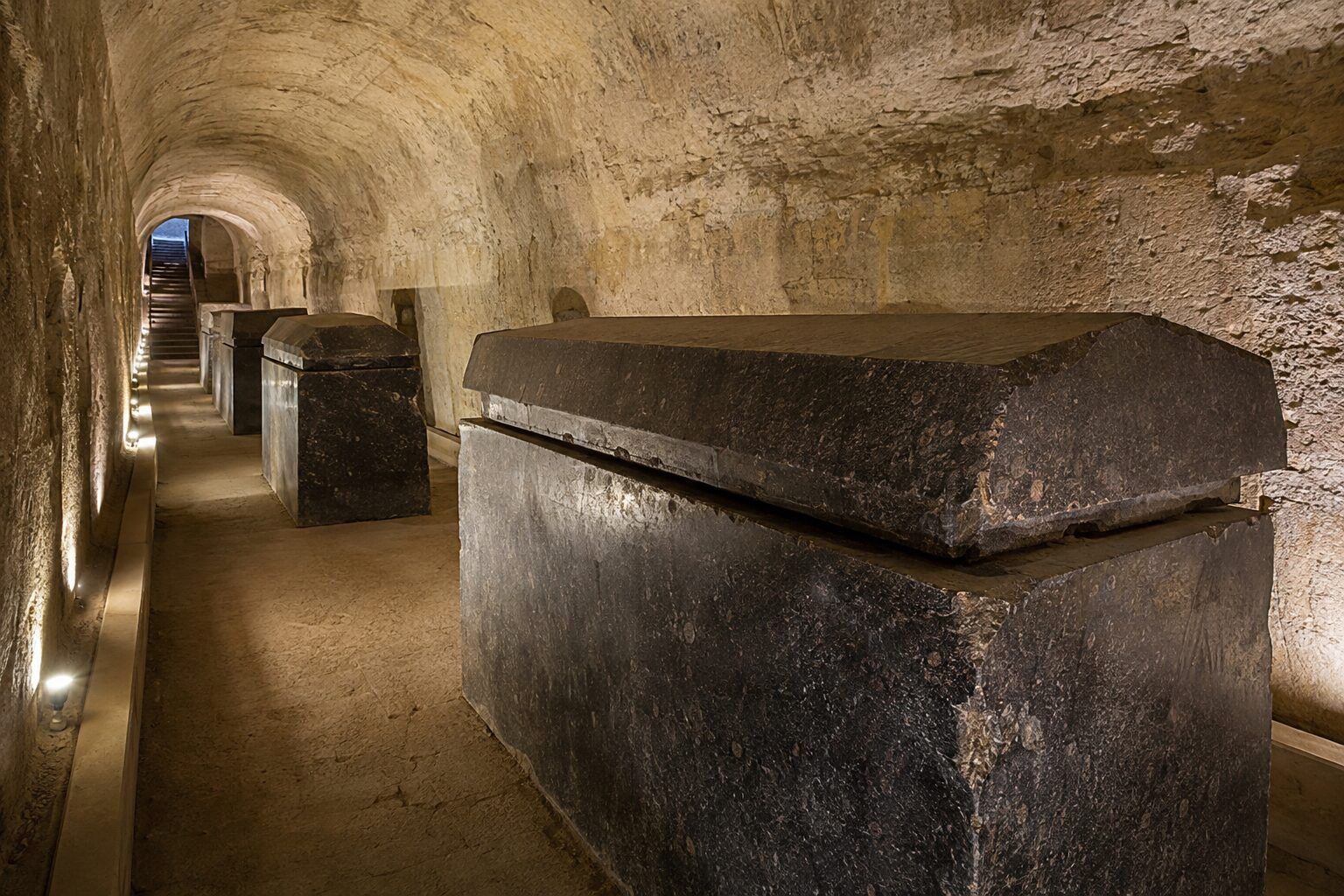
History, Discovery & the Sacred Burial Place of the Apis Bulls
Welcome to the Serapeum of Saqqara
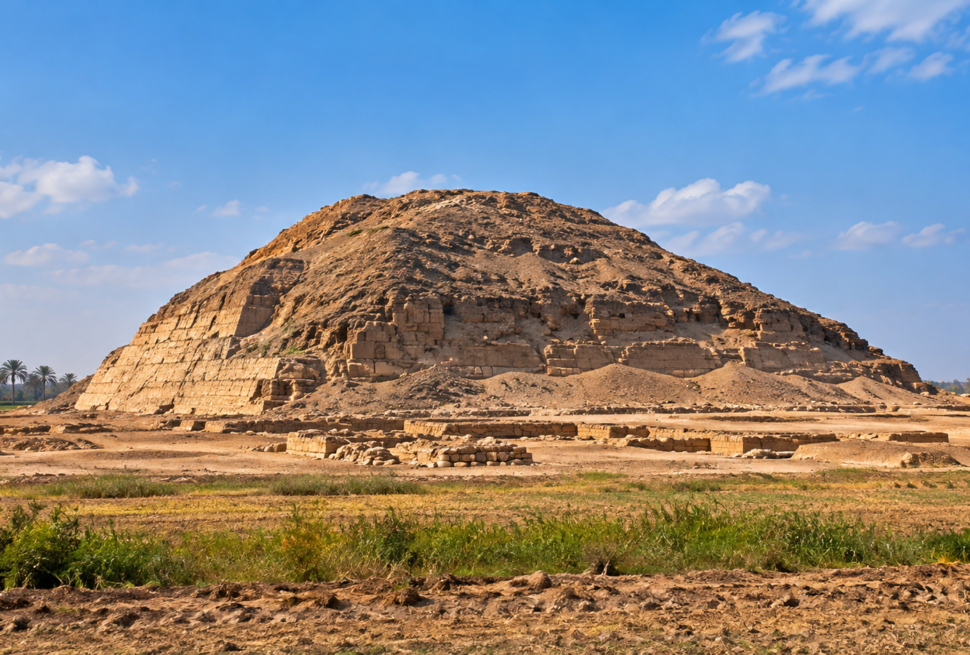
Hidden beneath the golden sands of the Saqqara Necropolis lies one of Ancient Egypt’s most mysterious and awe-inspiring monuments—the Serapeum of Saqqara. Unlike the towering pyramids and richly decorated tombs above ground, the Serapeum is an underground labyrinth of tunnels and chambers that once housed the sacred Apis Bulls, revered as living manifestations of the god Ptah.
Discovered in the 19th century after centuries of being buried beneath the desert, the Serapeum continues to fascinate archaeologists, historians, engineers, and travellers alike. Its enormous granite sarcophagi, some weighing more than 60 tons, remain among the largest stone coffins ever created in the ancient world.
Today, the Serapeum is one of Saqqara’s most remarkable attractions, offering visitors a unique glimpse into Ancient Egyptian religion, engineering, and royal traditions.
Table 1: Serapeum of Saqqara at a Glance
| Feature | Details |
|---|---|
| Official Name | Serapeum of Saqqara |
| Location | Saqqara Necropolis, Egypt |
| Purpose | Burial place of the sacred Apis Bulls |
| Main Deity | Ptah (later associated with Osiris) |
| Discovery | 1850–1851 |
| Discoverer | Auguste Mariette |
| Construction Period | Primarily New Kingdom onward |
| UNESCO Site | Memphis and its Necropolis |
What Is the Serapeum?
The Serapeum is a vast underground necropolis built to house the mummified remains of the sacred Apis Bulls.
Each Apis Bull was believed to be the earthly manifestation of Ptah, the creator god of Memphis. During its lifetime, the bull was worshipped as a divine being. Upon its death, it received elaborate funeral ceremonies before being placed inside a massive granite sarcophagus within the underground galleries.
Over many centuries, numerous Apis Bulls were buried here, making the Serapeum one of the most sacred religious sites in Ancient Egypt.
Table 2: What Makes the Serapeum Special?
| Feature | Importance |
|---|---|
| Underground Galleries | Extensive burial tunnels |
| Granite Sarcophagi | Among the largest in Egypt |
| Apis Bull Burials | Sacred religious tradition |
| Engineering | Extraordinary stone craftsmanship |
| Archaeology | One of Saqqara’s greatest discoveries |
The Sacred Apis Bull
The Apis Bull was one of the most important sacred animals in Ancient Egypt.
Priests searched for a calf displaying specific physical characteristics believed to indicate the presence of the divine spirit of Ptah.
According to ancient traditions, the chosen bull possessed distinctive markings, such as:
- A white triangle on its forehead.
- A crescent-shaped mark on its side.
- A special marking beneath its tongue.
- A unique tail formation.
Once selected, the Apis Bull lived in luxury within a temple at Memphis, receiving offerings, ceremonies, and public devotion throughout its life.
Table 3: The Sacred Apis Bull
| Feature | Details |
|---|---|
| Associated God | Ptah |
| Later Connection | Osiris-Apis |
| Sacred City | Memphis |
| Religious Role | Living manifestation of Ptah |
| Burial Site | Serapeum of Saqqara |
Why Were the Bulls Buried?
The death of an Apis Bull was considered a national event.
Ancient Egyptians believed that after death, the bull became united with Osiris, the god of the afterlife, creating the divine figure known as Osiris-Apis (later associated with Serapis during the Ptolemaic Period).
To honor this transformation, priests conducted elaborate funeral rituals that included:
- Mummification
- Religious processions
- Offerings
- Sacred ceremonies
- Burial in a granite sarcophagus
The Serapeum served as the eternal resting place for these revered animals.
Table 4: Funeral Process
| Stage | Description |
|---|---|
| Selection | Sacred bull identified |
| Worship | Bull lived in the temple at Memphis |
| Death | National mourning |
| Mummification | Preservation of the body |
| Burial | Placement inside the Serapeum |
Discovery by Auguste Mariette
For centuries, the Serapeum remained hidden beneath drifting desert sands.
In 1850, French archaeologist Auguste Mariette began searching Saqqara after noticing references to an avenue of sphinxes in ancient texts.
Following this avenue, he uncovered the entrance to the underground galleries.
His excavation revealed:
- Long underground corridors.
- Massive granite sarcophagi.
- Burial chambers.
- Ancient inscriptions.
- Statues and religious objects.
The discovery transformed Egyptology and established Mariette as one of the pioneers of archaeological research in Egypt.
Table 5: Discovery Timeline
| Year | Event |
|---|---|
| Ancient Egypt | Construction of the Serapeum begins |
| 1850 | Mariette begins excavations |
| 1851 | Main galleries uncovered |
| Late 1800s | Further exploration |
| Modern Era | Conservation and visitor access |
Memphis and the Serapeum
The Serapeum was closely connected to the ancient capital of Memphis.
Since the Apis Bull lived at the Temple of Ptah in Memphis, funeral processions traveled from the city to Saqqara upon the bull’s death.
This sacred journey symbolized the transition from earthly life to eternal existence.
The close relationship between Memphis and Saqqara highlights the deep integration of politics, religion, and royal authority in Ancient Egypt.
Table 6: Memphis and the Serapeum
| Memphis | Serapeum |
|---|---|
| Home of Ptah’s Temple | Burial place of Apis Bulls |
| City of the Living | Sacred Necropolis |
| Religious Center | Funerary Complex |
| Capital of Ancient Egypt | Royal Cemetery |
Religious Importance
The Serapeum was not simply a cemetery.
It represented one of the most important centers of animal worship in Ancient Egypt.
The Apis Bull symbolized:
- Strength
- Fertility
- Kingship
- Divine power
- Resurrection
Its burial reinforced Egyptian beliefs in eternal life and the cyclical nature of death and rebirth.
Table 7: Religious Symbolism
| Symbol | Meaning |
|---|---|
| Bull | Power and fertility |
| Ptah | Creator god |
| Osiris | Lord of the afterlife |
| Granite Sarcophagus | Eternal protection |
| Underground Galleries | Sacred passage to eternity |
The Origin of the Name “Serapeum”
The name Serapeum derives from Serapis, a deity introduced during the Ptolemaic Period that combined aspects of the Egyptian gods Osiris and Apis with elements of Greek religion.
Although the underground complex was built long before the cult of Serapis developed, later generations associated the site with this new deity, giving it the name by which it is known today.
Table 8: Evolution of the Name
| Period | Name |
|---|---|
| New Kingdom | Burial place of the Apis Bulls |
| Late Period | Osiris-Apis cult |
| Ptolemaic Period | Serapeum |
| Modern Era | Serapeum of Saqqara |
Amazing Facts About the Serapeum
The Serapeum continues to astonish visitors with its scale and mystery.
Some fascinating facts include:
- It contains some of the largest granite sarcophagi ever carved.
- Certain sarcophagi weigh more than 60 tons.
- The underground galleries stretch for hundreds of meters.
- The site remained buried for centuries before its rediscovery.
- It played a central role in the worship of the sacred Apis Bulls.
Table 9: Fast Facts
| Fact | Information |
|---|---|
| Discovery | 1850–1851 |
| Discoverer | Auguste Mariette |
| Main Purpose | Burial of sacred Apis Bulls |
| Location | Saqqara Necropolis |
| Construction Material | Limestone & granite |
| Historical Importance | One of Egypt’s most important religious sites |
Why the Serapeum Is One of Egypt’s Greatest Hidden Treasures
While the pyramids dominate Egypt’s skyline, the Serapeum of Saqqara reveals another side of Ancient Egyptian civilization—its deep religious traditions, extraordinary engineering, and reverence for sacred animals.
Descending into its cool underground galleries, visitors experience a completely different atmosphere from the monuments above ground. Massive granite sarcophagi, silent passageways, and centuries of history combine to create one of the most unforgettable archaeological experiences in Egypt.
Underground Galleries, Giant Sarcophagi & Ancient Engineering
Descending into the Underground World
While the pyramids of Saqqara rise proudly above the desert, the true mystery of the Serapeum of Saqqara lies beneath the surface.
Visitors descend through a stone entrance into a cool underground network of tunnels where enormous granite sarcophagi line both sides of the galleries. The atmosphere is unlike anywhere else in Egypt—quiet, dimly lit, and filled with an overwhelming sense of history.
These underground passages demonstrate the remarkable engineering abilities of Ancient Egyptian builders, who created one of the most impressive subterranean monuments in the ancient world.
Table 1: Underground Complex at a Glance
| Feature | Details |
|---|---|
| Type | Underground Necropolis |
| Main Purpose | Burial of Sacred Apis Bulls |
| Main Construction Material | Limestone |
| Sarcophagus Material | Granite |
| Number of Burial Chambers | More than 20 major chambers |
| Historical Period | New Kingdom to Ptolemaic Period |
The Main Gallery
The central gallery is the heart of the Serapeum.
This long underground corridor extends for hundreds of meters and connects a series of side chambers, each built to house a sacred Apis Bull.
Walking through the gallery, visitors notice:
- Massive limestone walls.
- High vaulted ceilings.
- Granite burial chambers.
- Carefully cut passageways.
- Exceptional stone craftsmanship.
The scale of the construction is remarkable, especially considering that it was built more than 2,500 years ago using simple tools.
Table 2: Main Gallery Features
| Feature | Description |
|---|---|
| Corridor Type | Underground tunnel |
| Ceiling | Vaulted limestone |
| Side Chambers | Burial rooms |
| Lighting Today | Artificial museum lighting |
| Visitor Experience | Walk-through archaeological monument |
The Giant Granite Sarcophagi
The most famous features of the Serapeum are its enormous granite sarcophagi.
Each coffin was carved from a single block of granite and polished to an extraordinary finish.
Some sarcophagi weigh between 60 and 70 tons, while their lids alone can weigh more than 20 tons.
The precision of their construction continues to amaze engineers and archaeologists.
Even today, creating objects of similar size would require heavy industrial machinery.
Table 3: Granite Sarcophagus Specifications
| Feature | Approximate Value |
|---|---|
| Material | Granite |
| Weight | 60–70 tons |
| Lid Weight | Up to 20 tons |
| Surface Finish | Highly polished |
| Construction | Single carved blocks |
How Were They Built?
The production of these giant sarcophagi required extraordinary planning.
Ancient craftsmen first quarried massive granite blocks, most likely from Aswan, more than 800 kilometers (500 miles) south of Saqqara.
The process probably involved:
- Quarrying the stone.
- Rough shaping.
- River transport along the Nile.
- Overland transport to Saqqara.
- Final polishing inside workshops.
Although historians understand the general process, many details remain uncertain.
Table 4: Construction Process
| Stage | Activity |
|---|---|
| Quarrying | Granite extracted in Aswan |
| Shaping | Initial carving |
| River Transport | Nile transportation |
| Land Transport | Delivery to Saqqara |
| Finishing | Polishing and installation |
Engineering Without Modern Machinery
One of the greatest mysteries of the Serapeum is how ancient engineers handled such enormous weights.
Without cranes, engines, or steel tools, they successfully:
- Moved granite blocks weighing dozens of tons.
- Lowered them into underground chambers.
- Positioned them with remarkable precision.
- Placed massive lids onto the sarcophagi.
Researchers believe they relied on:
- Wooden sledges.
- Rollers.
- Earthen ramps.
- Levers.
- Large teams of workers.
Table 5: Ancient Engineering Techniques
| Technique | Purpose |
|---|---|
| Wooden Sledges | Moving heavy stones |
| Earthen Ramps | Elevation changes |
| Levers | Positioning blocks |
| Copper Tools | Stone shaping |
| Sand Lubrication | Reducing friction |
Burial Chambers
Each burial chamber was designed to hold a single granite sarcophagus.
The chambers are arranged along the main gallery, creating a symmetrical underground layout.
Although many sarcophagi were found empty due to ancient tomb robbery, the chambers themselves remain among the finest examples of underground architecture in Ancient Egypt.
Table 6: Burial Chambers
| Feature | Details |
|---|---|
| Layout | Side chambers |
| Purpose | Burial of Apis Bulls |
| Construction Material | Limestone |
| Main Feature | Granite sarcophagus |
| Preservation | Excellent |
Precision Stonework
One of the most impressive aspects of the Serapeum is the remarkable precision of its stone surfaces.
The granite sarcophagi display:
- Smooth polished walls.
- Sharp corners.
- Flat surfaces.
- Accurate symmetry.
These features demonstrate the exceptional skill of Ancient Egyptian stoneworkers.
While some modern theories exaggerate the methods used, archaeologists generally attribute this precision to highly skilled craftsmanship developed over centuries of experience.
Table 7: Stoneworking Achievements
| Achievement | Importance |
|---|---|
| Smooth Polishing | Exceptional craftsmanship |
| Accurate Angles | Precise engineering |
| Massive Blocks | Advanced quarrying |
| Fine Surface Finish | High-quality workmanship |
Tunnel Design
The underground layout was carefully planned to support both religious ceremonies and practical access.
The design includes:
- Central gallery.
- Side burial chambers.
- Entrance corridor.
- Ventilation openings.
- Drainage considerations.
Despite being underground, the tunnels have remained remarkably stable for thousands of years.
Table 8: Underground Layout
| Section | Function |
|---|---|
| Entrance Passage | Visitor access |
| Main Gallery | Processional route |
| Side Chambers | Bull burials |
| Storage Areas | Ritual equipment |
| Ventilation Shafts | Air circulation |
Modern Scientific Studies
Engineers and archaeologists continue to study the Serapeum using modern technologies.
Research includes:
- Laser scanning.
- 3D modeling.
- Structural analysis.
- Stone sourcing.
- Conservation monitoring.
These studies help preserve the monument while improving our understanding of ancient construction techniques.
Table 9: Modern Research Methods
| Method | Purpose |
|---|---|
| Laser Scanning | Digital documentation |
| 3D Models | Structural analysis |
| Geological Studies | Granite sourcing |
| Conservation Surveys | Preservation planning |
| Photography | Long-term monitoring |
Why the Engineering Still Amazes Experts
The Serapeum demonstrates that Ancient Egyptian builders possessed extraordinary expertise in quarrying, transportation, precision stone carving, and underground construction.
The combination of massive granite sarcophagi, carefully designed tunnels, and remarkable craftsmanship makes this monument one of the finest engineering achievements of the ancient world.
For many visitors, standing beside these enormous stone coffins is one of the most memorable moments of a trip to Saqqara.
Table 10: Why the Serapeum Is an Engineering Marvel
| Feature | Why It Matters |
|---|---|
| Granite Sarcophagi | Among the largest ever carved |
| Underground Design | Advanced planning and construction |
| Precision Stonework | Exceptional craftsmanship |
| Transportation | Massive stones moved over long distances |
| Preservation | Survived for more than 2,500 years |
| Historical Importance | Unique religious and engineering mo |
Archaeology, Ancient Religion, Mysteries & Modern Discoveries
One of Egypt’s Greatest Archaeological Discoveries
The Serapeum of Saqqara is more than an underground cemetery—it is one of the most remarkable archaeological discoveries ever made in Egypt. Since its rediscovery by Auguste Mariette in the mid-19th century, the site has provided invaluable evidence about Ancient Egyptian religion, engineering, royal ceremonies, and the worship of sacred animals.
Unlike royal pyramids built for kings, the Serapeum demonstrates the extraordinary importance that the Egyptians placed on the divine nature of the Apis Bull, believed to be the earthly manifestation of the creator god Ptah.
Even today, archaeologists continue to study the monument, revealing new insights into one of Egypt’s most fascinating religious traditions.
Table 1: Archaeological Importance
| Feature | Significance |
|---|---|
| Discovery | One of Egypt’s greatest archaeological finds |
| Main Purpose | Burial of the sacred Apis Bulls |
| Historical Period | New Kingdom to Ptolemaic Period |
| UNESCO Site | Memphis and its Necropolis |
| Ongoing Research | Conservation and archaeological studies |
The Excavations of Auguste Mariette
In 1850, French archaeologist Auguste Mariette began excavating Saqqara after reading ancient references to a sacred avenue lined with sphinxes.
Following this route beneath the desert sands, he uncovered the entrance to the underground galleries of the Serapeum.
His excavations revealed:
- Long underground corridors
- Massive granite sarcophagi
- Religious inscriptions
- Statues
- Funerary objects
- Burial chambers
Mariette’s discovery established Saqqara as one of the world’s most important archaeological sites and laid the foundation for modern Egyptology.
Table 2: Excavation Timeline
| Year | Event |
|---|---|
| 1850 | Mariette begins excavations |
| 1851 | Main galleries uncovered |
| Late 1800s | Additional chambers explored |
| 20th Century | Conservation work |
| 21st Century | Digital documentation and research |
The Cult of the Apis Bull
For thousands of years, Egyptians believed that the Apis Bull carried the living spirit of Ptah, the chief deity of Memphis.
When an Apis Bull died, priests believed it became united with Osiris, the god of the afterlife, forming the sacred deity Osiris-Apis.
This belief made the bull’s funeral one of the most elaborate religious ceremonies in Ancient Egypt.
The successor to the deceased bull was carefully selected based on distinctive physical markings believed to indicate divine favor.
Table 3: Religious Beliefs
| Symbol | Meaning |
|---|---|
| Apis Bull | Living manifestation of Ptah |
| Ptah | Creator god of Memphis |
| Osiris | God of the afterlife |
| Serapis | Greco-Egyptian deity combining Osiris and Apis |
| Granite Sarcophagus | Eternal protection |
Animal Mummification
The Serapeum reflects the sophisticated process of animal mummification practiced in Ancient Egypt.
The sacred Apis Bull underwent many of the same funerary rituals as a pharaoh.
These included:
- Ritual purification
- Embalming
- Wrapping in linen
- Religious ceremonies
- Processions
- Burial inside a granite sarcophagus
This extraordinary treatment highlights the religious significance of the Apis Bull within Egyptian society.
Table 4: Mummification Process
| Stage | Purpose |
|---|---|
| Purification | Sacred preparation |
| Embalming | Preservation |
| Linen Wrapping | Protection |
| Funeral Ceremony | Religious rituals |
| Burial | Eternal resting place |
What Archaeologists Have Learned
The Serapeum has revealed important information about:
- Ancient Egyptian religion
- Animal worship
- Stone quarrying
- Engineering techniques
- Funerary rituals
- Royal ceremonies
- Long-distance transportation of granite
The site also illustrates how religious traditions evolved over many centuries, adapting to political and cultural changes while preserving core beliefs.
Table 5: Archaeological Discoveries
| Discovery | Importance |
|---|---|
| Granite Sarcophagi | Engineering achievement |
| Religious Inscriptions | Ancient beliefs |
| Burial Chambers | Funerary customs |
| Animal Burials | Sacred rituals |
| Excavation Records | Understanding the site |
Restoration and Preservation
Because the Serapeum is an underground monument, conservation requires continuous monitoring.
Major preservation efforts include:
- Structural reinforcement
- Humidity control
- Stone conservation
- Visitor management
- Digital documentation
These measures help protect the galleries and granite sarcophagi from environmental damage while ensuring safe access for visitors.
Table 6: Conservation Projects
| Project | Objective |
|---|---|
| Tunnel Stabilization | Structural safety |
| Stone Cleaning | Preserve granite surfaces |
| Environmental Monitoring | Control humidity |
| Visitor Pathways | Protect archaeological remains |
| Digital Recording | Long-term preservation |
Myths vs. Historical Facts
The enormous granite sarcophagi have inspired many sensational theories over the years.
Some claim the monument was built using mysterious or lost technologies.
However, archaeological evidence shows that the Serapeum can be explained through:
- Skilled craftsmanship
- Advanced planning
- Large organized workforces
- Proven quarrying techniques
- Ancient engineering methods
The achievements of Ancient Egyptian builders are extraordinary on their own and do not require unsupported explanations.
Table 7: Myths vs. Facts
| Myth | Historical Evidence |
|---|---|
| Impossible to build | Ancient engineering explains the construction |
| Unknown civilization built it | Built by Ancient Egyptians |
| Granite could not be carved | Quarrying and polishing techniques are well documented |
| Underground tunnels are mysterious | Built as planned burial galleries |
Hidden Mysteries
Despite decades of research, the Serapeum continues to raise fascinating questions.
Researchers are still investigating:
- Whether additional burial chambers remain undiscovered.
- The exact logistics of transporting the largest sarcophagi.
- The full sequence of construction phases.
- Lost religious ceremonies connected with the Apis Bulls.
- Undiscovered inscriptions hidden beneath the desert.
Modern archaeological technologies may answer some of these questions in the future.
Table 8: Unanswered Questions
| Mystery | Current Understanding |
|---|---|
| Hidden Chambers | Possible undiscovered areas |
| Construction Sequence | Still being studied |
| Lost Rituals | Limited historical records |
| Granite Transport | Generally understood but still researched |
| Additional Burials | Ongoing excavations |
Why Historians Love the Serapeum
The Serapeum provides a rare opportunity to study:
- Ancient Egyptian religious beliefs.
- Sacred animal worship.
- Monumental underground architecture.
- Granite quarrying techniques.
- Long-term evolution of Egyptian civilization.
Few archaeological sites combine engineering, religion, and history so effectively.
Table 9: Why the Serapeum Matters
| Category | Importance |
|---|---|
| Archaeology | ⭐⭐⭐⭐⭐ |
| Religion | ⭐⭐⭐⭐⭐ |
| Engineering | ⭐⭐⭐⭐⭐ |
| History | ⭐⭐⭐⭐⭐ |
| Conservation | ⭐⭐⭐⭐⭐ |
The Legacy of the Serapeum
Today, the Serapeum of Saqqara remains one of Egypt’s most fascinating monuments.
Its silent underground galleries, colossal granite sarcophagi, and rich religious history continue to inspire archaeologists, historians, engineers, and travelers from around the world.
As research continues and new discoveries emerge from the sands of Saqqara, the Serapeum remains a powerful reminder of the ingenuity, devotion, and cultural sophistication of Ancient Egypt.
Table 10: Why You Should Visit the Serapeum
| Experience | Rating |
|---|---|
| Underground Exploration | ⭐⭐⭐⭐⭐ |
| Ancient Engineering | ⭐⭐⭐⭐⭐ |
| Religious History | ⭐⭐⭐⭐⭐ |
| Archaeological Significance | ⭐⭐⭐⭐⭐ |
| Photography Opportunities | ⭐⭐⭐⭐☆ |
| Educational Value | ⭐⭐⭐⭐⭐ |
Visitor Guide, Travel Tips, FAQs & Everything You Need to Know
Planning Your Visit to the Serapeum of Saqqara
The Serapeum of Saqqara is one of Egypt’s most unique archaeological experiences. Unlike the towering pyramids above ground, the Serapeum invites visitors into a mysterious underground world where massive granite sarcophagi and ancient burial chambers tell the story of the sacred Apis Bulls.
Located within the Saqqara Necropolis, the Serapeum is best explored as part of a full-day visit that also includes the Step Pyramid of Djoser, the Pyramid of Unas, the Tomb of Ti, and the Imhotep Museum.
Whether you’re fascinated by archaeology, engineering, or ancient religion, the Serapeum offers an unforgettable journey beneath the sands of Saqqara.
Table 1: Visitor Information
| Feature | Details |
|---|---|
| Location | Saqqara Necropolis, Giza Governorate |
| Type | Underground archaeological site |
| Average Visit Time | 45–60 minutes |
| Family Friendly | ⭐⭐⭐⭐☆ |
| Guided Tour | Highly Recommended |
| Accessibility | Some uneven steps and passageways |
Best Time to Visit
The Serapeum can be visited throughout the year because most of the experience takes place underground, where temperatures are cooler than outside.
For the most comfortable day, combine your visit with the rest of Saqqara during the cooler months.
Best months:
- October
- November
- December
- January
- February
- March
- April
Morning visits are ideal for exploring the outdoor monuments before descending into the underground galleries.
Table 2: Best Seasons
| Season | Weather | Recommendation |
|---|---|---|
| October–November | Pleasant | ⭐⭐⭐⭐⭐ |
| December–February | Cool | ⭐⭐⭐⭐⭐ |
| March–April | Warm | ⭐⭐⭐⭐☆ |
| May–September | Hot outside, cooler underground | ⭐⭐⭐⭐☆ |
Opening Hours
The Serapeum is located inside the Saqqara archaeological site and generally follows the site’s official operating hours.
Opening times may occasionally change due to conservation work or public holidays, so checking current visitor information before your trip is recommended.
Because visitor numbers are usually lower early in the day, morning visits often provide a quieter experience.
Table 3: Suggested Visiting Schedule
| Time | Experience |
|---|---|
| Early Morning | Explore the Step Pyramid |
| Mid-Morning | Visit the Serapeum |
| Afternoon | Continue to nearby tombs and Memphis |
How to Get There
The Serapeum lies within the Saqqara archaeological zone, approximately 30 kilometers (19 miles) south of downtown Cairo.
The most convenient transportation options include:
- Private guided tour
- Private driver
- Taxi
- Ride-hailing services
Since the Serapeum is one stop within a larger archaeological complex, most travelers visit it as part of a combined Saqqara tour.
Table 4: Transportation Options
| Option | Comfort | Best For |
|---|---|---|
| Private Tour | ⭐⭐⭐⭐⭐ | First-time visitors |
| Private Driver | ⭐⭐⭐⭐⭐ | Flexible itineraries |
| Taxi | ⭐⭐⭐⭐☆ | Independent travelers |
| Ride-Hailing App | ⭐⭐⭐⭐☆ | Budget-conscious visitors |
Nearby Attractions
The Serapeum is surrounded by some of Egypt’s most remarkable archaeological monuments.
Many visitors combine it with:
- Step Pyramid of Djoser
- Pyramid of Unas
- Tomb of Ti
- Mastaba of Mereruka
- Imhotep Museum
- Memphis Open-Air Museum
- Bent Pyramid
- Red Pyramid
Together, these attractions create one of the finest archaeological day trips in Egypt.
Table 5: Nearby Attractions
| Attraction | Approximate Distance | Suggested Visit Time |
|---|---|---|
| Step Pyramid of Djoser | Short walk | 60–90 min |
| Pyramid of Unas | Nearby | 30 min |
| Tomb of Ti | Nearby | 30–45 min |
| Imhotep Museum | Nearby | 30–45 min |
| Memphis Museum | About 6 km | 45–60 min |
| Bent Pyramid | About 10 km | 45 min |
| Red Pyramid | About 10 km | 45 min |
Photography Tips
Photography inside archaeological sites may be subject to current regulations.
For the best images:
- Capture the entrance before descending.
- Use low-light settings inside the galleries if photography is permitted.
- Photograph the granite sarcophagi from multiple angles.
- Include people in your photos to highlight the immense scale of the chambers.
- Protect your camera equipment from dust when moving between outdoor and underground areas.
Table 6: Best Photography Locations
| Location | Best Time |
|---|---|
| Entrance to the Serapeum | Morning |
| Main Gallery | During visit (where permitted) |
| Granite Sarcophagi | Inside the chambers |
| Saqqara Desert Panorama | Early morning or late afternoon |
Frequently Asked Questions
What is the Serapeum of Saqqara?
It is an underground necropolis built to house the sacred Apis Bulls, which were worshipped as living manifestations of the god Ptah.
Is the Serapeum worth visiting?
Absolutely. The underground galleries and colossal granite sarcophagi make it one of the most unique archaeological sites in Egypt.
How long should I spend at the Serapeum?
Most visitors spend 45–60 minutes, although archaeology enthusiasts may stay longer.
Can I visit the Serapeum and the Step Pyramid on the same day?
Yes. In fact, they are commonly visited together as part of a full-day Saqqara tour.
Is the Serapeum suitable for children?
Older children interested in history usually enjoy the experience, but parents should note that there are steps, dim lighting, and uneven floors.
Table 7: Quick Answers
| Question | Answer |
|---|---|
| Worth Visiting? | ⭐ Absolutely |
| Guided Tour | Highly Recommended |
| Average Visit | 45–60 minutes |
| Family Friendly | Yes |
| Photography | Subject to site regulations |
Visitor Checklist
To make the most of your visit, bring:
- Comfortable walking shoes
- Light jacket (the galleries are cooler)
- Camera or smartphone
- Portable charger
- Water bottle
- Small backpack
- Flashlight (only if permitted and needed)
- Hat and sunscreen for the outdoor sections
Table 8: Packing Checklist
| Item | Bring? |
|---|---|
| Comfortable Shoes | ✅ |
| Camera | ✅ |
| Portable Charger | ✅ |
| Water Bottle | ✅ |
| Hat | ✅ |
| Sunscreen | ✅ |
| Light Jacket | ✅ |
| Small Backpack | ✅ |
Suggested One-Day Itinerary
Many travelers combine the Serapeum with the highlights of Saqqara and nearby archaeological sites.
Table 9: Suggested Itinerary
| Time | Activity |
|---|---|
| 8:00 AM | Arrive at Saqqara |
| 8:15 AM | Step Pyramid of Djoser |
| 9:45 AM | Heb-Sed Courtyard |
| 10:30 AM | Serapeum of Saqqara |
| 11:30 AM | Pyramid of Unas |
| 12:15 PM | Tomb of Ti |
| 1:00 PM | Lunch |
| 2:30 PM | Memphis Open-Air Museum |
| 4:00 PM | Bent & Red Pyramids at Dahshur |
Table 10: Why Visit the Serapeum?
| Experience | Rating |
|---|---|
| Underground Adventure | ⭐⭐⭐⭐⭐ |
| Ancient Engineering | ⭐⭐⭐⭐⭐ |
| Religious History | ⭐⭐⭐⭐⭐ |
| Archaeological Significance | ⭐⭐⭐⭐⭐ |
| Educational Value | ⭐⭐⭐⭐⭐ |
| Unique Experience | ⭐⭐⭐⭐⭐ |
Final Thoughts
The Serapeum of Saqqara is one of Ancient Egypt’s most extraordinary hidden treasures. Beneath the quiet desert landscape lies a remarkable underground world where religion, engineering, and history come together in spectacular fashion.
From its enormous granite sarcophagi and sacred burial chambers to its fascinating connection with the worship of the Apis Bulls, the Serapeum offers visitors a completely different perspective on Ancient Egyptian civilization.
Whether you’re exploring Saqqara for the first time or returning to uncover more of Egypt’s archaeological wonders, the Serapeum is an unforgettable destination that deserves a place on every travel itinerary.
Explore the Serapeum of Saqqara with Let’s Explore Egypt
Step beneath the sands of Saqqara and discover one of Ancient Egypt’s most mysterious and fascinating archaeological sites. The Serapeum of Saqqara is home to the enormous granite sarcophagi of the sacred Apis Bulls, offering visitors a unique journey into the religious beliefs, engineering achievements, and hidden underground world of the pharaohs.
At Let’s Explore Egypt, we offer 100% private tours led by licensed Egyptologist guides who bring these incredible stories to life. Explore the Serapeum at your own pace, ask questions, take amazing photos, and enjoy a personalized experience without the crowds.
Why Book with Let’s Explore Egypt?
- 🏛️ Licensed Egyptian Tour Operator
- 👨🏫 Professional English-Speaking Egyptologist Guides
- 🚗 Private Air-Conditioned Transportation
- 🐂 Explore the Underground Galleries of the Serapeum
- 🔺 Visit the Step Pyramid of Djoser – The World’s First Pyramid
- 📜 Discover the Pyramid of Unas and the Ancient Pyramid Texts
- 🏺 Explore the Tomb of Ti and Mastaba of Mereruka
- 🏛️ Visit the Imhotep Museum
- 📸 Plenty of Time for Photography
- 🌅 Flexible Departure Times
- 👨👩👧 Fully Customized Private Tours
- 💬 24/7 WhatsApp Support
- ⭐ Highly Rated by Travelers from Around the World
- 💳 Transparent Pricing – No Hidden Fees
- ❌ No Forced Shopping Stops
Complete Your Saqqara & Memphis Adventure
Make the most of your visit by combining the Serapeum of Saqqara with nearby historical landmarks:
- 🔺 Step Pyramid of Djoser
- 🏛️ Saqqara Necropolis
- 📜 Pyramid of Unas
- 🏺 Tomb of Ti
- 🏛️ Mastaba of Mereruka
- 🏺 Imhotep Museum
- 🌴 Memphis Open-Air Museum
- 🔺 Bent Pyramid of Dahshur
- 🔺 Red Pyramid of Dahshur
Our private tours are carefully planned to give you enough time to explore every site, learn from expert guides, and experience Egypt’s ancient wonders without rushing.
Book Your Private Serapeum Tour Today
Descend into one of Egypt’s most extraordinary underground monuments and discover the secrets of the sacred Apis Bulls, colossal granite sarcophagi, and remarkable engineering achievements that continue to amaze archaeologists today.
Whether you’re an archaeology enthusiast, history lover, photographer, or first-time visitor to Egypt, Let’s Explore Egypt will create a memorable experience tailored just for you.
📞 Contact Let’s Explore Egypt
📱 WhatsApp: +20 120 323 3365
📧 Email: info@lets-explore-egypt.com
Why Travelers Choose Let’s Explore Egypt
✅ 100% Private & Personalized Tours
✅ Licensed Egyptologist Guides
✅ Comfortable Air-Conditioned Vehicles
✅ Flexible Pickup from Cairo, Giza & Cairo Airport
✅ Family-Friendly Experiences
✅ Easy WhatsApp Booking
✅ Excellent Reviews from International Travelers
✅ Safe, Reliable & Hassle-Free Service
Let’s Explore Egypt – Go Beyond the Pyramids and Discover the Hidden Wonders of Ancient Egypt.
Contact us today for a free personalized itinerary and explore the Serapeum of Saqqara, the Step Pyramid of Djoser, Memphis, and Dahshur with Egypt’s trusted local experts.
Recommended Egypt Tours
Why You Can Trust Let's Explore Egypt
This article was written and reviewed by the Let's Explore Egypt Editorial Team, a licensed Egyptian tour operator specializing in private Egypt tours, Nile cruises, and tailor-made travel experiences since 2009.
- 🏛 Licensed Egyptian Tour Operator Since 2009
- ⭐ Trusted by Thousands of Travelers Worldwide
- 👨🏫 Written & Reviewed by Local Egypt Travel Experts
- 🚐 Private Tours & Tailor-Made Travel Experiences
- 📞 24/7 Customer Support