


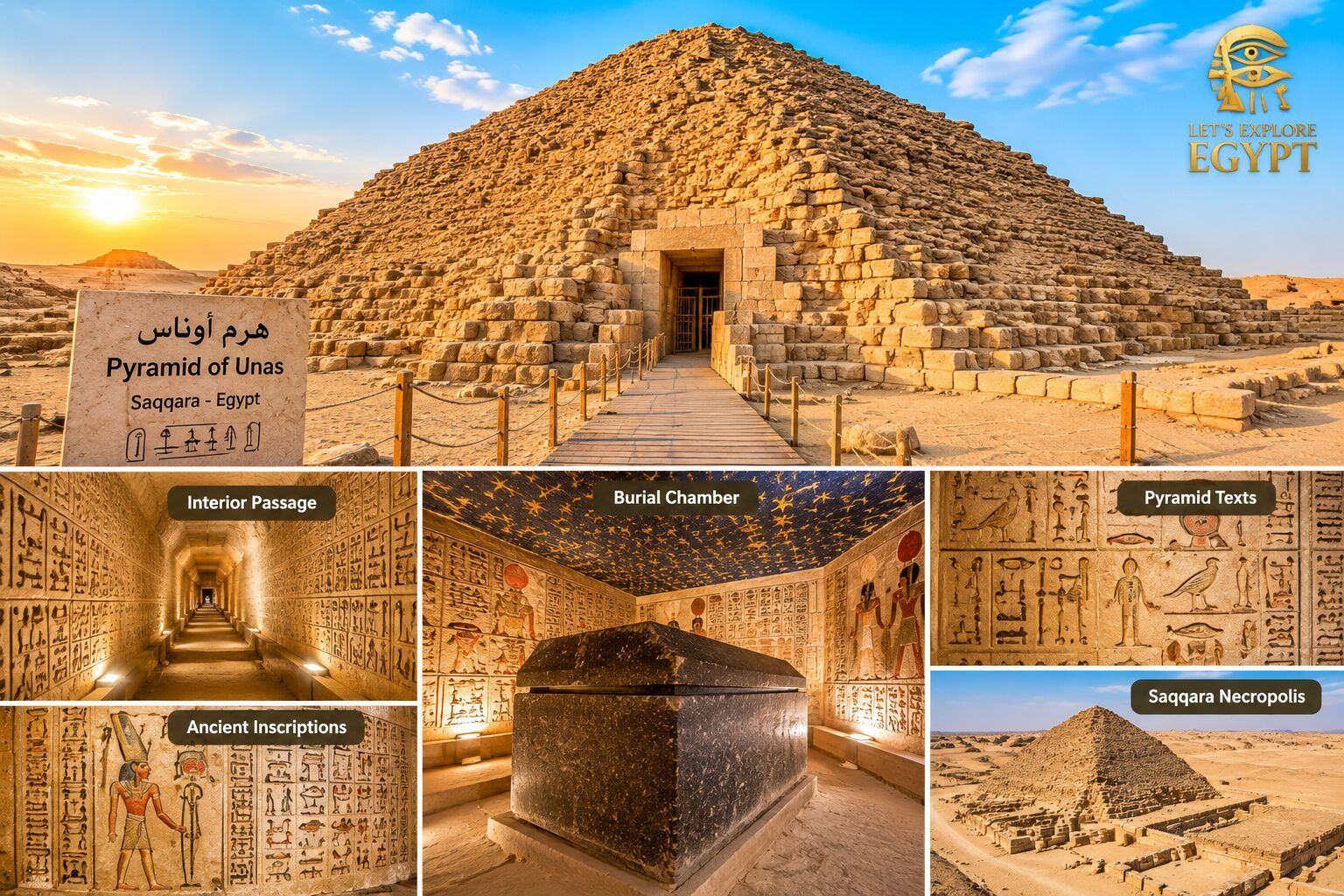
History, Construction & the First Pyramid Texts
Welcome to the Pyramid of Unas
Nestled within the vast Saqqara Necropolis, the Pyramid of Unas may appear modest compared to the towering pyramids of Giza, but it holds an extraordinary place in history. While its exterior has suffered the effects of time, its interior preserves one of the greatest treasures of Ancient Egypt—the Pyramid Texts, the oldest known collection of religious inscriptions ever carved into the walls of a royal tomb.
Built for Pharaoh Unas, the final ruler of Egypt’s Fifth Dynasty, this pyramid marks a turning point in Egyptian funerary traditions. For the first time, sacred spells intended to guide the king safely through the afterlife were permanently inscribed on the walls of the burial chambers.
Today, visitors to Saqqara can walk through the narrow entrance passages and stand before these remarkable hieroglyphic inscriptions, experiencing one of the most significant monuments in the history of Ancient Egyptian religion.
Table 1: Pyramid of Unas at a Glance
| Feature | Details |
|---|---|
| Official Name | Pyramid of Unas |
| Builder | Pharaoh Unas |
| Dynasty | Fifth Dynasty |
| Date | Around 2375–2345 BCE |
| Location | Saqqara Necropolis |
| Height (Original) | Approximately 43 meters (141 ft) |
| Base Length | About 57.7 meters |
| Famous For | The earliest Pyramid Texts |
| UNESCO Site | Memphis and its Necropolis |
Who Was Pharaoh Unas?
Pharaoh Unas (also written Unis or Wenis) was the last king of Egypt’s Fifth Dynasty. Although his reign was relatively short, his legacy became one of the most influential in Egyptian history because of the innovative decoration inside his pyramid.
Little is known about his political achievements, but his funerary monument transformed royal burial practices for centuries to come.
After Unas, later kings of the Sixth Dynasty adopted and expanded the tradition of decorating their pyramids with sacred religious texts.
Table 2: Pharaoh Unas Profile
| Feature | Information |
|---|---|
| Royal Name | Unas (Wenis) |
| Dynasty | Fifth Dynasty |
| Reign | Approximately 2375–2345 BCE |
| Capital | Memphis |
| Burial Site | Pyramid of Unas, Saqqara |
| Historical Legacy | First Pyramid Texts |
Why Was the Pyramid Built?
Like all royal pyramids of the Old Kingdom, the Pyramid of Unas was built as the eternal resting place of the king.
Ancient Egyptians believed that death was not an end but the beginning of a new journey. To ensure a successful transition into the afterlife, elaborate funerary monuments, temples, rituals, and sacred texts were created.
The Pyramid of Unas introduced an entirely new concept—covering the interior walls with religious inscriptions that were intended to:
- Protect the king.
- Defeat dangerous supernatural forces.
- Help the king ascend to the heavens.
- Unite the ruler with the gods.
- Guarantee eternal life.
Table 3: Purpose of the Pyramid
| Purpose | Explanation |
|---|---|
| Royal Tomb | Burial place of Pharaoh Unas |
| Religious Monument | Sacred funerary rituals |
| Spiritual Guide | Pyramid Texts for the afterlife |
| Symbol of Kingship | Eternal rule |
| Architectural Innovation | First decorated royal pyramid interior |
The Final King of the Fifth Dynasty
Unas ruled during a period of transition in Ancient Egypt.
The Fifth Dynasty had seen remarkable developments in:
- Solar temples.
- Religious ceremonies.
- Monumental architecture.
- Administrative expansion.
- Artistic achievements.
Although the dynasty came to an end with Unas, his pyramid established a tradition that continued into the Sixth Dynasty and influenced Egyptian religious literature for more than a thousand years.
Table 4: Fifth Dynasty Timeline
| Pharaoh | Significance |
|---|---|
| Userkaf | Founded the Fifth Dynasty |
| Sahure | Expansion of trade |
| Neferirkare | Administrative reforms |
| Nyuserre | Monumental building projects |
| Djedkare Isesi | Government reorganization |
| Unas | Introduced the Pyramid Texts |
Construction of the Pyramid
Compared to the Great Pyramid of Giza, the Pyramid of Unas is relatively small.
However, its modest size reflects changing architectural priorities during the late Old Kingdom.
Instead of focusing on creating the largest monument, builders invested tremendous effort in decorating the pyramid’s interior with carefully carved hieroglyphic inscriptions.
The pyramid was constructed using:
- Local limestone blocks.
- Fine white limestone casing.
- Granite elements in selected areas.
- Carefully planned underground chambers.
Table 5: Pyramid Dimensions
| Feature | Measurement |
|---|---|
| Original Height | 43 meters |
| Base Length | 57.7 meters |
| Shape | Smooth-sided pyramid |
| Material | Limestone |
| Orientation | Cardinal directions |
Discovery and Exploration
Although the Pyramid of Unas remained visible throughout history, much of its significance was hidden beneath collapsed stonework.
Modern archaeological exploration revealed one of the greatest discoveries ever made in Egypt—the Pyramid Texts carved across nearly every wall of the burial chambers.
These inscriptions revolutionized historians’ understanding of Ancient Egyptian religion and funerary beliefs.
Today, visitors can still enter the pyramid and admire these remarkable hieroglyphs.
Table 6: Discovery Timeline
| Period | Event |
|---|---|
| Ancient Egypt | Pyramid constructed |
| Medieval Period | Outer casing removed |
| 19th Century | Archaeological investigations |
| Modern Era | Conservation and restoration |
| Today | Open to visitors |
UNESCO World Heritage Site
The Pyramid of Unas forms part of the UNESCO World Heritage Site known as “Memphis and its Necropolis – the Pyramid Fields from Giza to Dahshur.”
This international recognition protects the monument as one of humanity’s most important cultural treasures.
Together with nearby monuments such as the Step Pyramid of Djoser, the Serapeum, and the Tomb of Ti, it illustrates the remarkable evolution of Ancient Egyptian civilization.
Table 7: UNESCO Facts
| Feature | Information |
|---|---|
| Heritage Site | Memphis and its Necropolis |
| UNESCO Listing | 1979 |
| Country | Egypt |
| Includes | Saqqara, Giza, Dahshur, Memphis |
| Category | Cultural Heritage |
Why the Pyramid of Unas Changed History
Although smaller than earlier pyramids, the Pyramid of Unas introduced one of the greatest innovations in Egyptian history.
The decision to decorate the burial chambers with sacred hieroglyphic inscriptions created the foundation for later religious literature, including:
- Coffin Texts
- Book of the Dead
- Funerary rituals of the Middle Kingdom
- Religious traditions of the New Kingdom
Without the Pyramid of Unas, historians would know far less about Ancient Egyptian beliefs concerning death and eternal life.
Table 8: Historical Significance
| Achievement | Importance |
|---|---|
| First Pyramid Texts | Beginning of royal funerary literature |
| Religious Innovation | New burial traditions |
| Architectural Development | Decorated interior walls |
| Historical Legacy | Influenced Egyptian religion for centuries |
Amazing Facts About the Pyramid of Unas
The Pyramid of Unas may be modest in size, but it contains extraordinary historical treasures.
Some fascinating facts include:
- It contains the oldest Pyramid Texts ever discovered.
- It belonged to the last king of the Fifth Dynasty.
- Visitors can still enter the pyramid today.
- The interior walls remain covered with beautifully carved hieroglyphs.
- It became the model for later royal pyramids.
Table 9: Fast Facts
| Fact | Information |
|---|---|
| Age | More than 4,300 years |
| Builder | Pharaoh Unas |
| Dynasty | Fifth Dynasty |
| Height | 43 meters |
| Famous For | Pyramid Texts |
| Location | Saqqara Necropolis |
Why Every Visitor Should See the Pyramid of Unas
While many travelers come to Saqqara to admire the Step Pyramid of Djoser, the Pyramid of Unas offers a completely different experience.
Instead of focusing on monumental size, it invites visitors into an intimate underground world where thousands of beautifully carved hieroglyphs reveal the hopes, beliefs, and spiritual journey of an ancient king.
Architecture, Pyramid Texts & Interior Design
A Small Pyramid with an Extraordinary Interior
From the outside, the Pyramid of Unas appears modest compared to the massive pyramids at Giza. Much of its smooth limestone casing disappeared centuries ago, leaving a mound of weathered stone blocks.
However, its true treasure lies beneath the surface.
Descending into the pyramid reveals one of the most remarkable interiors in Ancient Egypt, where nearly every wall is covered with finely carved hieroglyphs known as the Pyramid Texts. These inscriptions transformed royal burial traditions and became the foundation of Ancient Egyptian funerary literature.
Table 1: Pyramid Architecture at a Glance
| Feature | Details |
|---|---|
| Pyramid Type | Smooth-sided pyramid |
| Dynasty | Fifth Dynasty |
| Original Height | Approximately 43 meters |
| Base Length | About 57.7 meters |
| Main Material | Limestone |
| Interior Decoration | Pyramid Texts |
The Pyramid Layout
Like many Old Kingdom pyramids, the Pyramid of Unas follows a carefully planned layout designed to protect the king and symbolize his journey into eternity.
The interior consists of:
- North entrance
- Descending corridor
- Horizontal passage
- Antechamber
- Burial chamber
- Storage chamber (serdab)
Each space had both practical and symbolic functions connected with the king’s resurrection.
Table 2: Interior Layout
| Area | Purpose |
|---|---|
| North Entrance | Access to the pyramid |
| Descending Passage | Route to the underground chambers |
| Horizontal Corridor | Connects the main rooms |
| Antechamber | Ritual transition space |
| Burial Chamber | Final resting place of Pharaoh Unas |
| Storage Chamber | Funerary equipment and offerings |
The Entrance Passage
Visitors enter through a small opening on the pyramid’s northern side.
From there, a descending corridor leads deep into the monument.
Although narrow and relatively simple in appearance, the passage symbolized the king’s transition from the world of the living into the realm of eternity.
The corridor was originally sealed with large limestone blocks to protect the royal burial.
Table 3: Entrance Passage
| Feature | Description |
|---|---|
| Location | Northern side |
| Direction | Descending |
| Material | Limestone |
| Original Security | Blocking stones |
| Symbolism | Journey into the afterlife |
The Antechamber
The antechamber served as a transitional room before the burial chamber.
Ancient priests likely performed symbolic rituals here during the king’s funeral.
Its walls are decorated with beautifully carved Pyramid Texts that invoke divine protection and assistance for the deceased ruler.
The antechamber also marks the beginning of the most elaborate religious decoration inside the pyramid.
Table 4: Antechamber Features
| Feature | Details |
|---|---|
| Purpose | Ritual transition |
| Decoration | Pyramid Texts |
| Material | Limestone |
| Religious Function | Preparation for eternal life |
The Burial Chamber
The burial chamber is the spiritual center of the pyramid.
Here, Pharaoh Unas was placed inside a basalt sarcophagus, surrounded by sacred inscriptions designed to ensure his safe journey through the afterlife.
The chamber features:
- A dark stone sarcophagus.
- Walls covered in hieroglyphic texts.
- A ceiling decorated with white stars on a dark background, representing the night sky.
This celestial ceiling symbolized the heavens, where the king hoped to join the eternal stars.
Table 5: Burial Chamber
| Feature | Information |
|---|---|
| Sarcophagus | Black basalt |
| Ceiling | White stars on a dark background |
| Decoration | Pyramid Texts |
| Purpose | Royal burial |
The Pyramid Texts
The greatest treasure of the Pyramid of Unas is undoubtedly the Pyramid Texts.
These inscriptions are the oldest known religious writings carved inside a royal tomb.
They consist of hundreds of spells intended to:
- Protect the king.
- Defeat dangerous spirits.
- Help the king ascend to the heavens.
- Unite him with the gods.
- Guarantee eternal life.
Unlike later funerary texts written on coffins or papyrus, the Pyramid Texts were permanently carved into the stone walls of the pyramid itself.
Table 6: Pyramid Texts Overview
| Feature | Details |
|---|---|
| Language | Ancient Egyptian Hieroglyphs |
| Dynasty | Fifth Dynasty |
| First Appearance | Pyramid of Unas |
| Number of Spells | Hundreds |
| Purpose | Guide the king in the afterlife |
Religious Symbolism
Every architectural element inside the pyramid carries symbolic meaning.
The Egyptians believed that architecture itself could help the king achieve immortality.
Common symbols include:
- Stars representing eternal life.
- The sky goddess Nut protecting the king.
- Solar imagery connected with the sun god Ra.
- References to Osiris, lord of the afterlife.
- Hieroglyphic spells invoking divine assistance.
Together, these symbols created a sacred environment where the king could be reborn.
Table 7: Religious Symbols
| Symbol | Meaning |
|---|---|
| Stars | Eternal life |
| Ra | Solar rebirth |
| Osiris | Resurrection |
| Nut | Protection |
| Hieroglyphs | Sacred prayers |
Construction Materials
Although relatively small, the Pyramid of Unas demonstrates impressive construction techniques.
Builders used:
- Local limestone for the pyramid core.
- Fine white limestone casing.
- Basalt for the royal sarcophagus.
- Granite in selected structural elements.
These materials combined durability with symbolic significance.
Table 8: Construction Materials
| Material | Use |
|---|---|
| Limestone | Main pyramid structure |
| Fine Limestone | Outer casing |
| Basalt | Sarcophagus |
| Granite | Structural elements |
Engineering Achievements
The Pyramid of Unas may not match the Great Pyramid in size, but its engineering remains remarkable.
Innovations include:
- Precisely aligned passages.
- Stable underground chambers.
- Carefully carved hieroglyphic inscriptions.
- Decorative astronomical ceiling.
- Efficient use of smaller building materials.
The focus shifted from building the tallest pyramid to creating the most spiritually powerful interior.
Table 9: Engineering Innovations
| Innovation | Importance |
|---|---|
| Underground Layout | Safe burial chambers |
| Precision Alignment | Architectural accuracy |
| Hieroglyphic Decoration | Religious innovation |
| Star Ceiling | Symbolic representation of heaven |
| Durable Materials | Long-term preservation |
Comparison with Earlier Pyramids
The Pyramid of Unas reflects changing priorities during the late Old Kingdom.
Rather than competing with the enormous pyramids built by Khufu and Khafre, it emphasized religious symbolism and sacred literature.
Its decorated interior became the model for later pyramids built by Sixth Dynasty kings.
Table 10: Comparison with Other Pyramids
| Feature | Pyramid of Unas | Great Pyramid of Khufu | Step Pyramid of Djoser |
|---|---|---|---|
| Dynasty | Fifth | Fourth | Third |
| Height | 43 m | 146.6 m (original) | 62 m |
| Interior Decoration | Extensive Pyramid Texts | Minimal decoration | No Pyramid Texts |
| Main Importance | First Pyramid Texts | Largest pyramid | First pyramid ever built |
Why the Pyramid of Unas Is an Architectural Masterpiece
Although modest in size, the Pyramid of Unas represents one of the greatest milestones in Ancient Egyptian history.
Its beautifully planned interior, sacred inscriptions, and astronomical symbolism reveal a remarkable shift in royal funerary architecture—from constructing the largest monuments to creating spaces filled with profound religious meaning.
For historians, archaeologists, and visitors alike, the Pyramid of Unas offers a unique opportunity to stand inside the world’s oldest decorated royal pyramid and witness the origins of Ancient Egyptian sacred literature.
Archaeology, Pyramid Texts, Religious Beliefs & Modern Discoveries
A Treasure Hidden Beneath the Sands
Although the Pyramid of Unas is one of the smallest royal pyramids of the Old Kingdom, it has become one of the most important archaeological monuments in the world. Its true significance lies not in its size but in what archaeologists discovered inside—thousands of beautifully carved hieroglyphic inscriptions known as the Pyramid Texts.
These sacred writings revolutionized the study of Ancient Egyptian religion and provided historians with invaluable insight into royal funerary beliefs, the afterlife, and the evolution of religious literature.
Today, the Pyramid of Unas remains one of the highlights of the Saqqara Necropolis, attracting visitors eager to stand inside the first pyramid ever decorated with religious texts.
Table 1: Archaeological Importance
| Feature | Significance |
|---|---|
| First Pyramid Texts | Oldest royal religious inscriptions |
| Dynasty | Fifth Dynasty |
| UNESCO Site | Memphis and its Necropolis |
| Historical Value | One of Egypt’s most important pyramids |
| Visitor Access | Interior open to visitors (subject to regulations) |
Discovery of the Pyramid Texts
The most remarkable discovery inside the Pyramid of Unas was the extensive collection of sacred inscriptions covering the burial chamber and adjoining passages.
Before this discovery, historians had little direct evidence explaining how Ancient Egyptians believed a king reached eternal life.
The Pyramid Texts revealed prayers, hymns, magical spells, and ritual instructions that guided the deceased ruler through the dangers of the afterlife.
These inscriptions became the foundation for later funerary literature, including the Coffin Texts and the Book of the Dead.
Table 2: Pyramid Texts
| Feature | Information |
|---|---|
| Language | Ancient Egyptian Hieroglyphs |
| First Appearance | Pyramid of Unas |
| Purpose | Guide the king to eternal life |
| Content | Prayers, hymns, spells |
| Historical Importance | Oldest known religious inscriptions |
Religious Beliefs of Ancient Egypt
The Pyramid of Unas reflects the central belief that death was not the end of existence.
Ancient Egyptians believed that after death the king would:
- Rise into the heavens.
- Join the sun god Ra.
- Become united with Osiris.
- Live forever among the imperishable stars.
- Continue protecting Egypt as a divine ruler.
Every inscription inside the pyramid was carefully placed to assist this spiritual journey.
Table 3: Religious Concepts
| Concept | Meaning |
|---|---|
| Afterlife | Eternal existence |
| Osiris | Lord of the dead |
| Ra | Sun god |
| Imperishable Stars | Eternal kingship |
| Pyramid Texts | Spiritual protection |
Archaeological Excavations
Archaeologists have spent more than a century studying the Pyramid of Unas and the surrounding funerary complex.
Excavations have uncovered:
- Temple foundations
- Offering chapels
- Burial equipment
- Decorative reliefs
- Stone vessels
- Royal inscriptions
These discoveries have helped historians reconstruct the ceremonies that once took place during the king’s funeral.
Table 4: Major Discoveries
| Discovery | Importance |
|---|---|
| Pyramid Texts | Religious literature |
| Basalt Sarcophagus | Royal burial |
| Temple Ruins | Funerary rituals |
| Stone Reliefs | Ancient art |
| Offering Areas | Religious ceremonies |
Hidden Chambers and Underground Passages
Like many Old Kingdom pyramids, the Pyramid of Unas contains a carefully designed underground system.
The complex includes:
- Descending entrance corridor
- Horizontal passage
- Antechamber
- Burial chamber
- Storage room
Although smaller than the underground network beneath the Step Pyramid of Djoser, the layout demonstrates the increasing sophistication of pyramid construction during the Fifth Dynasty.
Table 5: Interior Features
| Chamber | Function |
|---|---|
| Entrance Corridor | Access to the pyramid |
| Horizontal Passage | Connects interior rooms |
| Antechamber | Ritual transition |
| Burial Chamber | Royal tomb |
| Storage Chamber | Funerary equipment |
The Legacy of the Pyramid Texts
The Pyramid Texts introduced inside the Pyramid of Unas became one of the most influential religious traditions in Ancient Egypt.
Later developments included:
- Coffin Texts of the Middle Kingdom.
- Book of the Dead of the New Kingdom.
- Funerary papyri.
- Temple inscriptions.
- Royal religious ceremonies.
Without the Pyramid of Unas, much of Ancient Egyptian theology would have been lost.
Table 6: Evolution of Egyptian Funerary Texts
| Period | Religious Text |
|---|---|
| Fifth Dynasty | Pyramid Texts |
| Middle Kingdom | Coffin Texts |
| New Kingdom | Book of the Dead |
| Late Period | Expanded funerary literature |
Restoration and Preservation
Protecting the Pyramid of Unas is essential for preserving its unique inscriptions.
Conservation projects have focused on:
- Stabilizing underground chambers.
- Cleaning hieroglyphic carvings.
- Controlling humidity.
- Improving visitor access.
- Digital documentation.
These efforts help ensure that future generations can continue to appreciate one of Egypt’s greatest religious monuments.
Table 7: Conservation Projects
| Project | Objective |
|---|---|
| Structural Reinforcement | Preserve the chambers |
| Cleaning Hieroglyphs | Protect inscriptions |
| Environmental Monitoring | Reduce humidity damage |
| Digital Scanning | Long-term documentation |
| Visitor Safety | Improve accessibility |
Myths vs. Historical Facts
Because of its sacred inscriptions, the Pyramid of Unas has inspired numerous myths.
Modern archaeology, however, provides clear explanations for its purpose and construction.
Table 8: Myths vs. Facts
| Myth | Historical Evidence |
|---|---|
| The texts are magical spells only | They combine prayers, hymns, rituals, and protective formulas |
| The pyramid was unfinished | Archaeological evidence shows it was completed for Pharaoh Unas |
| Only priests understood the inscriptions | They were written specifically for the king’s afterlife rituals |
| The pyramid has hidden treasure | The burial was looted in antiquity, as with many royal tombs |
Modern Research
Researchers continue studying the Pyramid of Unas using advanced technologies.
Current projects include:
- High-resolution photography.
- 3D laser scanning.
- Digital translation of inscriptions.
- Structural monitoring.
- Comparative studies with later pyramids.
These investigations continue to improve our understanding of Ancient Egyptian religion and architecture.
Table 9: Modern Research Techniques
| Method | Purpose |
|---|---|
| Laser Scanning | Record interior details |
| Digital Photography | Preserve inscriptions |
| Translation Studies | Improve interpretation |
| Structural Monitoring | Protect the monument |
| Comparative Research | Study pyramid evolution |
Why Historians Value the Pyramid of Unas
The Pyramid of Unas bridges the worlds of architecture, religion, and literature.
Its inscriptions preserve the earliest surviving royal religious texts, offering a direct voice from more than 4,300 years ago.
For historians, it provides a rare opportunity to study the beliefs, rituals, and hopes of Ancient Egyptian kings through original inscriptions that remain in their intended location.
Table 10: Why the Pyramid of Unas Matters
| Category | Importance |
|---|---|
| Archaeology | ⭐⭐⭐⭐⭐ |
| Ancient Religion | ⭐⭐⭐⭐⭐ |
| Hieroglyphic Inscriptions | ⭐⭐⭐⭐⭐ |
| Historical Value | ⭐⭐⭐⭐⭐ |
| Educational Experience | ⭐⭐⭐⭐⭐ |
| UNESCO Heritage | ⭐⭐⭐⭐⭐ |
The Enduring Legacy of Pharaoh Unas
Although Pharaoh Unas ruled more than four millennia ago, his pyramid continues to shape our understanding of Ancient Egypt.
Its extraordinary Pyramid Texts laid the foundation for centuries of religious tradition, influencing royal burials long after the Fifth Dynasty ended.
Today, visitors descending into the quiet chambers of the Pyramid of Unas can still read the sacred hieroglyphs that once guided a king toward eternal life, making this monument one of the most profound and rewarding experiences in the Saqqara Necropolis.
Visitor Guide, Travel Tips, FAQs & Everything You Need to Know
Planning Your Visit to the Pyramid of Unas
The Pyramid of Unas is one of the hidden gems of the Saqqara Necropolis. While its exterior may seem modest compared to the famous pyramids of Giza, its interior contains one of Ancient Egypt’s greatest treasures—the Pyramid Texts, the oldest surviving religious inscriptions carved inside a royal pyramid.
A visit to the Pyramid of Unas offers a unique opportunity to step inside an authentic Old Kingdom monument and witness beautifully carved hieroglyphs that have survived for more than 4,300 years.
Most visitors include the Pyramid of Unas as part of a full-day tour of Saqqara, together with the Step Pyramid of Djoser, the Serapeum, the Tomb of Ti, and the Imhotep Museum.
Table 1: Visitor Information
| Feature | Details |
|---|---|
| Location | Saqqara Necropolis, Giza Governorate |
| Builder | Pharaoh Unas |
| Dynasty | Fifth Dynasty |
| Average Visit Time | 30–45 minutes |
| Guided Tour | Highly Recommended |
| Interior Access | Usually available (subject to current regulations) |
Best Time to Visit
The Pyramid of Unas can be visited throughout the year, but the cooler months provide the most comfortable conditions for exploring Saqqara.
Best months:
- October
- November
- December
- January
- February
- March
- April
Morning visits are recommended, allowing you to enjoy cooler temperatures and better lighting before larger tour groups arrive.
Table 2: Best Seasons
| Season | Weather | Recommendation |
|---|---|---|
| October–November | Pleasant | ⭐⭐⭐⭐⭐ |
| December–February | Cool | ⭐⭐⭐⭐⭐ |
| March–April | Warm | ⭐⭐⭐⭐☆ |
| May–September | Hot | ⭐⭐⭐☆☆ |
Opening Hours
The Pyramid of Unas is located inside the Saqqara archaeological site and generally follows the site’s official opening hours.
Operating hours may occasionally change because of conservation work, archaeological missions, or public holidays.
To make the most of your visit, arrive early and combine the pyramid with nearby attractions.
Table 3: Suggested Visiting Schedule
| Time | Experience |
|---|---|
| 8:00 AM | Arrive at Saqqara |
| 8:15 AM | Step Pyramid of Djoser |
| 9:45 AM | Pyramid of Unas |
| 10:30 AM | Serapeum |
| Afternoon | Memphis & Dahshur |
How to Get There
The Pyramid of Unas is located within the Saqqara archaeological zone, approximately 30 km (19 miles) south of central Cairo.
The most convenient transportation options include:
- Private guided tour
- Private driver
- Taxi
- Ride-hailing services
Since the pyramid is located within walking distance of several important monuments, it is usually explored as part of a larger Saqqara itinerary.
Table 4: Transportation Options
| Option | Comfort | Best For |
|---|---|---|
| Private Tour | ⭐⭐⭐⭐⭐ | First-time visitors |
| Private Driver | ⭐⭐⭐⭐⭐ | Flexible itineraries |
| Taxi | ⭐⭐⭐⭐☆ | Independent travelers |
| Ride-Hailing App | ⭐⭐⭐⭐☆ | Budget-conscious visitors |
Nearby Attractions
The Pyramid of Unas is surrounded by some of Egypt’s most important archaeological sites.
Nearby attractions include:
- Step Pyramid of Djoser
- Serapeum of Saqqara
- Tomb of Ti
- Mastaba of Mereruka
- Imhotep Museum
- Memphis Open-Air Museum
- Bent Pyramid
- Red Pyramid
Together, they create one of the most rewarding archaeological day trips in Egypt.
Table 5: Nearby Attractions
| Attraction | Approximate Distance | Suggested Visit |
|---|---|---|
| Step Pyramid of Djoser | Short walk | 60–90 min |
| Serapeum | Nearby | 45–60 min |
| Tomb of Ti | Nearby | 30–45 min |
| Imhotep Museum | Nearby | 30–45 min |
| Memphis | About 6 km | 45–60 min |
| Bent Pyramid | About 10 km | 45 min |
| Red Pyramid | About 10 km | 45 min |
Photography Tips
The Pyramid of Unas offers excellent opportunities for photography both inside and outside the monument.
For the best results:
- Visit early in the morning.
- Capture the entrance from a low angle.
- Photograph the surrounding desert landscape.
- Take close-up images of the Pyramid Texts where photography is permitted.
- Use a wide-angle lens inside the burial chamber if allowed.
Always follow the latest photography regulations at the site.
Table 6: Best Photography Locations
| Location | Best Time |
|---|---|
| Pyramid Exterior | Morning |
| Entrance Passage | Mid-Morning |
| Burial Chamber | During your visit (where permitted) |
| Desert Panorama | Early morning or late afternoon |
Frequently Asked Questions
Why is the Pyramid of Unas famous?
It is famous for containing the Pyramid Texts, the oldest known religious inscriptions carved inside a royal tomb.
Can visitors enter the Pyramid of Unas?
Access to the interior is generally available, subject to official regulations and conservation work.
How much time should I spend here?
Most visitors spend 30–45 minutes, while history enthusiasts may stay longer to admire the hieroglyphic inscriptions.
Is the Pyramid of Unas worth visiting?
Absolutely. It is one of the most important monuments in Ancient Egypt for understanding royal funerary beliefs and the development of religious literature.
Can I visit it together with the Step Pyramid?
Yes. The Pyramid of Unas is usually included in private tours of the Saqqara Necropolis.
Table 7: Quick Answers
| Question | Answer |
|---|---|
| Worth Visiting? | ⭐ Absolutely |
| Guided Tour | Highly Recommended |
| Average Visit | 30–45 minutes |
| Photography | Excellent (subject to regulations) |
| Family Friendly | Yes |
Visitor Checklist
Before your visit, remember to bring:
- Comfortable walking shoes
- Hat
- Sunglasses
- Sunscreen
- Camera or smartphone
- Portable charger
- Water bottle
- Small backpack
Table 8: Packing Checklist
| Item | Bring? |
|---|---|
| Comfortable Shoes | ✅ |
| Camera | ✅ |
| Sunglasses | ✅ |
| Sunscreen | ✅ |
| Hat | ✅ |
| Water Bottle | ✅ |
| Portable Charger | ✅ |
| Backpack | ✅ |
Suggested One-Day Itinerary
A full-day visit to Saqqara allows you to explore several incredible monuments in one trip.
Table 9: Suggested Itinerary
| Time | Activity |
|---|---|
| 8:00 AM | Arrive at Saqqara |
| 8:15 AM | Step Pyramid of Djoser |
| 9:30 AM | Pyramid of Unas |
| 10:15 AM | Serapeum |
| 11:30 AM | Tomb of Ti |
| 12:15 PM | Imhotep Museum |
| 1:00 PM | Lunch |
| 2:30 PM | Memphis |
| 4:00 PM | Bent & Red Pyramids |
Table 10: Why Visit the Pyramid of Unas?
| Experience | Rating |
|---|---|
| Ancient History | ⭐⭐⭐⭐⭐ |
| Pyramid Texts | ⭐⭐⭐⭐⭐ |
| Archaeology | ⭐⭐⭐⭐⭐ |
| Photography | ⭐⭐⭐⭐☆ |
| Educational Value | ⭐⭐⭐⭐⭐ |
| Overall Experience | ⭐⭐⭐⭐⭐ |
Final Thoughts
The Pyramid of Unas proves that size is not everything. Although smaller than many royal pyramids, it preserves one of the greatest achievements of Ancient Egyptian civilization—the earliest Pyramid Texts, carved into stone to guide a king through eternity.
Walking through its narrow corridors and standing inside its beautifully inscribed burial chamber is a powerful experience that connects visitors with beliefs and traditions dating back more than four millennia.
Whether you’re an archaeology enthusiast, a history lover, or simply curious about Ancient Egypt, the Pyramid of Unas is an essential stop during any visit to the Saqqara Necropolis.
Discover the Pyramid of Unas with Let’s Explore Egypt
Step inside one of Ancient Egypt’s most remarkable hidden treasures and explore the Pyramid of Unas, the first royal pyramid ever decorated with the famous Pyramid Texts. Hidden beneath its modest exterior are thousands of beautifully carved hieroglyphs that reveal the ancient Egyptians’ beliefs about the afterlife and the journey to eternity.
At Let’s Explore Egypt, we offer 100% private tours led by licensed Egyptologist guides who bring the history of Saqqara to life. Explore the Pyramid of Unas, admire its extraordinary inscriptions, and discover the fascinating monuments surrounding it at your own pace.
Why Book with Let’s Explore Egypt?
- 🏛️ Licensed Egyptian Tour Operator
- 👨🏫 Professional English-Speaking Egyptologist Guides
- 🚗 Private Air-Conditioned Transportation
- 📜 Visit the Pyramid of Unas and See the World’s Oldest Pyramid Texts
- 🔺 Explore the Step Pyramid of Djoser
- 🐂 Discover the Serapeum of Saqqara
- 🏺 Visit the Tomb of Ti & Mastaba of Mereruka
- 🏛️ Explore the Imhotep Museum
- 📸 Plenty of Time for Photography
- 🌅 Flexible Departure Times
- 👨👩👧 100% Private & Customized Tours
- 💬 24/7 WhatsApp Support
- ⭐ Trusted by Travelers from Around the World
- 💳 Transparent Pricing – No Hidden Fees
- ❌ No Forced Shopping Stops
Complete Your Saqqara Experience
Enhance your journey by combining the Pyramid of Unas with other iconic archaeological sites:
- 🔺 Step Pyramid of Djoser
- 🏛️ Saqqara Necropolis
- 🐂 Serapeum of Saqqara
- 🏺 Tomb of Ti
- 🏛️ Mastaba of Mereruka
- 🏺 Imhotep Museum
- 🌴 Memphis Open-Air Museum
- 🔺 Bent Pyramid
- 🔺 Red Pyramid
Our carefully designed private tours let you explore Egypt’s oldest pyramids, spectacular tombs, and fascinating museums in comfort, with expert guidance and plenty of time to enjoy every stop.
Book Your Private Pyramid of Unas Tour Today
Discover the monument that forever changed Ancient Egyptian funerary traditions. Stand before the earliest Pyramid Texts ever carved into stone and experience one of the most important religious monuments in the world.
Whether you’re passionate about archaeology, history, photography, or simply wish to explore beyond the Giza Pyramids, Let’s Explore Egypt will create an unforgettable private experience tailored to your interests.
📞 Contact Let’s Explore Egypt
📱 WhatsApp: +20 120 323 3365
📧 Email: info@lets-explore-egypt.com
🌐 Website: https://lets-explore-egypt.com/
Why Travelers Choose Let’s Explore Egypt
✅ 100% Private & Personalized Tours
✅ Licensed Egyptologist Guides
✅ Comfortable Air-Conditioned Vehicles
✅ Flexible Pickup from Cairo, Giza & Cairo Airport
✅ Family-Friendly Experiences
✅ Easy WhatsApp Booking
✅ Excellent Reviews from International Travelers
✅ Safe, Reliable & Hassle-Free Service
Let’s Explore Egypt – Walk Through the Sacred Passages of the Pyramid of Unas and Discover the Origins of Ancient Egyptian Funerary Beliefs.
Contact us today for a free personalized itinerary and explore the Pyramid of Unas, the Step Pyramid of Djoser, the Serapeum, Memphis, and Dahshur with Egypt’s trusted local experts.
Recommended Egypt Tours

Why You Can Trust Let's Explore Egypt
This article was written and reviewed by the Let's Explore Egypt Editorial Team, a licensed Egyptian tour operator specializing in private Egypt tours, Nile cruises, and tailor-made travel experiences since 2009.
- 🏛 Licensed Egyptian Tour Operator Since 2009
- ⭐ Trusted by Thousands of Travelers Worldwide
- 👨🏫 Written & Reviewed by Local Egypt Travel Experts
- 🚐 Private Tours & Tailor-Made Travel Experiences
- 📞 24/7 Customer Support