

The Life, Career & Legacy of the Architect of the First Pyramid
Who Was Imhotep?
Few individuals in history have left a legacy as remarkable as Imhotep. More than 4,600 years ago, during Egypt’s Third Dynasty, he transformed architecture, engineering, medicine, and government, becoming one of the most influential figures of the ancient world.
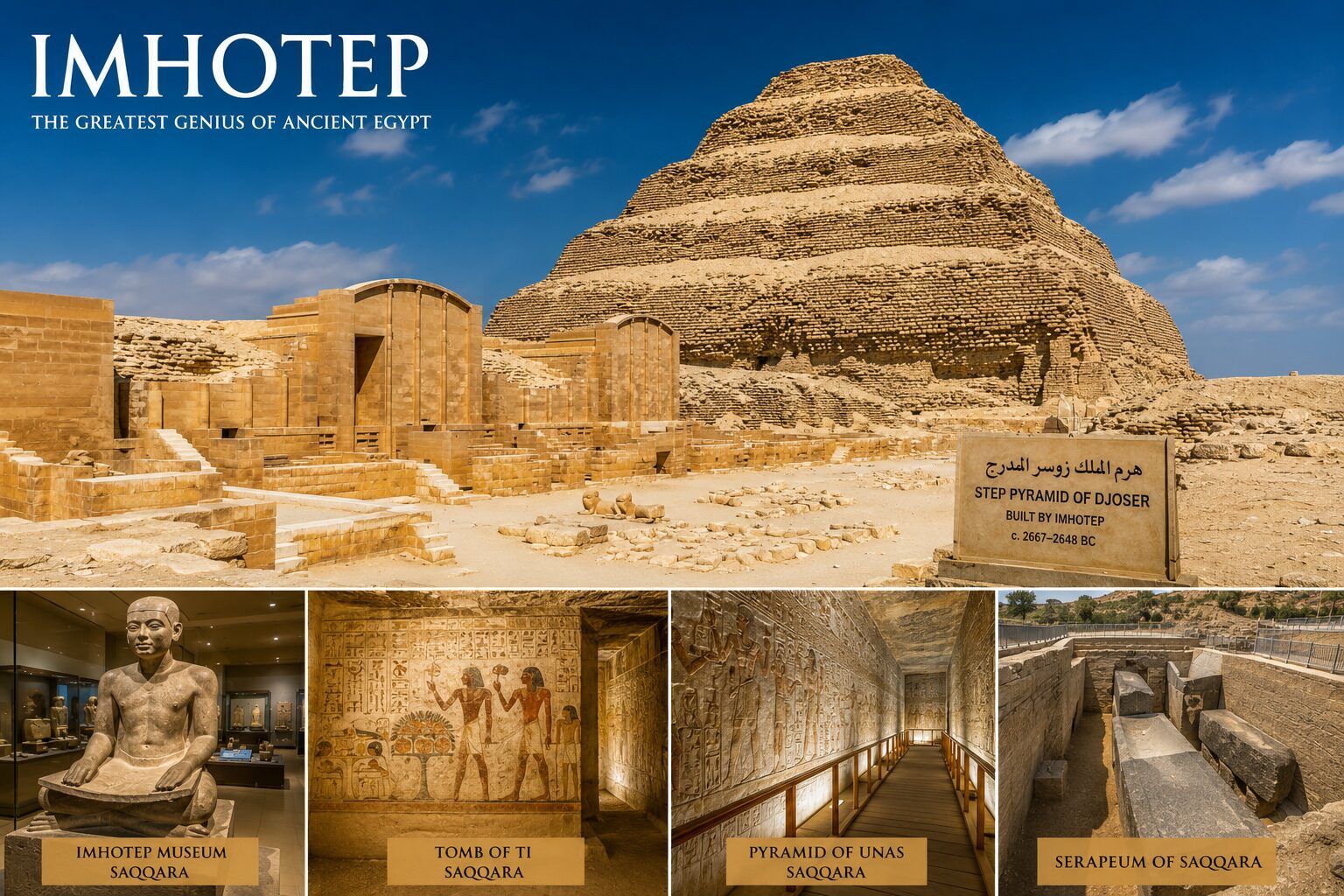
Today, Imhotep is best known as the visionary architect who designed the Step Pyramid of Djoser at Saqqara—the world’s first monumental stone building and the earliest pyramid ever constructed.
Unlike most famous figures of Ancient Egypt, Imhotep was not a pharaoh. Instead, he rose through talent, intelligence, and innovation to become the highest-ranking official in King Djoser’s court. His achievements earned him lasting fame, and centuries later he was worshipped as a god of wisdom and healing.
His influence extended far beyond architecture, making him one of the earliest known scholars whose accomplishments shaped both Egyptian civilization and world history.
Table 1: Imhotep at a Glance
| Feature | Details |
|---|---|
| Name | Imhotep |
| Meaning of Name | “The One Who Comes in Peace” |
| Dynasty | Third Dynasty |
| Served Under | Pharaoh Djoser |
| Profession | Architect, Engineer, Physician, Priest, Vizier |
| Greatest Achievement | Design of the Step Pyramid |
| Historical Legacy | Egypt’s greatest architect |
Early Life
Very little is known about Imhotep’s childhood, and much of what historians know comes from inscriptions and later historical writings.
He is believed to have lived during the 27th century BCE, at a time when Egypt was rapidly developing into one of the world’s earliest centralized kingdoms.
Although his family background remains uncertain, his remarkable education suggests he belonged to a respected household with access to literacy and administrative training.
From an early age, Imhotep demonstrated exceptional abilities in mathematics, engineering, writing, and religious studies—skills that would later define his extraordinary career.
Table 2: Early Life
| Feature | Information |
|---|---|
| Birth | Around the 27th century BCE (estimated) |
| Place | Ancient Egypt |
| Education | Writing, mathematics, religion, administration |
| Language | Ancient Egyptian |
| Historical Sources | Royal inscriptions and later traditions |
The Third Dynasty
Imhotep lived during a period of remarkable transformation in Egyptian history.
The Third Dynasty marked the beginning of the Old Kingdom, often called the “Age of the Pyramids.”
During this era:
- Royal authority expanded.
- Monumental stone architecture emerged.
- Government administration became more sophisticated.
- Religious ceremonies grew increasingly elaborate.
- Egypt experienced political stability and economic prosperity.
These favorable conditions allowed visionary officials like Imhotep to experiment with ambitious architectural projects that had never been attempted before.
Table 3: Third Dynasty Timeline
| Event | Approximate Date |
|---|---|
| Beginning of the Third Dynasty | c. 2686 BCE |
| Reign of Pharaoh Djoser | c. 2667–2648 BCE |
| Construction of the Step Pyramid | During Djoser’s reign |
| Rise of Imhotep | Third Dynasty |
| Beginning of Monumental Stone Architecture | Third Dynasty |
Serving Pharaoh Djoser
Imhotep served Pharaoh Djoser, one of Egypt’s most successful early rulers.
As the king’s trusted adviser, he supervised numerous aspects of government, including:
- Royal construction projects
- Religious ceremonies
- Administration
- Engineering
- State planning
- Temple management
His close relationship with Djoser gave him the opportunity to create the revolutionary Step Pyramid complex at Saqqara.
The success of this project permanently changed Egyptian architecture and inspired the construction of later pyramids at Giza and elsewhere.
Table 4: Roles Under Pharaoh Djoser
| Position | Responsibility |
|---|---|
| Vizier | Chief adviser to the king |
| Architect | Designed royal monuments |
| Engineer | Planned construction projects |
| High Priest | Supervised religious ceremonies |
| Administrator | Managed state affairs |
Imhotep’s Titles
Ancient Egyptian inscriptions attribute numerous prestigious titles to Imhotep, reflecting his broad range of responsibilities.
Among them were:
- Chancellor of the King of Lower Egypt
- First After the King of Upper Egypt
- High Priest of Heliopolis
- Chief Sculptor
- Master Builder
- Overseer of Royal Works
These titles demonstrate that Imhotep was far more than an architect—he was one of the most influential officials in the kingdom.
Table 5: Titles of Imhotep
| Title | Meaning |
|---|---|
| Vizier | Chief government official |
| Chancellor | Senior royal adviser |
| High Priest | Religious leader |
| Master Builder | Supervisor of construction |
| Chief Sculptor | Director of artistic works |
Why Imhotep Changed History
Before Imhotep, royal tombs were primarily constructed from mudbrick.
His decision to build Djoser’s funerary complex entirely from limestone revolutionized architecture forever.
His innovations included:
- Large-scale stone construction.
- Monumental planning.
- Multi-level pyramid design.
- Precision stone cutting.
- Organized construction methods.
These achievements became the foundation of pyramid building throughout the Old Kingdom.
Table 6: Major Achievements
| Achievement | Historical Importance |
|---|---|
| Step Pyramid | World’s first pyramid |
| Stone Architecture | First monumental stone complex |
| Engineering | New construction techniques |
| Government | Administrative leadership |
| Medicine | Later regarded as founder of Egyptian medicine |
Historical Sources
Unlike many officials of his time, Imhotep is mentioned in several ancient inscriptions and later historical texts.
Evidence for his life comes from:
- Djoser’s monuments.
- Saqqara inscriptions.
- Later Egyptian religious writings.
- Greek historical accounts.
- Archaeological discoveries.
Although some later stories became legendary, they reflect the extraordinary respect later generations had for his achievements.
Table 7: Historical Evidence
| Source | Importance |
|---|---|
| Royal Inscriptions | Contemporary evidence |
| Saqqara Archaeology | Physical remains |
| Temple Inscriptions | Religious traditions |
| Greek Writers | Later historical accounts |
| Ancient Manuscripts | Cultural memory |
Imhotep’s Growing Reputation
During his lifetime, Imhotep was admired as an exceptional official.
Over the following centuries, however, his reputation continued to grow.
Egyptians came to regard him as:
- A brilliant architect.
- A wise scholar.
- A gifted physician.
- A master engineer.
- A symbol of knowledge.
Eventually, he was worshipped as a divine figure associated with healing and wisdom.
Table 8: Imhotep’s Legacy
| Field | Contribution |
|---|---|
| Architecture | Step Pyramid |
| Engineering | Monumental stone construction |
| Government | Royal administration |
| Medicine | Healing traditions |
| Religion | Later deified |
Amazing Facts About Imhotep
- He designed the world’s first pyramid.
- He pioneered monumental stone architecture.
- He served as vizier to Pharaoh Djoser.
- He was later worshipped as a god.
- The Imhotep Museum at Saqqara is named in his honor.
- He inspired generations of architects, physicians, and scholars.
Table 9: Quick Facts
| Fact | Information |
|---|---|
| Lifetime | c. 27th century BCE |
| Pharaoh | Djoser |
| Dynasty | Third Dynasty |
| Famous For | Step Pyramid |
| Profession | Architect, Vizier, Physician |
| Legacy | One of history’s greatest innovators |
Why Imhotep Still Inspires the World
More than 4,600 years after his lifetime, Imhotep remains one of the most celebrated individuals in Ancient Egyptian history.
His revolutionary ideas transformed architecture, influenced medicine, advanced engineering, and laid the foundation for the pyramid age that would define Egypt’s global legacy.
For visitors exploring Saqqara, understanding Imhotep’s life brings new meaning to every stone of the Step Pyramid of Djoser and every artifact displayed in the Imhotep Museum.
Architect, Engineer, Physician & the Creator of the World’s First Pyramid
The Man Who Changed Architecture Forever
Among all the remarkable achievements of Imhotep, none had a greater impact than his revolutionary approach to architecture. Before his lifetime, Egyptian royal tombs were simple rectangular mastabas built primarily from mudbrick.
Imhotep envisioned something entirely different.
Instead of constructing a single mastaba, he designed a series of progressively smaller mastabas stacked on top of one another, creating the Step Pyramid of Djoser—the world’s first pyramid and the earliest monumental stone building ever constructed.
This revolutionary idea transformed architecture forever and marked the beginning of Egypt’s famous Pyramid Age.
Table 1: Imhotep’s Greatest Achievements
| Achievement | Historical Importance |
|---|---|
| Step Pyramid | World’s first pyramid |
| Stone Architecture | First monumental limestone complex |
| Engineering Innovation | Revolutionized construction |
| Royal Administration | Strengthened government |
| Medicine | Later honored as a master healer |
Designing the Step Pyramid
The Step Pyramid of Djoser was unlike anything the world had ever seen.
Instead of using mudbrick, Imhotep chose finely cut limestone blocks, creating a structure that would survive for more than 4,600 years.
The pyramid originally began as a traditional mastaba before being enlarged several times into its final six-step design.
The completed monument reached a height of approximately 62 meters (203 feet) and became the centerpiece of an enormous funerary complex covering nearly 15 hectares (37 acres).
Table 2: Step Pyramid Facts
| Feature | Details |
|---|---|
| Pharaoh | Djoser |
| Architect | Imhotep |
| Dynasty | Third Dynasty |
| Height | Approximately 62 meters |
| Material | Limestone |
| Significance | World’s first pyramid |
Revolutionary Engineering
Constructing the Step Pyramid required engineering solutions that had never been attempted before.
Imhotep introduced innovations such as:
- Large-scale stone quarrying
- Precision stone cutting
- Layered construction techniques
- Structural stability through stepped design
- Organized labor management
- Long-term building planning
These advances laid the foundation for the later pyramids at Giza, including the Great Pyramid of Khufu.
Table 3: Engineering Innovations
| Innovation | Importance |
|---|---|
| Limestone Construction | Greater durability |
| Layered Pyramid Design | Improved structural strength |
| Precision Stone Cutting | Better stability |
| Organized Workforce | Efficient construction |
| Monument Planning | Large-scale architecture |
Building in Stone
Before Imhotep, most monumental buildings were constructed using mudbrick and wood.
His decision to build entirely in limestone represented one of history’s greatest architectural breakthroughs.
Stone offered several advantages:
- Greater durability
- Fire resistance
- Monumental appearance
- Long-term preservation
- Ability to support massive structures
Because of Imhotep’s vision, many Old Kingdom monuments still stand today.
Table 4: Mudbrick vs. Limestone
| Feature | Mudbrick | Limestone |
|---|---|---|
| Durability | Moderate | Excellent |
| Fire Resistance | Low | High |
| Longevity | Limited | Thousands of years |
| Monument Size | Small | Monumental |
| Artistic Detail | Limited | Exceptional carving quality |
Master of Engineering
The Step Pyramid was only one part of a much larger funerary complex.
Imhotep designed an entire ceremonial landscape that included:
- Courtyards
- Temples
- Colonnades
- Storage chambers
- Underground galleries
- Ceremonial entrances
- Boundary walls
This integrated design demonstrated an extraordinary understanding of architecture, engineering, and urban planning.
Table 5: Components of Djoser’s Complex
| Structure | Purpose |
|---|---|
| Step Pyramid | Royal tomb |
| Heb-Sed Court | Royal jubilee ceremonies |
| South Tomb | Symbolic burial structure |
| Entrance Colonnade | Ceremonial access |
| Courtyards | Religious festivals |
| Enclosure Wall | Sacred boundary |
Imhotep and Medicine
Although best known as an architect, Imhotep later became equally famous for his association with medicine.
Ancient Egyptian tradition remembered him as:
- A physician
- A healer
- A scholar
- A teacher
- A master of medical knowledge
Centuries after his death, people prayed to Imhotep for healing and left offerings at temples dedicated to him.
While surviving contemporary evidence for his medical practice is limited, his later reputation became so influential that the Greeks identified him with Asclepius, their god of medicine.
Table 6: Medical Legacy
| Contribution | Importance |
|---|---|
| Healing Traditions | Later worship |
| Medical Knowledge | Symbol of wisdom |
| Temple Healing | Pilgrimage sites |
| Greek Association | Linked with Asclepius |
| Legacy | Father figure of Egyptian medicine |
Religious Responsibilities
Imhotep also held important religious offices.
As a senior priest, he supervised:
- Temple rituals
- Religious festivals
- Sacred ceremonies
- Royal funerary practices
- Offerings to the gods
Religion, architecture, and government worked closely together in Ancient Egypt, making Imhotep’s diverse expertise invaluable.
Table 7: Religious Roles
| Role | Responsibility |
|---|---|
| High Priest | Temple leadership |
| Royal Adviser | Religious guidance |
| Ceremony Supervisor | State rituals |
| Funerary Expert | Burial traditions |
| Temple Administrator | Sacred complexes |
Government and Administration
Imhotep was much more than a builder.
As Vizier, he supervised nearly every aspect of the Egyptian government.
His responsibilities included:
- Tax administration
- Agriculture
- Construction projects
- Justice
- State finances
- Royal estates
This combination of administrative and technical expertise made him indispensable to Pharaoh Djoser.
Table 8: Administrative Responsibilities
| Area | Responsibility |
|---|---|
| Government | State administration |
| Agriculture | Food production |
| Construction | Royal projects |
| Finance | Resource management |
| Justice | Legal oversight |
Influence on Later Egyptian Architecture
The success of Imhotep’s Step Pyramid inspired generations of architects.
Within just a few centuries, Egyptian builders created:
- The Bent Pyramid
- The Red Pyramid
- The Great Pyramid of Khufu
- The Pyramid of Khafre
- The Pyramid of Menkaure
Without Imhotep’s innovations, Egypt’s most iconic monuments might never have existed.
Table 9: Architectural Legacy
| Monument | Influence of Imhotep |
|---|---|
| Step Pyramid | Original design |
| Bent Pyramid | Continued experimentation |
| Red Pyramid | True pyramid development |
| Great Pyramid | Perfection of stone architecture |
| Giza Plateau | Culmination of pyramid evolution |
Why Imhotep Is Considered One of History’s Greatest Geniuses
Imhotep’s achievements extended far beyond a single monument.
He transformed architecture, pioneered monumental stone construction, influenced medicine, strengthened royal administration, and established engineering principles that shaped Egypt for centuries.
Few individuals in history have excelled across so many fields with such lasting impact.
Table 10: Imhotep’s Fields of Excellence
| Field | Achievement |
|---|---|
| Architecture | Step Pyramid of Djoser |
| Engineering | Monumental stone construction |
| Medicine | Later revered as a healer |
| Religion | High priest and temple official |
| Government | Vizier and royal adviser |
| Legacy | One of the greatest minds of the ancient world |
The Architect Who Built Eternity
Imhotep’s vision changed the course of architectural history. His revolutionary ideas transformed simple mudbrick tombs into magnificent stone monuments that still dominate Egypt’s landscape today.
More than four and a half millennia later, his masterpiece—the Step Pyramid of Djoser—continues to inspire architects, engineers, historians, and travelers from around the globe. His extraordinary career proves that innovation, knowledge, and imagination can leave a legacy that endures for thousands of years.
Archaeology, Deification, Historical Legacy & Modern Discoveries
From Royal Official to Ancient Egyptian Legend
Few historical figures have experienced such an extraordinary transformation after death as Imhotep.
During his lifetime, he served as the trusted Vizier of Pharaoh Djoser, overseeing architecture, administration, engineering, and religious affairs. Yet over the following two thousand years, his reputation grew far beyond that of a royal official.
By the Late Period, Egyptians honored Imhotep as a divine figure associated with wisdom, healing, learning, architecture, and medicine. Pilgrims traveled from across Egypt seeking his guidance and blessings, while scholars remembered him as the greatest intellectual of Ancient Egypt.
Today, archaeologists continue to study his life through inscriptions, monuments, and discoveries across Saqqara and beyond.
Table 1: Imhotep’s Historical Legacy
| Feature | Importance |
|---|---|
| Royal Official | Highest-ranking adviser to Djoser |
| Architect | Creator of the Step Pyramid |
| Engineer | Pioneer of monumental stone construction |
| Physician | Later honored as a master healer |
| Deity | Worshipped as a god of wisdom and medicine |
Archaeological Evidence
Although Imhotep lived more than 4,600 years ago, several archaeological discoveries confirm his historical existence.
Evidence includes:
- Inscriptions from the Step Pyramid Complex
- Royal monuments of Pharaoh Djoser
- Stone bases mentioning Imhotep’s titles
- Old Kingdom inscriptions
- Later temple inscriptions
- Ancient papyri referring to his wisdom
These discoveries demonstrate that Imhotep was a real historical figure whose achievements inspired generations of Egyptians.
Table 2: Archaeological Sources
| Source | Historical Value |
|---|---|
| Step Pyramid Inscriptions | Contemporary evidence |
| Saqqara Archaeology | Physical remains |
| Royal Monuments | Official recognition |
| Temple Inscriptions | Religious traditions |
| Ancient Papyri | Literary references |
The Deification of Imhotep
Unlike most officials, Imhotep’s reputation continued to grow long after his death.
Over many centuries, Egyptians began to honor him as a divine figure.
He became associated with:
- Wisdom
- Medicine
- Healing
- Knowledge
- Writing
- Architecture
People believed he could cure illnesses and offer guidance through dreams and prayers.
This rare honor reflected the enormous respect later generations had for his achievements.
Table 3: Why Imhotep Was Worshipped
| Attribute | Significance |
|---|---|
| Wisdom | Patron of scholars |
| Healing | Divine physician |
| Architecture | Master builder |
| Learning | Symbol of knowledge |
| Engineering | Creator of the first pyramid |
Temples Dedicated to Imhotep
As his popularity increased, several temples and healing sanctuaries were dedicated to Imhotep.
Pilgrims visited these sacred sites to:
- Pray for recovery from illness
- Offer gifts
- Seek wisdom
- Request divine protection
- Honor his memory
Some temples became important centers for healing rituals during the Late Period and the Greco-Roman era.
Table 4: Worship of Imhotep
| Practice | Purpose |
|---|---|
| Prayer | Seek healing |
| Offerings | Honor Imhotep |
| Pilgrimages | Religious devotion |
| Temple Rituals | Spiritual guidance |
| Healing Ceremonies | Hope for recovery |
Imhotep and Asclepius
When the Greeks came to Egypt, they recognized similarities between Imhotep and Asclepius, the Greek god of medicine.
As a result, the two figures became closely associated during the Ptolemaic Period.
Both were revered for:
- Healing
- Medical knowledge
- Wisdom
- Compassion
- Divine guidance
This cultural connection helped spread Imhotep’s fame beyond Egypt.
Table 5: Imhotep vs. Asclepius
| Feature | Imhotep | Asclepius |
|---|---|---|
| Civilization | Egyptian | Greek |
| Main Role | Wisdom & Healing | Medicine |
| Historical Origin | Real person | Mythological figure |
| Later Worship | Yes | Yes |
| Legacy | Architecture & Medicine | Healing |
Modern Archaeological Research
Modern Egyptologists continue to investigate Imhotep’s life and achievements.
Research focuses on:
- Step Pyramid construction
- Stone-cutting techniques
- Ancient engineering
- Administrative records
- Religious development
- Medical traditions
New discoveries at Saqqara continue to improve our understanding of the world in which Imhotep lived.
Table 6: Modern Research Areas
| Research Topic | Objective |
|---|---|
| Architecture | Study pyramid construction |
| Engineering | Analyze building methods |
| Archaeology | Discover new evidence |
| Religion | Understand later worship |
| Conservation | Preserve monuments |
Myths vs. Historical Facts
Because Imhotep became legendary, many popular stories have emerged over the centuries.
Archaeological evidence helps separate fact from fiction.
Table 7: Myths vs. Facts
| Myth | Historical Fact |
|---|---|
| Imhotep was a pharaoh | He served as Djoser’s vizier |
| He built every pyramid in Egypt | He designed the Step Pyramid, inspiring later builders |
| He invented medicine | He became a symbol of healing, but medicine existed before him |
| He was always worshipped as a god | His deification occurred many centuries after his death |
Why Historians Admire Imhotep
Historians consider Imhotep one of the greatest minds of the ancient world because his influence extended across numerous fields.
His contributions include:
- Architecture
- Engineering
- Government
- Religion
- Education
- Medicine
- Monumental planning
Very few historical figures achieved such broad and lasting impact.
Table 8: Fields of Influence
| Field | Contribution |
|---|---|
| Architecture | Step Pyramid |
| Engineering | Monumental stone construction |
| Government | Royal administration |
| Religion | High priest and later deity |
| Medicine | Symbol of healing |
| Education | Inspiration for scholars |
Imhotep’s Influence on World History
Imhotep’s architectural innovations transformed not only Ancient Egypt but also the history of construction.
His use of cut limestone and large-scale planning influenced centuries of Egyptian architecture and inspired some of the most famous monuments ever built, including the pyramids of Giza.
Today, he remains one of the earliest named architects in recorded history and a symbol of human creativity and innovation.
Table 9: Lasting Legacy
| Achievement | Global Importance |
|---|---|
| Step Pyramid | First monumental stone building |
| Engineering | Foundation of pyramid construction |
| Medicine | Symbol of healing traditions |
| Architecture | Inspiration for future civilizations |
| Historical Reputation | One of history’s greatest scholars |
Why Imhotep Still Matters Today
More than 46 centuries after his lifetime, Imhotep continues to inspire architects, engineers, doctors, archaeologists, historians, and travelers.
His achievements remind us that innovation, curiosity, and knowledge can shape civilizations and leave a legacy that endures for thousands of years.
Visitors exploring Saqqara, the Step Pyramid of Djoser, and the Imhotep Museum encounter not only magnificent monuments but also the lasting vision of one extraordinary individual.
Table 10: Why Imhotep Is Remembered
| Category | Rating |
|---|---|
| Architecture | ⭐⭐⭐⭐⭐ |
| Engineering | ⭐⭐⭐⭐⭐ |
| Historical Importance | ⭐⭐⭐⭐⭐ |
| Educational Value | ⭐⭐⭐⭐⭐ |
| Global Legacy | ⭐⭐⭐⭐⭐ |
| Overall Influence | ⭐⭐⭐⭐⭐ |
The Enduring Legacy of Imhotep
Imhotep’s life demonstrates how talent and imagination can transcend time. From designing the world’s first pyramid to becoming a revered symbol of wisdom and healing, his influence continues to shape our understanding of Ancient Egypt.
Whether you are fascinated by architecture, archaeology, medicine, or history, Imhotep remains one of the most remarkable individuals ever to have lived—an enduring icon whose achievements still captivate the world.
Visiting Imhotep’s Legacy Today – Travel Guide, FAQs & Visitor Tips
Follow in the Footsteps of Imhotep
More than 4,600 years after his lifetime, Imhotep’s genius can still be experienced throughout Saqqara, where his greatest masterpiece continues to dominate the landscape.
Although no confirmed tomb of Imhotep has ever been identified, visitors can explore the places most closely connected with his remarkable achievements, including the Step Pyramid of Djoser, the Imhotep Museum, and the surrounding monuments that transformed Egyptian architecture forever.
For anyone interested in archaeology, engineering, history, or Ancient Egyptian civilization, following Imhotep’s legacy is one of the most rewarding experiences in Egypt.
Table 1: Places Connected to Imhotep
| Site | Importance |
|---|---|
| Step Pyramid of Djoser | Designed by Imhotep |
| Imhotep Museum | Dedicated to his legacy |
| Saqqara Necropolis | His greatest architectural achievement |
| Djoser’s Funerary Complex | Masterpiece of Old Kingdom design |
| Memphis | Ancient capital where he served the royal court |
Visit the Step Pyramid of Djoser
The Step Pyramid remains Imhotep’s greatest surviving achievement.
Completed during the reign of Pharaoh Djoser, this revolutionary monument became:
- The world’s first pyramid.
- The first monumental stone building.
- The beginning of pyramid architecture.
- A model for future royal tombs.
Walking through the complex allows visitors to appreciate the extraordinary vision that changed architectural history forever.
Table 2: Step Pyramid Visitor Facts
| Feature | Details |
|---|---|
| Architect | Imhotep |
| Pharaoh | Djoser |
| Dynasty | Third Dynasty |
| Height | Approximately 62 meters |
| UNESCO Site | Yes |
| Visit Duration | 60–90 minutes |
Explore the Imhotep Museum
Before entering the archaeological site, many visitors choose to begin at the Imhotep Museum.
The museum displays:
- Statues
- Relief carvings
- Coffins
- Stone vessels
- Pottery
- Archaeological discoveries
- Models of Saqqara
Its exhibits provide valuable historical context for understanding Imhotep’s achievements and the monuments you’ll explore afterward.
Table 3: Museum Highlights
| Gallery | Main Attraction |
|---|---|
| History Gallery | Development of Saqqara |
| Statue Gallery | Old Kingdom sculptures |
| Relief Gallery | Limestone carvings |
| Funerary Collection | Coffins and burial objects |
| Lauer Memorial Hall | Restoration history |
Best Time to Visit
Saqqara can be explored year-round, but cooler temperatures provide the most comfortable experience.
Best months:
- October
- November
- December
- January
- February
- March
- April
Morning visits offer:
- Pleasant temperatures
- Better photography
- Fewer visitors
- Comfortable walking conditions
Table 4: Best Seasons
| Season | Weather | Recommendation |
|---|---|---|
| October–November | Pleasant | ⭐⭐⭐⭐⭐ |
| December–February | Cool | ⭐⭐⭐⭐⭐ |
| March–April | Warm | ⭐⭐⭐⭐☆ |
| May–September | Hot | ⭐⭐⭐☆☆ |
How to Get There
Saqqara is located approximately 30 kilometers (19 miles) south of downtown Cairo.
Visitors typically arrive by:
- Private guided tour
- Private driver
- Taxi
- Ride-hailing services
A guided tour is highly recommended, as it provides historical context and efficient transportation between monuments.
Table 5: Transportation Options
| Option | Comfort | Best For |
|---|---|---|
| Private Tour | ⭐⭐⭐⭐⭐ | First-time visitors |
| Private Driver | ⭐⭐⭐⭐⭐ | Flexible itineraries |
| Taxi | ⭐⭐⭐⭐☆ | Independent travelers |
| Ride-Hailing App | ⭐⭐⭐⭐☆ | Budget-conscious visitors |
Nearby Attractions
Several world-famous archaeological sites can easily be combined into one unforgettable day.
These include:
- Step Pyramid of Djoser
- Imhotep Museum
- Tomb of Ti
- Mastaba of Mereruka
- Pyramid of Unas
- Serapeum of Saqqara
- Memphis Open-Air Museum
- Bent Pyramid
- Red Pyramid
Together, these monuments tell the complete story of Egypt’s earliest pyramid builders.
Table 6: Nearby Attractions
| Attraction | Suggested Visit |
|---|---|
| Step Pyramid | 60–90 min |
| Imhotep Museum | 45–60 min |
| Tomb of Ti | 30–45 min |
| Mastaba of Mereruka | 45–60 min |
| Pyramid of Unas | 30–45 min |
| Serapeum | 45–60 min |
| Memphis Museum | 45–60 min |
| Dahshur Pyramids | 90–120 min |
Frequently Asked Questions
Who was Imhotep?
Imhotep was the architect, engineer, vizier, priest, and scholar who designed the Step Pyramid of Djoser during Egypt’s Third Dynasty.
Why is Imhotep famous?
He designed the world’s first pyramid and pioneered monumental stone architecture.
Was Imhotep a pharaoh?
No. He served as Pharaoh Djoser’s chief adviser and vizier.
Can I visit places connected to Imhotep today?
Yes. The Step Pyramid, the Imhotep Museum, and the Saqqara Necropolis are all open to visitors.
Is a guide recommended?
Absolutely. A licensed Egyptologist guide can explain the historical significance of Imhotep’s achievements and the monuments associated with him.
Table 7: Quick Answers
| Question | Answer |
|---|---|
| Worth Visiting? | ⭐ Absolutely |
| Best Starting Point | Imhotep Museum |
| Main Monument | Step Pyramid of Djoser |
| Guided Tour | Highly Recommended |
| Family Friendly | Yes |
Visitor Checklist
Prepare for your visit with:
- Comfortable walking shoes
- Camera or smartphone
- Portable charger
- Water bottle
- Hat
- Sunglasses
- Sunscreen
- Small backpack
Table 8: Packing Checklist
| Item | Bring? |
|---|---|
| Comfortable Shoes | ✅ |
| Camera | ✅ |
| Water Bottle | ✅ |
| Portable Charger | ✅ |
| Hat | ✅ |
| Sunglasses | ✅ |
| Sunscreen | ✅ |
| Backpack | ✅ |
Suggested One-Day Imhotep Itinerary
Explore the places that preserve Imhotep’s remarkable legacy.
Table 9: One-Day Itinerary
| Time | Activity |
|---|---|
| 8:00 AM | Arrive at Imhotep Museum |
| 9:00 AM | Step Pyramid of Djoser |
| 10:30 AM | Mastaba of Mereruka |
| 11:30 AM | Tomb of Ti |
| 12:15 PM | Pyramid of Unas |
| 1:00 PM | Lunch |
| 2:30 PM | Serapeum of Saqqara |
| 4:00 PM | Memphis Open-Air Museum |
Table 10: Why Follow Imhotep’s Legacy?
| Experience | Rating |
|---|---|
| Architecture | ⭐⭐⭐⭐⭐ |
| Archaeology | ⭐⭐⭐⭐⭐ |
| Engineering | ⭐⭐⭐⭐⭐ |
| Historical Importance | ⭐⭐⭐⭐⭐ |
| Educational Value | ⭐⭐⭐⭐⭐ |
| Overall Experience | ⭐⭐⭐⭐⭐ |
Final Thoughts
Imhotep was more than an architect—he was a visionary whose ideas transformed the course of human history. His revolutionary approach to stone construction gave rise to the world’s first pyramid and laid the foundations for the magnificent monuments that continue to define Ancient Egypt.
Today, visitors can still experience his extraordinary legacy by exploring the Step Pyramid of Djoser, the Imhotep Museum, and the remarkable monuments of Saqqara. Whether you’re fascinated by architecture, engineering, archaeology, or history, following in Imhotep’s footsteps is one of the most inspiring journeys Egypt has to offer.
Walk in the Footsteps of Imhotep with Let’s Explore Egypt
Discover the extraordinary legacy of Imhotep, the visionary architect who changed the course of history by designing the Step Pyramid of Djoser—the world’s first pyramid and the earliest monumental stone structure ever built.
Join Let’s Explore Egypt on a 100% private guided tour through Saqqara, where you’ll explore the monuments, museums, and archaeological treasures connected to Ancient Egypt’s greatest genius. Accompanied by a licensed Egyptologist guide, you’ll uncover the stories behind Imhotep’s revolutionary achievements in architecture, engineering, religion, and science.
Why Book with Let’s Explore Egypt?
- 🏛️ Licensed Egyptian Tour Operator
- 👨🏫 Expert English-Speaking Egyptologist Guides
- 🚗 Private Air-Conditioned Transportation
- 🔺 Explore the Step Pyramid of Djoser
- 🏺 Visit the Imhotep Museum
- 🏛️ Discover the Mastaba of Mereruka
- 🎨 Explore the Tomb of Ti
- 📜 Visit the Pyramid of Unas and the Pyramid Texts
- 🐂 Discover the Serapeum of Saqqara
- 🌴 Continue to Memphis, Egypt’s Ancient Capital
- 📸 Plenty of Time for Photography
- 🌅 Flexible Departure Times
- 👨👩👧 100% Private & Tailor-Made Tours
- 💬 24/7 WhatsApp Support
- ⭐ Excellent Reviews from Travelers Worldwide
- 💳 Transparent Pricing – No Hidden Fees
Experience the Complete Story of Imhotep
Follow the path of Ancient Egypt’s greatest architect by visiting the landmarks that define his remarkable legacy:
- 🔺 Step Pyramid of Djoser – The world’s first pyramid and Imhotep’s greatest masterpiece.
- 🏛️ Imhotep Museum – Discover artifacts and archaeological discoveries from Saqqara.
- 🏺 Mastaba of Mereruka – Explore the largest private tomb in Ancient Egypt.
- 🎨 Tomb of Ti – Admire spectacular wall reliefs depicting daily life during the Old Kingdom.
- 📜 Pyramid of Unas – See the earliest known Pyramid Texts.
- 🐂 Serapeum of Saqqara – Visit the underground galleries of the sacred Apis Bulls.
- 🌴 Memphis Open-Air Museum – Explore the ancient capital of Egypt and its colossal monuments.
Our expertly designed itineraries combine history, archaeology, and culture into one unforgettable experience, allowing you to understand how Imhotep’s vision shaped the future of Egyptian civilization.
Book Your Private Imhotep & Saqqara Tour Today
Stand where history was made and discover how one brilliant architect transformed mudbrick tombs into magnificent stone monuments that still inspire the world more than 4,600 years later.
Whether you’re an archaeology enthusiast, architecture lover, history student, or first-time visitor to Egypt, Let’s Explore Egypt will create a personalized private tour tailored to your interests.
📞 Contact Let’s Explore Egypt
📱 WhatsApp: +20 120 323 3365
📧 Email: info@lets-explore-egypt.com
🌐 Website: https://lets-explore-egypt.com/
Why Travelers Choose Let’s Explore Egypt
✅ 100% Private & Personalized Tours
✅ Licensed Egyptologist Guides
✅ Comfortable Air-Conditioned Vehicles
✅ Flexible Pickup from Cairo, Giza & Cairo Airport
✅ Family-Friendly Experiences
✅ Easy WhatsApp Booking
✅ Excellent Reviews from International Travelers
✅ Safe, Reliable & Hassle-Free Service
Let’s Explore Egypt – Discover the Genius of Imhotep and Experience the Birthplace of Pyramid Architecture.
Contact us today for a free personalized itinerary and explore the Step Pyramid of Djoser, the Imhotep Museum, the Tomb of Ti, the Mastaba of Mereruka, the Pyramid of Unas, the Serapeum of Saqqara, Memphis, and Dahshur with Egypt’s trusted local experts.
Recommended Egypt Tours


Why You Can Trust Let's Explore Egypt
This article was written and reviewed by the Let's Explore Egypt Editorial Team, a licensed Egyptian tour operator specializing in private Egypt tours, Nile cruises, and tailor-made travel experiences since 2009.
- 🏛 Licensed Egyptian Tour Operator Since 2009
- ⭐ Trusted by Thousands of Travelers Worldwide
- 👨🏫 Written & Reviewed by Local Egypt Travel Experts
- 🚐 Private Tours & Tailor-Made Travel Experiences
- 📞 24/7 Customer Support