

History, Collections & the Legacy of Ancient Egypt’s Greatest Architect
Welcome to the Imhotep Museum
Located at the entrance of the Saqqara Necropolis, the Imhotep Museum is the perfect introduction to one of the world’s most extraordinary archaeological sites. Named after Imhotep—the legendary architect of the Step Pyramid of Djoser—the museum showcases remarkable discoveries from centuries of excavations at Saqqara.
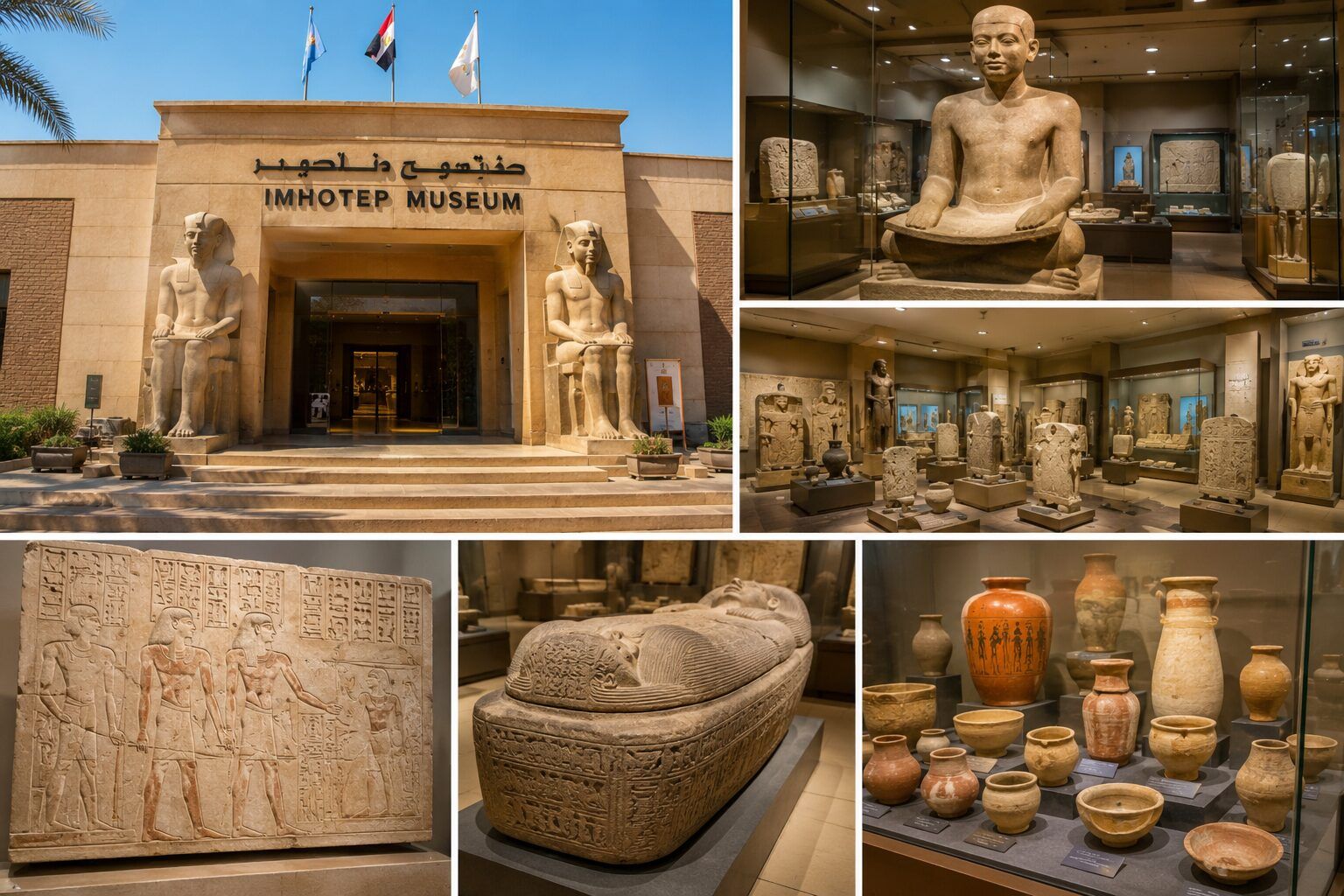
Opened in 2006, the museum houses artifacts recovered from the surrounding necropolis, including statues, coffins, reliefs, pottery, architectural fragments, mummies, and objects that reveal the daily life, religion, and artistic achievements of Ancient Egypt. The museum contains six main exhibition halls, each highlighting a different aspect of Saqqara’s rich history.
Whether you are visiting Saqqara for the first time or returning to explore its hidden treasures, the Imhotep Museum provides valuable historical context before you step into the pyramids, tombs, and temples outside.
Table 1: Imhotep Museum at a Glance
| Feature | Details |
|---|---|
| Official Name | Imhotep Museum |
| Location | Saqqara Necropolis, Giza Governorate |
| Opened | 2006 |
| Named After | Imhotep |
| Exhibition Halls | 6 |
| Collection | Artifacts from Saqqara excavations |
| Famous For | Old Kingdom discoveries and Djoser’s complex |
| UNESCO Site | Memphis and its Necropolis |
Who Was Imhotep?
Imhotep is one of the most celebrated figures in Ancient Egyptian history.
He served under Pharaoh Djoser during the Third Dynasty and is widely recognized as:
- Architect
- Engineer
- Physician
- High Priest
- Scholar
- Royal Adviser
His greatest achievement was designing the Step Pyramid of Djoser, the world’s first large-scale stone monument and the earliest pyramid ever built.
Over the centuries, Imhotep’s reputation grew so greatly that he was eventually worshipped as a deity associated with wisdom, medicine, and healing.
Table 2: Who Was Imhotep?
| Feature | Information |
|---|---|
| Profession | Architect, Engineer, Physician |
| Served Under | Pharaoh Djoser |
| Dynasty | Third Dynasty |
| Greatest Achievement | Step Pyramid of Djoser |
| Later Status | Deified as a god of wisdom and healing |
| Historical Legacy | One of Egypt’s greatest geniuses |
Why Was the Museum Built?
The Imhotep Museum was established to preserve and display archaeological discoveries made at Saqqara while honoring the remarkable legacy of Imhotep.
Before the museum opened, many important artifacts remained in archaeological storage or were transferred elsewhere. The museum now provides visitors with a dedicated space where discoveries from Saqqara can be appreciated close to where they were found. It was also designed to improve the visitor experience by introducing the history of the necropolis before exploring the monuments themselves.
Table 3: Purpose of the Museum
| Purpose | Description |
|---|---|
| Preserve Artifacts | Protect discoveries from Saqqara |
| Educate Visitors | Explain the history of the necropolis |
| Honor Imhotep | Celebrate Egypt’s greatest architect |
| Support Archaeology | Display excavation finds |
| Improve Visitor Experience | Introduce Saqqara before touring |
Opening of the Museum
The Imhotep Museum officially opened on 26 April 2006 as part of broader efforts to improve the management and presentation of the Saqqara archaeological site.
Since its inauguration, the museum has become an essential stop for travelers exploring the Step Pyramid complex and the surrounding monuments. It was designed as a modern, climate-controlled museum to ensure the long-term preservation of fragile archaeological objects recovered from Saqqara.
Table 4: Museum Timeline
| Year | Event |
|---|---|
| Ancient Egypt | Saqqara flourishes as a royal necropolis |
| 19th–20th Century | Major archaeological excavations |
| 2006 | Imhotep Museum officially opens |
| 2023 | Museum restoration and upgrades completed |
| Today | One of Saqqara’s top visitor attractions |
The Museum’s Collections
Although compact compared to larger museums, the Imhotep Museum contains an exceptional collection spanning thousands of years of Egyptian history.
Its galleries include:
- Stone statues
- Wooden coffins
- Mummies
- Funerary equipment
- Architectural fragments
- Pottery
- Jewelry
- Relief carvings
- Stone vessels
- Excavation discoveries
Many of these objects were uncovered during archaeological missions at Saqqara and are displayed close to their original archaeological context.
Table 5: Collection Highlights
| Collection | Description |
|---|---|
| Stone Statues | Old Kingdom sculptures |
| Coffins | Wooden and stone funerary coffins |
| Pottery | Daily-use and ceremonial vessels |
| Reliefs | Carved limestone panels |
| Architectural Elements | Pieces from temples and tombs |
| Mummies | Human and animal remains |
Why the Imhotep Museum Is Unique
Unlike large national museums that display artifacts from across Egypt, the Imhotep Museum focuses exclusively on Saqqara.
This allows visitors to understand how the monuments, tombs, and artifacts are connected.
The museum provides valuable background before visiting sites such as:
- Step Pyramid of Djoser
- Pyramid of Unas
- Serapeum of Saqqara
- Tomb of Ti
- Mastaba of Mereruka
Together, these monuments tell the complete story of the Old Kingdom.
Table 6: Why Visit the Museum First?
| Benefit | Why It Matters |
|---|---|
| Historical Context | Understand Saqqara before exploring |
| Original Artifacts | See discoveries from nearby monuments |
| Better Appreciation | Learn about architecture and religion |
| Climate-Controlled Galleries | Comfortable introduction to the site |
| Educational Displays | Easy-to-follow explanations |
UNESCO World Heritage Connection
The Imhotep Museum sits within the UNESCO World Heritage Site known as “Memphis and its Necropolis – the Pyramid Fields from Giza to Dahshur.”
Its collections help interpret one of the world’s most important archaeological landscapes, preserving artifacts that illustrate more than three thousand years of Egyptian civilization.
Table 7: UNESCO Facts
| Feature | Information |
|---|---|
| Heritage Site | Memphis and its Necropolis |
| UNESCO Listing | 1979 |
| Country | Egypt |
| Category | Cultural Heritage |
| Includes | Saqqara, Memphis, Dahshur & Giza |
Amazing Facts About the Imhotep Museum
- It is dedicated to Imhotep, the architect of the world’s first pyramid.
- The museum contains six permanent exhibition halls.
- Its collections come primarily from excavations at Saqqara.
- It includes a reconstructed burial chamber and galleries devoted to major archaeological discoveries.
- A special room honors French Egyptologist Jean-Philippe Lauer, who devoted decades to restoring Djoser’s Step Pyramid complex.
Table 8: Fast Facts
| Fact | Information |
|---|---|
| Opened | 2006 |
| Number of Galleries | 6 |
| Main Theme | Archaeology of Saqqara |
| Named After | Imhotep |
| Visit Duration | 45–60 minutes |
| Best Combined With | Step Pyramid of Djoser |
Why Every Visitor Should Explore the Imhotep Museum
The Imhotep Museum is more than a collection of ancient objects—it is the gateway to understanding Saqqara.
Before walking among pyramids, mastabas, and underground galleries, visitors can explore the people, beliefs, architecture, and discoveries that shaped one of the most influential archaeological sites in the world.
For history lovers, archaeology enthusiasts, and first-time travelers alike, the museum offers the perfect introduction to the remarkable legacy of Ancient Egypt.
Museum Galleries, Top Artifacts & Must-See Exhibits
Explore the Heart of Saqqara’s Archaeological Treasures
The Imhotep Museum offers visitors an extraordinary opportunity to see some of the most important discoveries ever made at the Saqqara Necropolis. Although smaller than the Grand Egyptian Museum, its carefully curated galleries provide a focused and immersive experience dedicated entirely to Saqqara.
The museum’s collection spans thousands of years of Egyptian history, from the Early Dynastic Period through the Old Kingdom and later eras. Each gallery tells part of the story of how Saqqara developed into one of the most important burial grounds in the ancient world.
Table 1: Museum Galleries at a Glance
| Gallery | Main Theme |
|---|---|
| Gallery 1 | History of Saqqara |
| Gallery 2 | Old Kingdom Statues |
| Gallery 3 | Funerary Artifacts |
| Gallery 4 | Daily Life Objects |
| Gallery 5 | Architectural Discoveries |
| Gallery 6 | Jean-Philippe Lauer Memorial Hall |
The Entrance Hall
The museum experience begins with a welcoming entrance hall introducing visitors to the history of Saqqara.
Highlights include:
- Information panels
- Maps of the necropolis
- Archaeological timelines
- Site models
- Historical photographs
These displays help visitors understand how Saqqara evolved over more than three millennia into Egypt’s largest ancient cemetery.
Table 2: Entrance Hall Highlights
| Exhibit | Description |
|---|---|
| Site Map | Layout of Saqqara |
| Timeline | Development of the necropolis |
| Information Panels | Historical overview |
| Scale Models | Major monuments |
Stone Statues
Among the museum’s finest exhibits are beautifully carved limestone and granite statues discovered throughout Saqqara.
These sculptures portray:
- Officials
- Priests
- Nobles
- Royal family members
- Deities
The statues reveal the remarkable artistic skills achieved by Ancient Egyptian sculptors and provide insight into clothing, hairstyles, jewelry, and religious symbolism.
Table 3: Statue Collection
| Artifact | Period |
|---|---|
| Limestone Statues | Old Kingdom |
| Granite Sculptures | Various Periods |
| Royal Figures | Old Kingdom |
| Priest Statues | Late Period |
Coffins and Funerary Objects
The museum displays an impressive collection of funerary equipment recovered from nearby tombs.
Visitors can admire:
- Wooden coffins
- Stone sarcophagi
- Canopic containers
- Funerary masks
- Offering vessels
- Burial equipment
These objects illustrate Ancient Egyptian beliefs about death, preservation, and eternal life.
Table 4: Funerary Collection
| Artifact | Purpose |
|---|---|
| Coffins | Protect the deceased |
| Sarcophagi | Stone burial containers |
| Canopic Equipment | Preservation of internal organs |
| Offering Vessels | Religious rituals |
| Funerary Masks | Protection in the afterlife |
Reliefs and Architectural Fragments
One of the museum’s greatest strengths is its collection of relief carvings recovered from tombs and temples across Saqqara.
These fragments depict:
- Religious ceremonies
- Agricultural scenes
- Offering processions
- Hieroglyphic inscriptions
- Royal officials
- Ancient craftsmen
Many originally decorated monuments such as the Mastaba of Mereruka, Tomb of Ti, and other elite tombs.
Table 5: Relief Themes
| Theme | Examples |
|---|---|
| Religion | Offerings and rituals |
| Agriculture | Harvesting |
| Daily Life | Craftsmen and workers |
| Hieroglyphs | Official inscriptions |
| Family | Banquets and celebrations |
Pottery and Everyday Objects
Not every artifact belonged to royalty.
The museum also preserves objects used in everyday Egyptian life, including:
- Pottery jars
- Bowls
- Oil lamps
- Storage vessels
- Stone tools
- Cosmetic containers
These objects provide valuable evidence about domestic life, trade, and craftsmanship.
Table 6: Daily Life Collection
| Object | Function |
|---|---|
| Pottery | Food storage |
| Bowls | Dining |
| Oil Lamps | Lighting |
| Stone Tools | Craftsmanship |
| Cosmetic Jars | Personal care |
Architectural Discoveries
Several galleries feature architectural fragments recovered during excavations.
These include:
- Limestone columns
- Decorative blocks
- Temple fragments
- Door lintels
- False doors
- Inscribed stone panels
These discoveries help archaeologists reconstruct monuments that have partially collapsed over time.
Table 7: Architectural Artifacts
| Artifact | Original Location |
|---|---|
| Columns | Temples |
| False Doors | Private tombs |
| Relief Blocks | Mastabas |
| Door Frames | Burial complexes |
| Inscribed Panels | Offering chapels |
Jean-Philippe Lauer Memorial Hall
One of the museum’s most meaningful galleries honors Jean-Philippe Lauer, the French architect and Egyptologist who dedicated much of his career to studying and restoring the Step Pyramid of Djoser.
His work transformed our understanding of Saqqara and contributed significantly to the preservation of the site.
The gallery displays:
- Personal photographs
- Field notes
- Excavation drawings
- Restoration plans
- Historical documents
This exhibition celebrates one of the pioneers of modern Egyptology.
Table 8: Lauer Memorial Hall
| Exhibit | Description |
|---|---|
| Photographs | Excavation history |
| Drawings | Restoration work |
| Field Notes | Archaeological research |
| Documents | Historical records |
Suggested Visitor Route
To make the most of your visit, follow a logical route through the museum before exploring the outdoor archaeological site.
Table 9: Recommended Museum Route
| Stop | Gallery |
|---|---|
| 1 | Entrance Hall |
| 2 | History of Saqqara |
| 3 | Statue Gallery |
| 4 | Funerary Collection |
| 5 | Relief Gallery |
| 6 | Architectural Discoveries |
| 7 | Jean-Philippe Lauer Hall |
Top Highlights You Shouldn’t Miss
If you’re short on time, these are the museum’s must-see exhibits:
- Statue of Imhotep
- Old Kingdom limestone statues
- Decorated relief fragments
- Stone architectural elements
- Funerary coffins
- Canopic equipment
- Daily-life pottery
- Jean-Philippe Lauer Memorial Hall
- Scale models of the Step Pyramid complex
- Artifacts recovered from Saqqara excavations
Table 10: Top 10 Museum Highlights
| Highlight | Why It’s Special |
|---|---|
| Statue of Imhotep | Honors Egypt’s greatest architect |
| Old Kingdom Statues | Exceptional craftsmanship |
| Relief Fragments | Ancient daily life and religion |
| Coffins | Funerary traditions |
| Pottery | Everyday life |
| Stone Vessels | Fine craftsmanship |
| Architectural Blocks | Monument reconstruction |
| Site Models | Understanding Saqqara |
| Lauer Memorial | History of modern archaeology |
| Excavation Finds | Direct connection to nearby monuments |
Why the Imhotep Museum Is a Must-Visit
The Imhotep Museum transforms a visit to Saqqara from simple sightseeing into a deeper historical experience. Its galleries provide the context needed to appreciate the pyramids, mastabas, temples, and tombs scattered across the necropolis.
By exploring the museum first, visitors gain a richer understanding of Ancient Egyptian architecture, religion, art, and archaeology—making every monument outside even more meaningful.
Archaeological Discoveries, Conservation & the Legacy of Saqqara
Preserving Thousands of Years of History
The Imhotep Museum is far more than a museum—it serves as the archaeological gateway to the Saqqara Necropolis, helping visitors understand one of the world’s oldest and most important archaeological landscapes.
Every artifact displayed inside the museum was once part of a temple, pyramid, mastaba, or burial complex discovered at Saqqara. Together, these discoveries reveal how Egyptian civilization evolved over thousands of years, from the Early Dynastic Period through the Ptolemaic Period.
For archaeologists, the museum represents decades of excavation, conservation, and research dedicated to preserving Egypt’s extraordinary cultural heritage.
Table 1: Why the Imhotep Museum Matters
| Feature | Importance |
|---|---|
| Archaeological Center | Preserves discoveries from Saqqara |
| Educational Museum | Explains Ancient Egyptian civilization |
| Conservation Hub | Protects fragile artifacts |
| Visitor Gateway | Introduces Saqqara before touring |
| UNESCO Connection | Supports interpretation of the World Heritage Site |
Archaeological Excavations at Saqqara
Saqqara has been continuously explored for more than 170 years.
Archaeological teams from Egypt and around the world continue to uncover remarkable discoveries beneath the desert sands.
Excavations have revealed:
- Royal pyramids
- Private mastabas
- Animal cemeteries
- Wooden coffins
- Painted sarcophagi
- Statues
- Mummies
- Burial shafts
- Temple complexes
- Ancient workshops
Many of these finds are now displayed inside the Imhotep Museum, where visitors can appreciate them in a secure and climate-controlled environment.
Table 2: Major Discoveries from Saqqara
| Discovery | Historical Importance |
|---|---|
| Step Pyramid Complex | World’s first large stone monument |
| Pyramid of Unas | Earliest Pyramid Texts |
| Serapeum | Burial place of the sacred Apis Bulls |
| Tomb of Ti | Daily life reliefs |
| Mastaba of Mereruka | Largest private tomb |
| Wooden Coffins | Exceptional preservation |
The Story Behind the Artifacts
Every object displayed in the museum tells a story.
Some artifacts were buried with kings, while others belonged to priests, officials, craftsmen, or ordinary Egyptians.
The collection illustrates many aspects of Ancient Egyptian life, including:
- Religion
- Architecture
- Medicine
- Agriculture
- Trade
- Art
- Engineering
- Daily life
Rather than displaying isolated treasures, the museum explains how each object fits into the broader history of Saqqara.
Table 3: Artifact Categories
| Category | Examples |
|---|---|
| Religion | Statues, offering tables |
| Burial Customs | Coffins and sarcophagi |
| Architecture | Stone blocks and columns |
| Daily Life | Pottery and tools |
| Administration | Hieroglyphic inscriptions |
| Art | Relief carvings and sculptures |
Conservation and Restoration
Many archaeological objects arrive at the museum after centuries underground.
Before they can be displayed, specialists carefully clean, stabilize, document, and preserve each artifact.
Conservation work includes:
- Removing dirt and salt deposits
- Stabilizing fragile limestone
- Repairing damaged pottery
- Monitoring humidity
- Protecting pigments
- Digital documentation
These efforts ensure that future generations can continue to study and admire these priceless treasures.
Table 4: Conservation Projects
| Project | Objective |
|---|---|
| Stone Cleaning | Preserve carved reliefs |
| Structural Repairs | Stabilize damaged objects |
| Climate Control | Protect sensitive materials |
| Digital Recording | Long-term documentation |
| Artifact Storage | Safe preservation |
Modern Archaeological Missions
Saqqara remains one of the world’s most active archaeological sites.
Egyptian and international teams continue to discover:
- New tombs
- Burial shafts
- Painted coffins
- Mummies
- Ancient temples
- Ritual objects
- Workshop areas
Many newly excavated artifacts are studied before selected pieces become part of museum exhibitions.
These ongoing discoveries continue to reshape our understanding of Ancient Egyptian civilization.
Table 5: Ongoing Archaeological Research
| Research Area | Purpose |
|---|---|
| Excavation | Discover new monuments |
| Surveying | Map archaeological remains |
| Documentation | Record discoveries |
| Conservation | Preserve artifacts |
| Publication | Share research findings |
Ancient Egyptian Engineering
Many museum exhibits highlight the remarkable engineering skills of Ancient Egypt.
Visitors learn how builders created:
- Massive limestone monuments
- Precision-cut stone blocks
- Monumental statues
- Decorative reliefs
- Complex underground tombs
- Sophisticated drainage and construction systems
The museum helps explain how these techniques were used in nearby monuments such as the Step Pyramid of Djoser and the Pyramid of Unas.
Table 6: Engineering Achievements
| Achievement | Significance |
|---|---|
| Stone Construction | Durable monuments |
| Relief Carving | Artistic excellence |
| Pyramid Design | Architectural innovation |
| Burial Chambers | Advanced planning |
| Masonry | Precision craftsmanship |
Museum Research and Documentation
The Imhotep Museum plays an important role in documenting archaeological discoveries.
Researchers use:
- High-resolution photography
- 3D laser scanning
- Digital databases
- Hieroglyphic translations
- Comparative analysis
- Scientific conservation reports
These technologies help preserve archaeological information even if fragile objects deteriorate over time.
Table 7: Research Techniques
| Technique | Purpose |
|---|---|
| Digital Photography | Record artifacts |
| 3D Scanning | Create accurate models |
| Translation | Interpret inscriptions |
| Scientific Analysis | Study materials |
| Digital Archives | Long-term preservation |
Myths vs. Historical Facts
Many popular myths surround Saqqara and its discoveries.
Modern archaeology provides evidence-based explanations.
Table 8: Myths vs. Facts
| Myth | Historical Fact |
|---|---|
| Every artifact belongs to a pharaoh | Many belonged to officials, priests, and private individuals |
| The museum only displays treasures | It also exhibits everyday objects that explain ancient society |
| Saqqara is fully excavated | Large areas remain unexplored |
| Archaeology is finished | New discoveries continue every year |
Why Historians Value the Imhotep Museum
The museum brings together discoveries from across Saqqara, allowing researchers and visitors to understand the relationship between monuments, tombs, and artifacts.
It provides valuable evidence about:
- Ancient Egyptian religion
- Architecture
- Government
- Art
- Engineering
- Burial customs
- Daily life
- Archaeological history
Its carefully curated displays make complex archaeological discoveries accessible to everyone.
Table 9: Educational Value
| Subject | What Visitors Learn |
|---|---|
| Religion | Burial beliefs and rituals |
| Architecture | Pyramid and tomb construction |
| Art | Sculpture and relief carving |
| Engineering | Building techniques |
| Society | Daily life in Ancient Egypt |
| Archaeology | Modern excavation methods |
Why the Imhotep Museum Is Essential Before Visiting Saqqara
Exploring the museum before entering the archaeological site helps visitors recognize the significance of the monuments they will encounter.
Understanding how artifacts relate to the Step Pyramid, the Serapeum, the Pyramid of Unas, the Tomb of Ti, and the Mastaba of Mereruka transforms a simple sightseeing trip into a deeper historical experience.
For this reason, many Egyptologists recommend beginning any Saqqara visit at the Imhotep Museum.
Table 10: Why Visit the Museum?
| Experience | Rating |
|---|---|
| Archaeology | ⭐⭐⭐⭐⭐ |
| Ancient Egyptian Art | ⭐⭐⭐⭐⭐ |
| Historical Context | ⭐⭐⭐⭐⭐ |
| Educational Value | ⭐⭐⭐⭐⭐ |
| Family Friendly | ⭐⭐⭐⭐☆ |
| Overall Experience | ⭐⭐⭐⭐⭐ |
The Legacy of the Imhotep Museum
The Imhotep Museum preserves far more than ancient artifacts—it preserves the story of one of the world’s greatest civilizations.
By protecting discoveries from the Saqqara Necropolis, supporting archaeological research, and helping visitors understand the remarkable achievements of Ancient Egypt, the museum plays a vital role in safeguarding this UNESCO World Heritage Site for future generations.
Whether you are an archaeology enthusiast, history lover, student, or first-time visitor, the Imhotep Museum provides the perfect foundation for exploring the extraordinary monuments of Saqqara.
Visitor Guide, Travel Tips, FAQs & Everything You Need to Know
Planning Your Visit to the Imhotep Museum
The Imhotep Museum is the perfect starting point for exploring the Saqqara Necropolis. Before visiting the Step Pyramid, ancient tombs, and underground galleries, the museum provides valuable insight into the history, architecture, and archaeological discoveries that shaped one of the world’s oldest royal cemeteries.
With its well-organized galleries, informative displays, and remarkable collection of artifacts excavated from Saqqara, the museum transforms your visit from simple sightseeing into a deeper understanding of Ancient Egyptian civilization.
Most visitors spend 45–60 minutes exploring the museum before continuing to the nearby monuments.
Table 1: Visitor Information
| Feature | Details |
|---|---|
| Location | Saqqara Necropolis, Giza Governorate |
| Museum Type | Archaeological Museum |
| Opened | 2006 |
| Average Visit Time | 45–60 minutes |
| Guided Tour | Highly Recommended |
| Family Friendly | Yes |
Best Time to Visit
The museum is open throughout the year, making it an excellent destination in every season.
Because most of the exhibits are indoors, it is especially enjoyable during the hotter summer months.
Best months:
- October
- November
- December
- January
- February
- March
- April
The ideal plan is to visit the museum first in the morning before exploring the outdoor monuments of Saqqara.
Table 2: Best Seasons
| Season | Weather | Recommendation |
|---|---|---|
| October–November | Pleasant | ⭐⭐⭐⭐⭐ |
| December–February | Cool | ⭐⭐⭐⭐⭐ |
| March–April | Warm | ⭐⭐⭐⭐☆ |
| May–September | Hot outdoors, comfortable indoors | ⭐⭐⭐⭐☆ |
Opening Hours
The Imhotep Museum generally follows the operating hours of the Saqqara archaeological site.
Opening times may occasionally change due to official holidays, archaeological missions, or conservation work.
Arriving early in the day offers a quieter experience and allows enough time to explore the nearby monuments afterward.
Table 3: Suggested Visiting Schedule
| Time | Activity |
|---|---|
| 8:00 AM | Arrive at Saqqara |
| 8:10 AM | Imhotep Museum |
| 9:15 AM | Step Pyramid of Djoser |
| 10:30 AM | Pyramid of Unas |
| 11:15 AM | Tomb of Ti |
| Afternoon | Serapeum & Mereruka |
How to Get There
The Imhotep Museum is located at the entrance to the Saqqara archaeological complex, approximately 30 kilometers (19 miles) south of downtown Cairo.
The easiest ways to reach the museum include:
- Private guided tour
- Private driver
- Taxi
- Ride-hailing services
Most private tours begin at the museum before continuing through the archaeological site.
Table 4: Transportation Options
| Option | Comfort | Best For |
|---|---|---|
| Private Tour | ⭐⭐⭐⭐⭐ | First-time visitors |
| Private Driver | ⭐⭐⭐⭐⭐ | Flexible itineraries |
| Taxi | ⭐⭐⭐⭐☆ | Independent travelers |
| Ride-Hailing App | ⭐⭐⭐⭐☆ | Budget-conscious visitors |
Nearby Attractions
The museum is surrounded by many of Egypt’s most famous archaeological sites.
Popular nearby attractions include:
- Step Pyramid of Djoser
- Pyramid of Unas
- Serapeum of Saqqara
- Tomb of Ti
- Mastaba of Mereruka
- Saqqara Necropolis
- Memphis Open-Air Museum
- Bent Pyramid
- Red Pyramid
These attractions can easily be combined into a full-day historical tour.
Table 5: Nearby Attractions
| Attraction | Approximate Distance | Suggested Visit |
|---|---|---|
| Step Pyramid of Djoser | Short walk | 60–90 min |
| Pyramid of Unas | Nearby | 30–45 min |
| Tomb of Ti | Nearby | 30–45 min |
| Mastaba of Mereruka | Nearby | 45–60 min |
| Serapeum | Nearby | 45–60 min |
| Memphis Museum | About 6 km | 45–60 min |
| Bent Pyramid | About 10 km | 45 min |
| Red Pyramid | About 10 km | 45 min |
Photography Tips
The museum offers excellent opportunities to photograph remarkable artifacts and beautifully displayed collections.
For the best experience:
- Photograph the galleries without blocking other visitors.
- Avoid using flash where prohibited.
- Capture wide gallery views before focusing on individual artifacts.
- Photograph information panels to help remember the exhibits.
- Always follow the museum’s latest photography regulations.
Table 6: Best Photography Opportunities
| Location | Best Subject |
|---|---|
| Entrance Hall | Museum architecture |
| Statue Gallery | Old Kingdom sculptures |
| Relief Gallery | Limestone carvings |
| Pottery Collection | Daily life artifacts |
| Lauer Memorial Hall | Historic excavation displays |
Frequently Asked Questions
Why is the Imhotep Museum famous?
It is dedicated to Imhotep, the architect of the Step Pyramid of Djoser, and displays many of the most important archaeological discoveries from Saqqara.
How long should I spend in the museum?
Most visitors spend 45–60 minutes, although archaeology enthusiasts may wish to stay longer.
Should I visit the museum before exploring Saqqara?
Yes. The museum provides valuable historical context that enhances your understanding of the surrounding monuments.
Is the museum suitable for children?
Yes. Interactive displays, statues, and artifacts make it an enjoyable educational experience for families.
Is a guide recommended?
Absolutely. A licensed Egyptologist guide can explain the significance of the artifacts and connect them with the monuments you’ll visit afterward.
Table 7: Quick Answers
| Question | Answer |
|---|---|
| Worth Visiting? | ⭐ Absolutely |
| Guided Tour | Highly Recommended |
| Average Visit | 45–60 minutes |
| Photography | Excellent (subject to regulations) |
| Family Friendly | Yes |
Visitor Checklist
Before visiting the museum, remember to bring:
- Comfortable walking shoes
- Camera or smartphone
- Portable charger
- Water bottle
- Hat (for the outdoor monuments afterward)
- Sunglasses
- Sunscreen
- Small backpack
Table 8: Packing Checklist
| Item | Bring? |
|---|---|
| Comfortable Shoes | ✅ |
| Camera | ✅ |
| Portable Charger | ✅ |
| Water Bottle | ✅ |
| Hat | ✅ |
| Sunglasses | ✅ |
| Sunscreen | ✅ |
| Backpack | ✅ |
Suggested One-Day Itinerary
The Imhotep Museum is the perfect first stop before exploring Saqqara’s archaeological wonders.
Table 9: Suggested Itinerary
| Time | Activity |
|---|---|
| 8:00 AM | Arrive at the Imhotep Museum |
| 9:00 AM | Step Pyramid of Djoser |
| 10:15 AM | Mastaba of Mereruka |
| 11:00 AM | Tomb of Ti |
| 11:45 AM | Pyramid of Unas |
| 12:30 PM | Serapeum of Saqqara |
| 1:30 PM | Lunch |
| 3:00 PM | Memphis Open-Air Museum |
| 4:30 PM | Bent & Red Pyramids at Dahshur |
Table 10: Why Visit the Imhotep Museum?
| Experience | Rating |
|---|---|
| Archaeological Collections | ⭐⭐⭐⭐⭐ |
| Educational Value | ⭐⭐⭐⭐⭐ |
| Ancient Egyptian Art | ⭐⭐⭐⭐⭐ |
| Historical Context | ⭐⭐⭐⭐⭐ |
| Family Experience | ⭐⭐⭐⭐☆ |
| Overall Experience | ⭐⭐⭐⭐⭐ |
Final Thoughts
The Imhotep Museum is the ideal introduction to the remarkable world of Saqqara. Its carefully curated galleries, outstanding archaeological collections, and informative exhibits provide visitors with the knowledge needed to fully appreciate the pyramids, tombs, temples, and monuments that await outside.
Whether you’re visiting Egypt for the first time or returning to deepen your understanding of the Old Kingdom, the Imhotep Museum offers an inspiring and educational experience that perfectly complements a journey through the Saqqara Necropolis.
Discover the Imhotep Museum with Let’s Explore Egypt
Begin your journey through Saqqara at the Imhotep Museum, where the story of Ancient Egypt comes to life through extraordinary artifacts, statues, reliefs, coffins, and archaeological discoveries from one of the world’s oldest royal necropolises.
Named after Imhotep, the brilliant architect of the Step Pyramid of Djoser, the museum offers the perfect introduction to the monuments you’ll explore throughout Saqqara. With a licensed Egyptologist guide from Let’s Explore Egypt, every gallery becomes a fascinating chapter in the history of one of the world’s greatest civilizations.
Why Book with Let’s Explore Egypt?
- 🏛️ Licensed Egyptian Tour Operator
- 👨🏫 Professional English-Speaking Egyptologist Guides
- 🚗 Private Air-Conditioned Transportation
- 🏺 Visit the Imhotep Museum Before Exploring Saqqara
- 🔺 Explore the Step Pyramid of Djoser
- 📜 Discover the Pyramid of Unas and the World’s Oldest Pyramid Texts
- 🐂 Visit the Serapeum of Saqqara
- 🏛️ Explore the Tomb of Ti
- 🏺 Discover the Mastaba of Mereruka
- 📸 Plenty of Time for Photography
- 🌅 Flexible Departure Times
- 👨👩👧 100% Private & Tailor-Made Tours
- 💬 24/7 WhatsApp Support
- ⭐ Trusted by Travelers from Around the World
- 💳 Transparent Pricing – No Hidden Fees
Complete Your Saqqara Experience
Combine your visit to the Imhotep Museum with the most iconic attractions in Saqqara:
- 🔺 Step Pyramid of Djoser
- 🏛️ Saqqara Necropolis
- 📜 Pyramid of Unas
- 🐂 Serapeum of Saqqara
- 🏺 Tomb of Ti
- 🏛️ Mastaba of Mereruka
- 🌴 Memphis Open-Air Museum
- 🔺 Bent Pyramid
- 🔺 Red Pyramid
Our expertly designed private tours provide a complete Old Kingdom experience, allowing you to explore Egypt’s earliest pyramids, magnificent tombs, fascinating museums, and extraordinary archaeological discoveries—all in one unforgettable day.
Book Your Private Imhotep Museum & Saqqara Tour Today
Discover the genius of Imhotep, admire priceless artifacts recovered from centuries of archaeological excavations, and gain a deeper understanding of Ancient Egypt before walking among the pyramids and tombs of Saqqara.
Whether you’re passionate about archaeology, history, photography, or simply want to experience Egypt beyond the famous Giza Pyramids, Let’s Explore Egypt will create a personalized private tour tailored to your interests.
📞 Contact Let’s Explore Egypt
📱 WhatsApp: +20 120 323 3365
📧 Email: info@lets-explore-egypt.com
Why Travelers Choose Let’s Explore Egypt
✅ 100% Private & Personalized Tours
✅ Licensed Egyptologist Guides
✅ Comfortable Air-Conditioned Vehicles
✅ Flexible Pickup from Cairo, Giza & Cairo Airport
✅ Family-Friendly Experiences
✅ Easy WhatsApp Booking
✅ Excellent Reviews from International Travelers
✅ Safe, Reliable & Hassle-Free Service
Let’s Explore Egypt – Start Your Saqqara Adventure at the Imhotep Museum and Discover the Origins of Ancient Egyptian Architecture.
Contact us today for a free personalized itinerary and explore the Imhotep Museum, the Step Pyramid of Djoser, the Serapeum of Saqqara, the Pyramid of Unas, the Tomb of Ti, the Mastaba of Mereruka, Memphis, and Dahshur with Egypt’s trusted local experts.
Recommended Egypt Tours
Why You Can Trust Let's Explore Egypt
This article was written and reviewed by the Let's Explore Egypt Editorial Team, a licensed Egyptian tour operator specializing in private Egypt tours, Nile cruises, and tailor-made travel experiences since 2009.
- 🏛 Licensed Egyptian Tour Operator Since 2009
- ⭐ Trusted by Thousands of Travelers Worldwide
- 👨🏫 Written & Reviewed by Local Egypt Travel Experts
- 🚐 Private Tours & Tailor-Made Travel Experiences
- 📞 24/7 Customer Support