


Planning a trip to Cairo can feel overwhelming.
Egypt’s capital is enormous, busy, historic, and packed with attractions. The famous Giza Pyramids alone can take several hours to explore properly, while museums, mosques, historic markets, churches, restaurants, and Nile River experiences are spread across different parts of the city.
The good news is that three days in Cairo is enough to experience the city’s major highlights while still leaving time to enjoy Egyptian food, local neighborhoods, and the atmosphere of the Nile.
The key is planning your days geographically and avoiding an itinerary that sends you back and forth across Cairo.
This 3-day Cairo itinerary is designed for first-time visitors who want a balanced introduction to ancient Egypt, Islamic Cairo, Coptic Cairo, museums, local culture, shopping, food, and the Nile.
It works well for couples, families, solo travelers, and private groups.
You will visit the iconic Giza Pyramids and Great Sphinx, explore the Grand Egyptian Museum, discover Saqqara and Memphis, walk through Islamic and Coptic Cairo, visit the Citadel, shop at Khan el-Khalili, and experience the Nile.
You will also have time for traditional Egyptian meals and a relaxing evening.
The itinerary can be adjusted depending on your arrival time, hotel location, interests, and physical ability.
Why Spend Three Days in Cairo?
Cairo is sometimes treated as a one-day stop before travelers move on to Luxor or Hurghada.
That is a mistake.
One day can cover the highlights, but three days allow you to understand the city rather than simply photograph it.
With three days, you can divide the experience into three themes:
Day 1: Giza Pyramids and the Grand Egyptian Museum
Day 2: Saqqara, Memphis, Dahshur, and ancient Egypt beyond Giza
Day 3: Islamic Cairo, Coptic Cairo, Khan el-Khalili, and the Nile
This structure minimizes unnecessary travel and gives you a better balance between major attractions and cultural experiences.
Before You Start: Practical Cairo Planning Tips
Before going through the daily itinerary, there are a few things worth knowing.
Start Early
Early mornings are usually the most comfortable time for outdoor sightseeing, especially when visiting the Giza Plateau or Saqqara.
Starting early also gives you more flexibility later in the day.
Expect Traffic
Cairo is enormous, and traffic can be unpredictable.
A journey that looks short on a map can take much longer than expected.
That is why a geographically organized itinerary is important.
Wear Comfortable Shoes
You will walk more than you may expect.
The pyramids, historic Cairo, museums, and markets all involve walking.
Comfortable shoes are essential.
Carry Water
Keep water with you throughout the day, particularly during warmer months.
Bring Sun Protection
For outdoor sightseeing, pack:
- Sunscreen
- Sunglasses
- Hat
- Comfortable light clothing
Dress Respectfully
Cairo is a modern international city, but many religious sites require modest clothing.
Women may want to carry a light scarf for visits to certain religious locations.
Men should also dress appropriately when entering mosques.
Don’t Overpack Each Day
Three days sounds like plenty, but Cairo can be exhausting.
It is better to enjoy a few attractions properly than rush through ten locations.
Day 1: Giza Pyramids, Sphinx and Grand Egyptian Museum
Your first day is all about ancient Egypt.
This is the day most travelers look forward to, and it should be planned carefully because the Giza Plateau and museum can easily fill most of the day.
Morning: Visit the Giza Pyramids
Begin your day with the Giza Pyramids.
The plateau contains three major pyramids:
- Great Pyramid of Khufu
- Pyramid of Khafre
- Pyramid of Menkaure
The Great Pyramid is the largest and most famous.
It was built for Pharaoh Khufu and is the only surviving wonder of the ancient Seven Wonders of the World.
Seeing the pyramids in person is different from seeing them in photographs.
Their size is difficult to understand until you are standing next to them.
Allow enough time to walk between viewpoints, take photographs, and listen to your guide explain the history of the complex.
The Great Pyramid of Khufu
The Great Pyramid is the centrepiece of the Giza Plateau.
The exterior alone is impressive, but visitors interested in archaeology can also consider entering the pyramid with the required ticket.
The internal passages can be narrow and physically demanding.
If you dislike enclosed spaces or steep climbs, there is no need to enter.
The exterior experience is already extraordinary.
The Pyramid of Khafre
The Pyramid of Khafre is the second-largest pyramid.
It often appears taller than Khufu’s pyramid because it sits on higher ground.
Look carefully near the summit and you may notice surviving smooth limestone casing.
The Pyramid of Menkaure
Menkaure’s pyramid is the smallest of the three major pyramids.
It is located toward the southern part of the plateau and is often less crowded than the Great Pyramid.
Don’t rush past it.
The relationship between the three pyramids helps visitors understand how the Giza complex was planned.
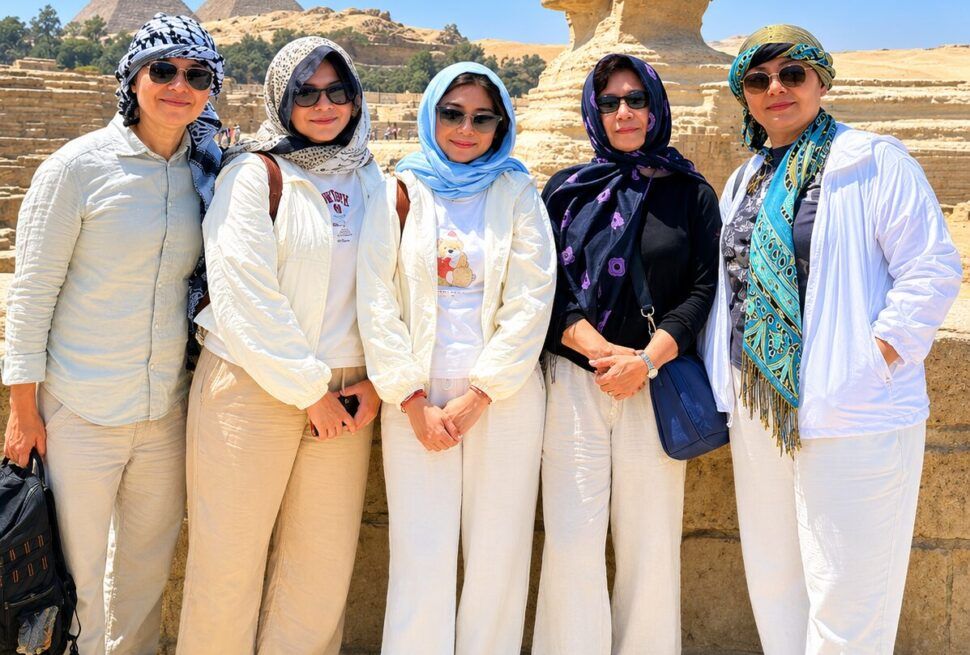
Visit the Great Sphinx
After exploring the pyramids, continue to the Great Sphinx.
The Sphinx is one of Egypt’s most recognizable monuments.
It has the body of a lion and the head of a human and is traditionally associated with royal power.
The monument is carved from limestone bedrock and sits near the temple complex associated with Khafre’s pyramid.
Take time to see the Sphinx from the designated viewing areas.
This is also one of the best locations for classic photographs.
A guide can explain the different theories about the monument, its symbolism, and its relationship to the surrounding complex.
Explore the Valley Temple
The Valley Temple is an important part of the Giza complex and is often overlooked by travelers focused only on the pyramids.
The temple was used as part of the funerary complex associated with Khafre.
Its massive stone construction gives visitors a better understanding of the engineering methods used by ancient Egyptians.
Look carefully at the enormous stone blocks and interior spaces.
It is an excellent place to appreciate the complexity of the pyramid complexes beyond the pyramids themselves.
Camel Ride at Giza: Optional Experience
A camel ride can be added to your Giza experience if you want something more adventurous.
It can also provide different photography angles.
However, treat it as an optional activity.
You do not need a camel ride to enjoy the pyramids.
If you decide to ride, confirm the price, duration, and route before starting and choose a reputable operator.
Midday: Have an Egyptian Lunch
After several hours at Giza, stop for lunch.
A good Egyptian lunch may include:
- Koshari
- Grilled chicken
- Kofta
- Kebab
- Salads
- Tahini
- Egyptian bread
- Rice
- Hawawshi
For your first day, this is a good opportunity to try a classic Egyptian meal rather than eating international food.
If you are staying near the pyramids, a pyramid-view restaurant can also be an enjoyable option.
Afternoon: Grand Egyptian Museum
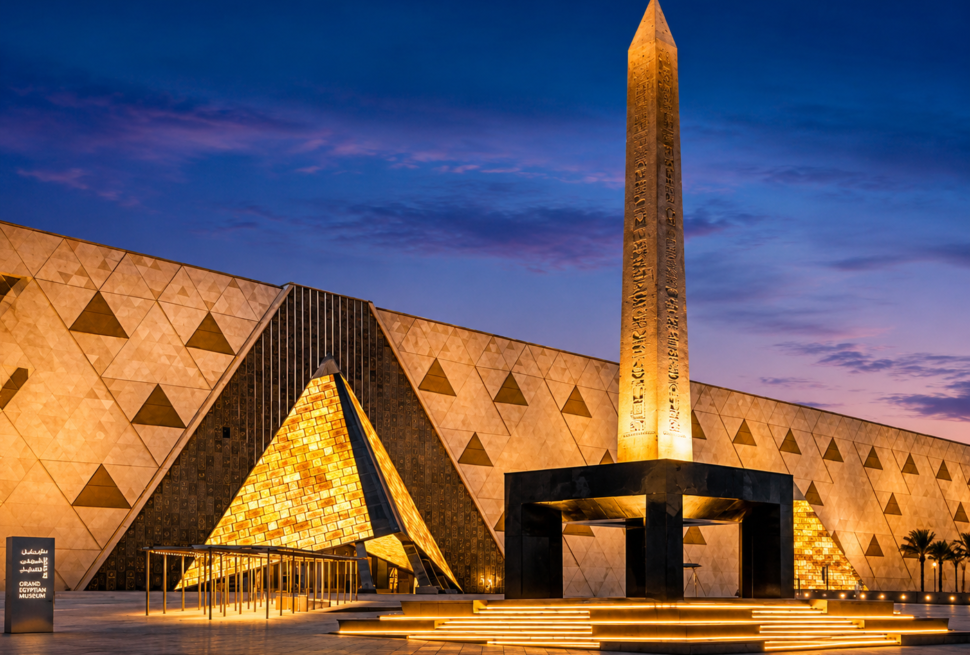
After lunch, continue to the Grand Egyptian Museum.
The museum is located near the Giza Plateau and makes a natural combination with a pyramid tour.
This is where the first day becomes more than simply a visit to the pyramids.
The museum gives you access to archaeological objects and historical context that help explain the civilization behind the monuments.
Allow several hours.
Do not make the mistake of trying to see the museum in one rushed hour.
What to See at the Grand Egyptian Museum
The Grand Egyptian Museum contains major spaces designed to present ancient Egyptian collections in a modern environment.
Depending on current ticket access and museum operations, visitors may experience areas such as:
- Grand Hall
- Grand Stairs
- Main Galleries
- Tutankhamun Galleries
- Gardens
- Commercial areas
One of the major attractions for many visitors is the collection connected with Tutankhamun.
The story of Tutankhamun is one of the most famous stories in Egyptian archaeology.
Seeing the objects associated with his reign within a broader collection helps put them into historical context.
How Long Should You Spend at GEM?
Plan several hours.
History lovers may want even longer.
If museums are not your main interest, you can still enjoy the major galleries and highlights without trying to read every display.
A private guide can be particularly helpful because you can focus on the pieces most relevant to your interests.
Evening: Sunset Felucca Ride on the Nile
After the pyramids and museum, your first day should end with something relaxing.
A sunset felucca ride on the Nile is an excellent choice.
The contrast is perfect.
You have spent the day surrounded by ancient monuments and museums.
Now you are on the water, watching modern Cairo move around you.
As the sun sets, the skyline changes and the city’s lights begin to appear.
A private felucca is ideal for couples and families who want a quieter experience.
Dinner: Traditional Egyptian Food
After the Nile ride, have dinner at a local restaurant.
Try another traditional Egyptian dish rather than repeating lunch.
Good options include:
- Molokhia
- Hawawshi
- Grilled kofta
- Fatta
- Chicken
- Egyptian rice
- Kunafa
- Om Ali
Don’t skip dessert.
Egyptian sweets are an important part of the country’s food culture.
Day 1 at a Glance
Morning
Giza Pyramids
Great Pyramid
Khafre Pyramid
Menkaure Pyramid
Great Sphinx
Valley Temple
Afternoon
Lunch
Grand Egyptian Museum
Evening
Sunset felucca
Egyptian dinner
Approximate sightseeing time: 9–11 hours
This is a busy day, but it is the right kind of busy because all the main attractions are concentrated around Giza.
Day 2: Saqqara, Memphis and Dahshur
Day two goes deeper into ancient Egypt.
Instead of focusing on the most famous monuments, you will explore the evolution of Egyptian pyramid architecture and the ancient capital of Memphis.
This day is ideal for history lovers.
It also provides a useful contrast to Giza because the archaeological sites are generally more spread out and less visually concentrated.
Morning: Saqqara
Start your second day with Saqqara.
Saqqara was one of ancient Egypt’s most important burial grounds and contains monuments from multiple periods.
The most famous is the Step Pyramid of Djoser.
The Step Pyramid of Djoser
The Step Pyramid represents one of the most important stages in the development of pyramid architecture.
The structure was built for Pharaoh Djoser and is traditionally associated with the architect Imhotep.
Rather than being a smooth-sided pyramid like those later built at Giza, it consists of stepped levels.
It is an extraordinary example of architectural experimentation.
When you visit, think about the progression:
Early burial structures
→ mastabas
→ stepped pyramid
→ true smooth-sided pyramid
→ giant pyramids of Giza
This sequence helps explain how Egyptian architecture developed over time.
Explore the Saqqara Necropolis
Saqqara is much larger than the Step Pyramid alone.
Depending on the current access and itinerary, you may also explore tombs, temples, causeways, and other archaeological areas.
This is one of the places where a professional Egyptologist makes a significant difference.
Without context, individual ruins may look like stones.
With context, they become parts of a story.
See Ancient Egyptian Tombs
Some tombs around Saqqara contain detailed reliefs and inscriptions.
These scenes can show farming, hunting, food preparation, music, religious rituals, and everyday life.
This is one reason Saqqara can be more informative than simply visiting the pyramids.
The pyramids tell you about royal burial architecture.
The tombs can tell you about people and daily life.
Midday: Travel to Memphis
After Saqqara, continue to Memphis.
Memphis was one of ancient Egypt’s most important cities and played a major role in the development of the Egyptian state.
Although the modern archaeological site is smaller than the original city, the remaining statues and monuments provide a glimpse into its importance.
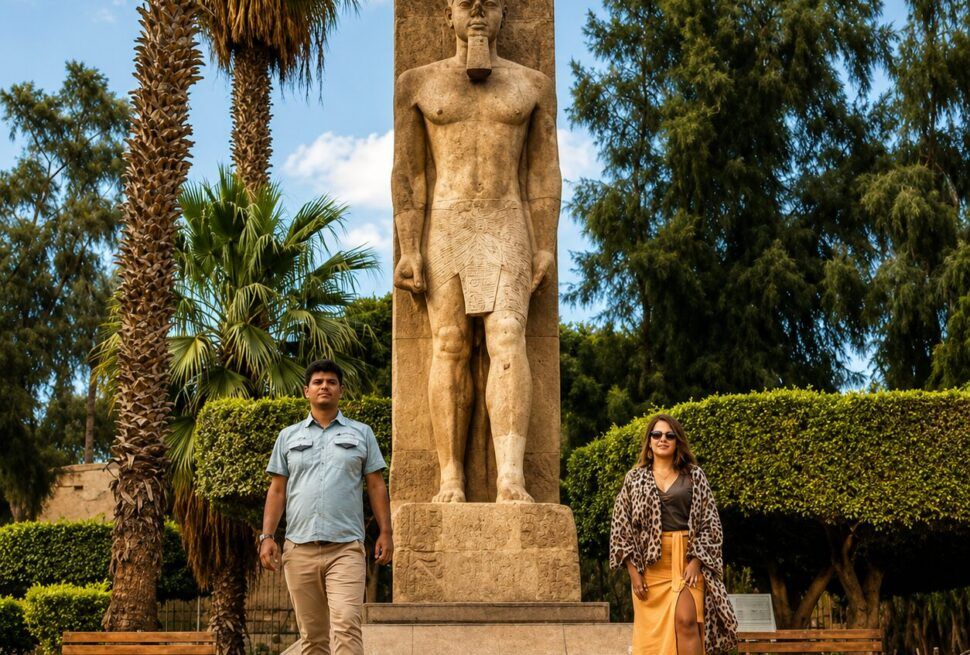
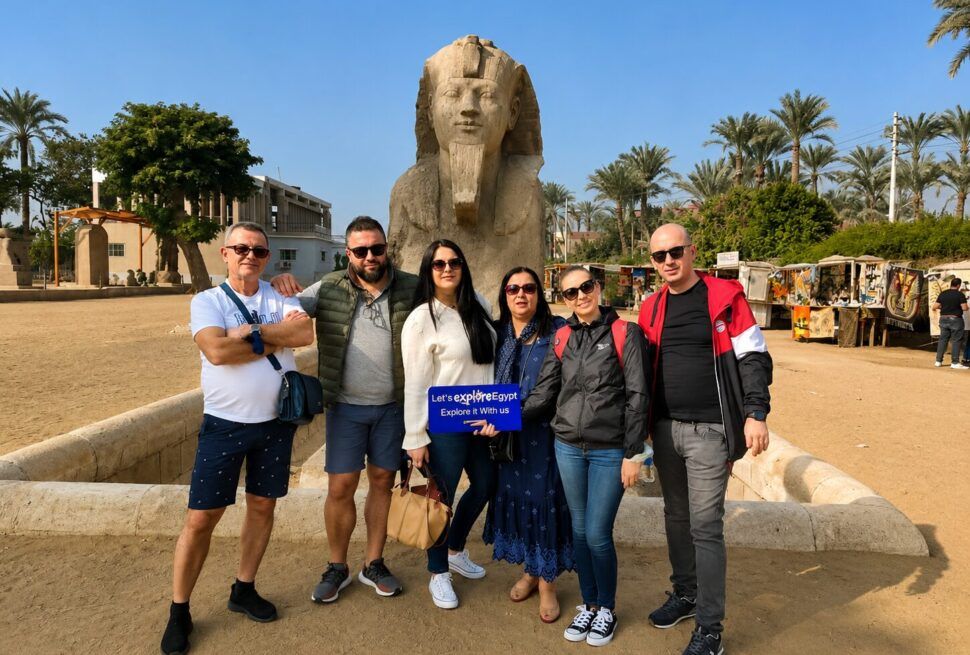
See the Colossal Statue of Ramesses II
One of the most memorable objects at Memphis is the enormous reclining statue associated with Ramesses II.
The craftsmanship and scale are impressive.
Stand beside the statue and consider how much larger the ancient city would have been when Memphis was functioning as a major political and cultural center.
Why Memphis Matters
Visitors sometimes wonder why they should visit Memphis when Giza already has pyramids.
The answer is context.
Memphis helps explain the civilization surrounding the monuments.
It was not only about tombs.
Ancient Egypt had cities, administration, religion, trade, agriculture, art, and political institutions.
Exploring Memphis brings that wider world into your itinerary.
Lunch: Egyptian Village or Local Restaurant
By midday, you will probably be hungry.
Choose a traditional Egyptian lunch.
You could try:
- Grilled chicken
- Kofta
- Koshari
- Molokhia
- Hawawshi
- Rice
- Fresh salads
- Tahini
This is also a good day to try fresh Egyptian bread.
Afternoon: Dahshur
After lunch, continue to Dahshur.
The area is famous for two major pyramids:
- Bent Pyramid
- Red Pyramid
This is where ancient Egyptian pyramid engineering becomes particularly interesting.
Visit the Bent Pyramid
The Bent Pyramid is named after its unusual shape.
The angle of the pyramid changes partway up the monument.
This is believed to reflect an important stage of experimentation in pyramid construction.
For visitors interested in architecture, it is one of the most fascinating pyramids in Egypt.
Visit the Red Pyramid
The Red Pyramid is one of the earliest successful examples of a true smooth-sided pyramid.
It is associated with Pharaoh Sneferu.
The Red Pyramid is especially interesting because of its place in the development that eventually led to the Great Pyramid.
Visitors who are physically comfortable can enter the pyramid through a narrow passage.
The climb can be challenging, so consider your fitness level and comfort before entering.
Why Dahshur Is Worth Visiting
One of the biggest advantages of Dahshur is atmosphere.
Giza is famous, spectacular, and busy.
Dahshur is often quieter.
That allows you to appreciate the landscape without constantly moving through large crowds.
For travelers who want a more peaceful archaeological experience, this can be one of the highlights of their Egypt trip.
Return to Cairo
After Dahshur, return to Cairo.
You will probably want a relaxed evening after a long archaeological day.
You can either have dinner near your hotel or explore a nearby restaurant.
Avoid booking another major attraction unless you still have plenty of energy.
Travel is supposed to be enjoyable, not a race.
Evening Option: Cairo Rooftop Dinner
A rooftop restaurant is a great way to end your second day.
You can enjoy the city lights while resting after hours of archaeological exploration.
Depending on the location, you may have views of the Nile, Downtown Cairo, or parts of the historic city.
Day 2 at a Glance
Morning
Saqqara
Step Pyramid of Djoser
Tombs
Midday
Memphis
Lunch
Afternoon
Dahshur
Bent Pyramid
Red Pyramid
Evening
Return to Cairo
Rooftop dinner
Approximate sightseeing time: 8–10 hours
Day 3: Islamic Cairo, Coptic Cairo, Khan el-Khalili and the Nile
Your third day moves away from ancient pyramids and into Cairo’s historic neighborhoods.
This is where you experience the city as a living cultural capital.
The day combines Islamic architecture, Christian heritage, museums, markets, food, and the Nile.
Morning: Visit the Citadel of Saladin
Start your day at the Citadel of Saladin.
The Citadel was built as a major defensive complex and became one of the most important centers of political power in Cairo.
Today, it is one of the city’s most recognizable historic landmarks.
The elevated location also provides broad views across Cairo.
Take time to look beyond the monument.
The enormous modern city surrounding the Citadel gives you a sense of just how large Cairo has become.
Visit the Mosque of Muhammad Ali
The Mosque of Muhammad Ali is located within the Citadel complex.
Its large dome, smaller domes, and minarets create one of the most iconic Cairo skylines.
The mosque is strongly influenced by Ottoman architectural traditions.
Inside, the scale is impressive.
Take time to appreciate the lighting, decorative details, columns, and central dome.
Dress respectfully.
Remove your shoes when required and follow the rules of the site.
Continue to Islamic Cairo
After the Citadel, continue into historic Islamic Cairo.
This area contains centuries of architecture.
You can see:
- Mosques
- Madrasas
- Historic houses
- Gates
- Markets
- Traditional workshops
Unlike the Giza Plateau, this is a living urban environment.
People still live and work in these historic streets.
That makes the experience particularly interesting.
Walk Along Al-Muizz Street
Al-Muizz Street is one of the highlights of Islamic Cairo.
The street contains an extraordinary concentration of historic buildings.
Walk slowly.
Look at the doors, windows, stone carvings, domes, minarets, and wooden screens.
This is not an attraction you should rush through.
Allow time for photographs.
A guide can explain who built each monument, why it was important, and how the neighborhood developed.
Lunch in Historic Cairo
This is a good day to have lunch in or near the historic district.
Try a traditional Egyptian meal.
Possible dishes include:
Koshari
Taameya
Hawawshi
Molokhia
Grilled meats
Fatta
Fresh bread
Egyptian desserts
Eating local food is an important part of understanding Cairo.
Explore Coptic Cairo
After lunch, continue to Old Cairo.
Coptic Cairo contains churches, monasteries, museums, and religious sites connected to Egypt’s Christian heritage.
It provides a fascinating contrast to Islamic Cairo.
Visit the Hanging Church
The Hanging Church is one of the best-known Christian landmarks in Cairo.
It is associated with the historic Coptic district and is known for its architecture and long religious history.
Take your time inside and notice the details of the interior.
Visit the Coptic Museum
The Coptic Museum contains objects that help explain the history and culture of Egypt’s Christian communities.
You can see religious art, manuscripts, textiles, and other historical objects.
A museum visit can provide context for the churches and monuments you see around the neighborhood.
See the Ben Ezra Synagogue
The Ben Ezra Synagogue provides another perspective on Cairo’s religious history.
Its presence alongside Christian and Islamic monuments highlights the long history of religious communities living in Egypt.
Old Cairo is therefore much more than a collection of tourist attractions.
It represents different chapters of Egyptian history existing within the same landscape.
Visit the National Museum of Egyptian Civilization
The National Museum of Egyptian Civilization is an excellent addition to the afternoon.
Unlike the Grand Egyptian Museum, which focuses heavily on ancient Egyptian archaeological collections, this museum presents Egyptian civilization across a much broader historical timeline.
One of its most famous attractions is the Royal Mummies collection.
Seeing the mummies of ancient rulers after visiting the pyramids can create a powerful connection between the monuments and the people who ruled Egypt.
Late Afternoon: Khan el-Khalili
As the afternoon moves toward evening, head to Khan el-Khalili.
This is one of Cairo’s most famous traditional markets.
The narrow streets are filled with:
- Souvenir shops
- Jewelry
- Lamps
- Spices
- Perfumes
- Clothing
- Crafts
- Cafés
- Restaurants
Take your time.
Do not feel pressured to buy something.
The experience is about atmosphere as much as shopping.
Shopping Tips at Khan el-Khalili
If you plan to shop, remember a few basic rules.
Compare prices.
Ask whether the price is fixed.
Negotiate politely when bargaining is appropriate.
Check the product before paying.
Agree on the final price before the transaction.
Do not buy something simply because a seller insists that it is a rare or ancient object.
For souvenirs, common handmade items are usually the easiest choice.
Tea at El-Fishawy Café
After shopping, sit down for tea or coffee.
El-Fishawy Café is a famous traditional café in the area.
Order Egyptian tea with mint, coffee, or another drink.
Spend some time watching the activity around you.
This is a perfect transition from sightseeing to evening.
Evening: Explore Cairo at Night
By now, Cairo will have changed.
The streets become busier as residents go out to eat and socialize.
Historic buildings become illuminated.
The Nile begins to reflect the lights of the city.
This is the perfect time for an evening experience.
Option 1: Sunset or Evening Felucca
Take a felucca on the Nile.
For many visitors, this is the most relaxing activity of the entire Cairo trip.
After three days of walking and sightseeing, sitting on the river gives you a chance to slow down.
Option 2: Nile Dinner Cruise
If you prefer a more structured evening, book a Nile dinner cruise.
Dinner, entertainment, and city views are combined into one activity.
This can be especially enjoyable for couples and families.
Option 3: Rooftop Dinner
Alternatively, finish your trip with a rooftop dinner.
Choose a restaurant with city or Nile views.
Order a traditional meal.
Enjoy dessert.
Reflect on everything you have seen over the last three days.
Your Complete 3-Day Cairo Itinerary
Here is the full itinerary in simple form.
Day 1: Ancient Cairo
Giza Pyramids
Great Pyramid
Khafre Pyramid
Menkaure Pyramid
Great Sphinx
Valley Temple
Lunch
Grand Egyptian Museum
Sunset felucca
Egyptian dinner
Day 2: Beyond Giza
Saqqara
Step Pyramid
Tombs
Memphis
Lunch
Dahshur
Bent Pyramid
Red Pyramid
Rooftop dinner
Day 3: Historic Cairo
Citadel
Mosque of Muhammad Ali
Islamic Cairo
Al-Muizz Street
Lunch
Coptic Cairo
Hanging Church
Coptic Museum
National Museum of Egyptian Civilization
Khan el-Khalili
El-Fishawy Café
Felucca or Nile dinner cruise
Where Should You Stay in Cairo for a 3-Day Trip?
Choosing the right neighborhood can make a major difference.
Giza
Best for travelers who prioritize:
- Pyramids
- Grand Egyptian Museum
- Pyramid views
- Quiet mornings near the archaeological area
Giza can be an excellent choice for first-time visitors who want the pyramids close by.
Downtown Cairo
Best for:
- Museums
- Central location
- Restaurants
- Historic architecture
- Easy access to many neighborhoods
Zamalek
Best for:
- Restaurants
- Cafés
- Modern atmosphere
- Nile views
- Nightlife
There is no single perfect area.
Choose based on your priorities.
Cairo 3-Day Itinerary for Couples
Couples can make the same itinerary more romantic by changing a few details.
Day 1
Giza Pyramids
Professional photography
Grand Egyptian Museum
Private sunset felucca
Romantic dinner
Day 2
Saqqara
Memphis
Dahshur
Sunset rooftop dinner
Day 3
Citadel
Islamic Cairo
Khan el-Khalili
Traditional café
Private Nile dinner cruise
This keeps the main historical attractions while adding privacy and memorable evening experiences.
Cairo 3-Day Itinerary for Families
Families should avoid overloading each day.
Day 1
Pyramids
Sphinx
Lunch
Grand Egyptian Museum
Early dinner
Day 2
Saqqara
Memphis
Lunch
Dahshur
Return to hotel
Day 3
Citadel
Coptic Cairo
Khan el-Khalili
Felucca ride
Family dinner
Allow extra breaks.
Children may enjoy the monuments more if the schedule does not feel like a race.
Cairo 3-Day Itinerary for History Lovers
History enthusiasts may want to spend more time at the museums and archaeological sites.
Day 1
Giza
Sphinx
Grand Egyptian Museum
Day 2
Saqqara
Memphis
Dahshur
Day 3
National Museum of Egyptian Civilization
Citadel
Islamic Cairo
Coptic Cairo
Khan el-Khalili
This creates a broad chronological journey through Egyptian history.
Cairo 3-Day Itinerary on a Budget
You do not need a luxury budget to enjoy Cairo.
Choose simple accommodation.
Use local restaurants.
Focus on the major attractions.
Use a mixture of public transportation and reputable ride-hailing services where appropriate.
Prioritize experiences that provide high value.
For example, walking through Islamic Cairo costs far less than a luxury dinner cruise while still providing a memorable experience.
A local breakfast of ful and taameya can also be inexpensive and delicious.
Cairo 3-Day Itinerary for Luxury Travelers
Luxury travelers can keep the same core structure while improving comfort.
Consider:
- Private airport transfers
- Private driver
- Private Egyptologist
- Premium hotel
- Pyramid-view room
- Private felucca
- Fine dining
- Professional photographer
- Private Nile dinner cruise
The biggest benefit is convenience.
You spend less time organizing transportation and more time enjoying the destinations.
How to Make This Cairo Itinerary More Flexible
The itinerary above is a framework, not a strict schedule.
You may want to change it based on your interests.
If You Love Museums
Spend more time at GEM and the National Museum of Egyptian Civilization.
If You Love Food
Add a food tour and spend more time exploring local restaurants.
If You Love Photography
Add sunset and rooftop stops.
If You Love Architecture
Spend more time in Islamic Cairo.
If You Have Children
Reduce museum time and add felucca rides and dessert stops.
If You Hate Crowds
Start earlier and spend more time at Saqqara and Dahshur.
What Not to Do During Three Days in Cairo
One of the biggest mistakes travelers make is trying to see everything.
Do not attempt to visit Giza, Saqqara, Alexandria, the Egyptian Museum, Old Cairo, and the Citadel all in one day.
You will spend most of the day in traffic.
Do not assume every attraction takes the same amount of time.
Do not ignore the weather.
Do not plan outdoor activities during the hottest hours if you can avoid it.
Do not skip meals because you are trying to save time.
And do not make every minute of your itinerary fixed.
Leave some flexibility.
Should You Book a Private Tour for Three Days in Cairo?
For many first-time visitors, a private tour can significantly improve the experience.
Cairo is geographically large.
Traffic can be unpredictable.
The historical sites have complicated stories.
A private guide allows you to ask questions, change the pace, spend more time at favorite attractions, and avoid wasting time.
A private driver also makes it easier to combine sites that would otherwise be difficult to reach efficiently.
For couples and families, the flexibility can be particularly valuable.
Should You Visit Alexandria During These Three Days?
Generally, no.
If you only have three days in Cairo, keep the itinerary focused on Cairo and nearby archaeological sites.
Alexandria deserves a full-day trip because the journey from Cairo takes a significant amount of time.
If your Egypt trip is longer, add Alexandria as a separate day.
Should You Visit Luxor From Cairo?
Not as a day trip unless you have a very specific reason.
Luxor contains an enormous concentration of ancient Egyptian monuments and deserves more time.
If you have a longer Egypt itinerary, spend separate days in Luxor instead of trying to squeeze it into your Cairo trip.
How Much Money Should You Budget?
Your budget depends heavily on the type of trip you want.
The largest variables include:
- Hotel category
- Private guide
- Private driver
- Restaurant level
- Entrance tickets
- Boat experiences
- Shopping
- Optional activities
A budget traveler can keep costs relatively low using local restaurants and simple accommodation.
A luxury traveler can create a highly personalized experience with private transfers and premium dining.
Rather than focusing on a single daily number, plan the categories that matter most to you.
What to Pack for Three Days in Cairo
For a three-day Cairo trip, pack:
- Comfortable walking shoes
- Lightweight clothing
- Modest clothing for religious sites
- Hat
- Sunglasses
- Sunscreen
- Reusable water bottle
- Small day bag
- Phone charger
- Power bank
- Camera
- Light jacket for cooler evenings
If you plan to enter pyramids, consider wearing clothes that allow comfortable movement.
Best Time of Year for This Itinerary
The cooler months are often the most comfortable for long outdoor sightseeing days.
However, Cairo can be visited year-round.
During summer, start earlier.
Use indoor attractions during the hottest part of the day where possible.
In winter, bring a light layer for mornings and evenings.
What Should You Eat During Three Days in Cairo?
Try to sample different dishes each day.
Day 1
Koshari
Grilled meat
Egyptian dessert
Day 2
Molokhia
Hawawshi
Kunafa
Day 3
Ful
Taameya
Fatta or grilled dishes
Om Ali
The goal is not to eat at expensive restaurants every day.
Some of the best Egyptian food is served in simple local establishments.
Is Cairo Safe for Tourists?
Millions of travelers visit Egypt each year.
As with any major metropolitan destination, visitors should use normal precautions.
Keep valuables secure.
Be careful in crowded places.
Use reputable transportation.
Agree on prices before accepting optional services.
Follow local regulations at archaeological and religious sites.
For travelers who are unfamiliar with Cairo, having a professional guide and organized transportation can make the experience more comfortable.
Best Photo Opportunities During Your 3 Days
Some of the strongest photography locations include:
Day 1
Giza Pyramids
Sphinx
Grand Egyptian Museum architecture
Sunset on the Nile
Day 2
Step Pyramid
Memphis statues
Bent Pyramid
Red Pyramid
Day 3
Citadel skyline
Mosque of Muhammad Ali
Islamic Cairo
Khan el-Khalili
Nile at night
If photography is a priority, consider scheduling sunrise or sunset around the most important monuments.
A More Relaxed 3-Day Cairo Itinerary
Not everyone wants a packed schedule.
If you prefer a slower trip, consider this variation.
Day 1
Giza Pyramids
Long lunch
Grand Egyptian Museum
Hotel rest
Dinner
Day 2
Saqqara
Memphis
Lunch
Dahshur
Hotel rest
Rooftop dinner
Day 3
Citadel
Islamic Cairo
Lunch
Coptic Cairo
Khan el-Khalili
Felucca
This version includes more rest periods.
A More Intensive 3-Day Cairo Itinerary
Travelers who want to maximize sightseeing can add:
Day 1
Giza
Sphinx
Grand Egyptian Museum
Cairo Tower
Day 2
Saqqara
Memphis
Dahshur
Egyptian Museum
Day 3
Citadel
Sultan Hassan
Islamic Cairo
Coptic Cairo
National Museum of Egyptian Civilization
Khan el-Khalili
This is much more tiring and requires efficient private transportation.
Common Questions About a 3-Day Cairo Trip
Is three days enough for Cairo?
Yes.
Three days is an excellent amount of time for a first visit because you can see the major attractions without spending the entire trip in transit.
Can I see the pyramids and museum in one day?
Yes.
They are a natural combination, but give both enough time.
Is Saqqara worth visiting?
Absolutely.
If you are interested in ancient Egyptian history, Saqqara helps explain the development of pyramid architecture.
Is Dahshur worth visiting?
Yes, particularly for travelers interested in pyramids and engineering.
It is also generally less crowded than Giza.
Should I book a guide?
For historical sites, a professional Egyptologist can add significant value.
Can I do Cairo without a car?
Yes, but private transportation is more convenient for a three-day sightseeing itinerary because Cairo is so large and traffic can be unpredictable.
Is Khan el-Khalili worth visiting?
Yes.
It is one of the city’s most atmospheric historic areas and an excellent place for shopping, cafés, food, and photography.
Is a Nile felucca worth it?
For most visitors, yes.
It provides a peaceful break from sightseeing and gives you a different perspective on Cairo.
Final Checklist for Your Cairo 3-Day Trip
Before you leave for Cairo, make sure you have planned:
Day 1
Giza tickets
Museum visit
Lunch
Felucca
Dinner
Day 2
Saqqara
Memphis
Dahshur
Lunch
Evening rest
Day 3
Citadel
Islamic Cairo
Coptic Cairo
Khan el-Khalili
Nile experience
Also remember:
Comfortable shoes
Water
Sunscreen
Camera
Respectful clothing
Flexible schedule
Final Thoughts: Is Three Days in Cairo Enough?
Three days in Cairo can be the perfect introduction to Egypt.
You will not see everything.
But you do not need to.
The purpose of a three-day itinerary is to experience the most important chapters of the city while leaving enough time to enjoy the atmosphere.
Day one introduces you to the monumental world of the pharaohs.
You stand in front of the Great Pyramid.
You see the Sphinx.
You explore the Grand Egyptian Museum.
Then you watch the sunset from the Nile.
Day two takes you deeper into ancient Egypt.
At Saqqara, you see the Step Pyramid and discover an archaeological landscape that is very different from Giza.
At Memphis, you learn about an ancient capital.
At Dahshur, you see the Bent Pyramid and Red Pyramid and learn more about the evolution of pyramid construction.
Day three introduces you to the living city.
You explore the Citadel.
You see the Mosque of Muhammad Ali.
You walk through Islamic Cairo.
You visit Coptic Cairo.
You explore Khan el-Khalili.
You drink tea in a traditional café.
Then you finish beside the Nile.
That is a much richer experience than simply checking the pyramids off your list.
Cairo is a city of layers.
Ancient Egypt is only one of them.
The Islamic period created another.
Coptic history adds another.
Modern Egyptian culture adds another.
The food, markets, cafés, art, music, and daily life continue to add new layers.
The best three-day itinerary is therefore one that balances sightseeing with experience.
See the famous monuments.
But also eat local food.
Walk historic streets.
Sit in a café.
Take a boat.
Watch the sunset.
Talk to your guide.
Leave some room for unexpected discoveries.
Cairo can be chaotic, but with a sensible plan, the city becomes much easier to explore.
And once you understand how the attractions fit together geographically, three days can accomplish a remarkable amount.
For travelers visiting Egypt for the first time, this itinerary provides a strong foundation.
After Cairo, you can continue to Luxor to explore the Valley of the Kings and the temples of ancient Thebes, travel to Aswan for the Nile and Nubian culture, or head to Hurghada and the Red Sea for beaches and diving.
But Cairo deserves to be more than the place where your Egyptian vacation starts.
Give it time.
Experience it.
Explore beyond the pyramids.
Because once you move beyond the obvious attractions, Cairo becomes an even more fascinating destination.
Plan Your Cairo Trip With Let’s Explore Egypt Travel
Organizing three full days in Cairo can be challenging when you have to coordinate transportation, entrance tickets, guides, restaurants, and different parts of this huge city.
Let’s Explore Egypt Travel offers private Cairo and Giza tours, customized three-day itineraries, private Egyptologist guides, private drivers, Nile felucca rides, airport transfers, Grand Egyptian Museum visits, Saqqara and Memphis tours, Islamic Cairo experiences, Coptic Cairo tours, and customized Egypt packages.
A private itinerary allows you to change the pace according to your interests.
You can spend longer at the pyramids, add photography stops, choose a specific restaurant, take a private felucca, or reduce the number of attractions if you prefer a relaxed experience.
Whether you are traveling as a couple, family, solo traveler, or private group, the goal is simple: make your three days in Cairo comfortable, organized, and memorable.
Explore Cairo beyond the pyramids and experience the real Egyptian capital.
Get in Touch
Planning your Cairo adventure? Let’s Explore Egypt Travel is here to help you create a private and unforgettable Egypt experience.
Whether you need a Cairo night tour, Nile felucca ride, dinner cruise, Giza Pyramids tour, airport transfer, or a customized Egypt itinerary, our local team is ready to assist.
📧 Email: info@lets-explore-egypt.com
📱 WhatsApp: +20 120 323 3365
🌍 Private Tours & Transfers Across Egypt
🏛️ Licensed Egyptian Tourism Company
📅 24/7 Booking Assistance
Contact us today and let’s plan your perfect Cairo experience.
Recommended Egypt Tours
Why You Can Trust Let's Explore Egypt
This article was written and reviewed by the Let's Explore Egypt Editorial Team, a licensed Egyptian tour operator specializing in private Egypt tours, Nile cruises, and tailor-made travel experiences since 2009.
- 🏛 Licensed Egyptian Tour Operator Since 2009
- ⭐ Trusted by Thousands of Travelers Worldwide
- 👨🏫 Written & Reviewed by Local Egypt Travel Experts
- 🚐 Private Tours & Tailor-Made Travel Experiences
- 📞 24/7 Customer Support