

Welcome to the Khufu Solar Boat
Hidden beneath the desert sands beside the Great Pyramid of Giza for more than 4,500 years, the Khufu Solar Boat is one of the greatest archaeological discoveries ever made in Egypt.
Unlike ordinary ancient boats, this extraordinary vessel was never intended for transporting people across the Nile. Instead, it was built for a far more sacred purpose—to accompany Pharaoh Khufu on his eternal journey with the sun god Ra through the heavens.
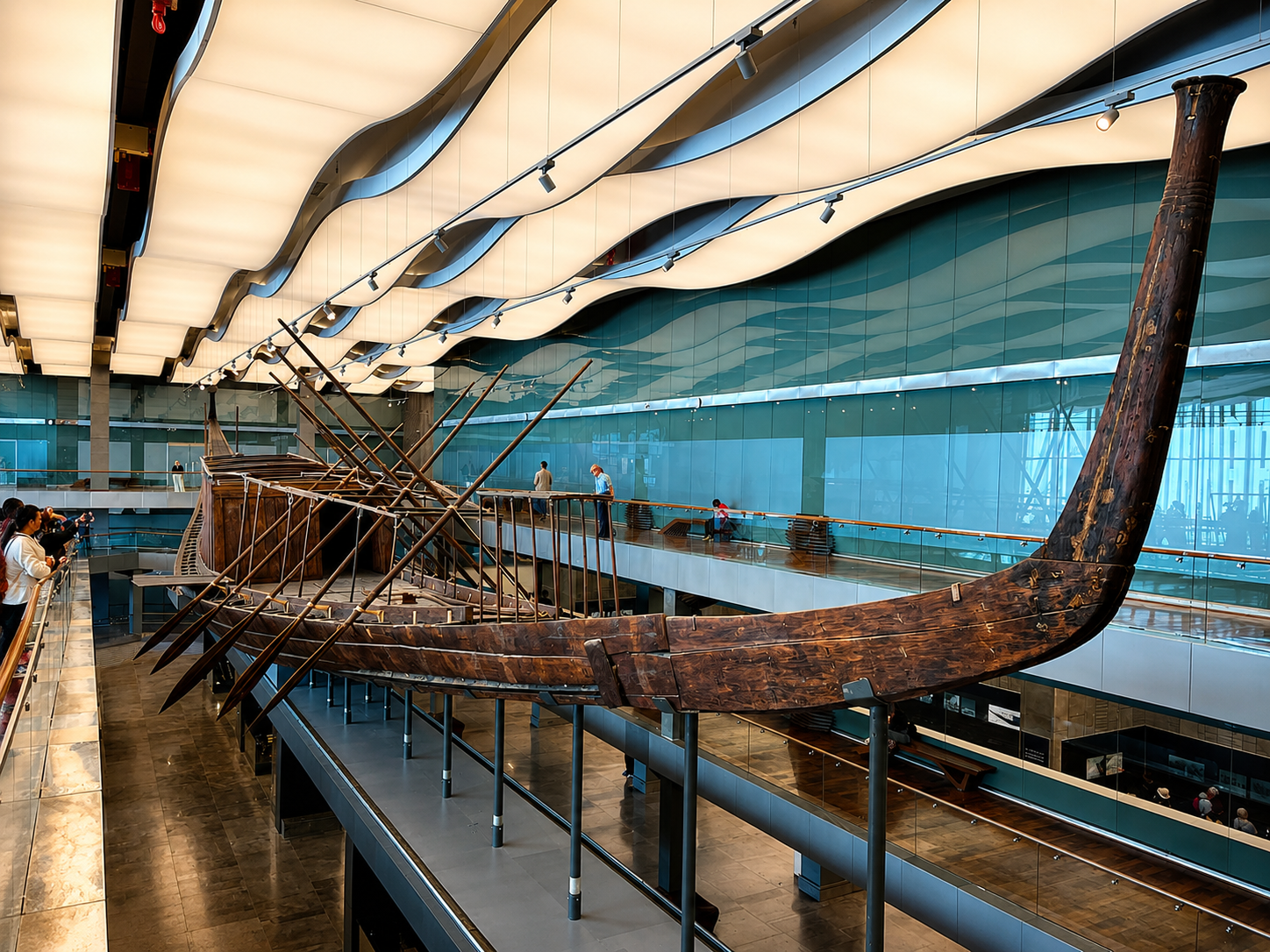
Today, the reconstructed boat stands as one of the finest surviving examples of ancient Egyptian engineering, woodworking, and religious belief. Measuring over 43 meters (142 feet) in length, it is the oldest intact royal ship ever discovered and provides an incredible glimpse into the craftsmanship of the Fourth Dynasty.
For anyone fascinated by the Pyramids of Giza, the Khufu Solar Boat tells an essential part of the story behind Egypt’s greatest monument.
Table 1: Khufu Solar Boat at a Glance
| Feature | Details |
|---|---|
| Official Name | Khufu Solar Boat |
| Also Known As | Solar Boat of Khufu, Khufu Ship |
| Builder | Ancient Egyptian craftsmen during Khufu’s reign |
| Date | Around 2580–2560 BCE |
| Length | Approximately 43.6 m (143 ft) |
| Material | Lebanese cedar wood |
| Discovery | 1954 |
| Current Location | Grand Egyptian Museum (GEM) |
| UNESCO Site | Giza Necropolis |
Who Was Pharaoh Khufu?
The Khufu Solar Boat was created for Pharaoh Khufu, the second king of Egypt’s Fourth Dynasty and the builder of the Great Pyramid of Giza.
Khufu ruled during one of Ancient Egypt’s most prosperous periods. His reign was marked by ambitious construction projects, advanced engineering, and centralized royal power.
Although little survives about his personal life, his architectural legacy transformed human history.
The Great Pyramid remained the tallest structure on Earth for nearly 3,800 years, and the Solar Boat demonstrates that Khufu’s achievements extended far beyond pyramid construction.
Table 2: Pharaoh Khufu
| Fact | Information |
|---|---|
| Royal Name | Khufu |
| Greek Name | Cheops |
| Dynasty | Fourth Dynasty |
| Reign | Approximately 2589–2566 BCE |
| Father | Sneferu |
| Famous Monument | Great Pyramid of Giza |
| Royal Complex | Giza Plateau |
What Is the Khufu Solar Boat?
The Khufu Solar Boat is a full-sized wooden vessel discovered in a sealed pit beside the Great Pyramid.
Unlike modern ships, it was carefully dismantled before burial.
Archaeologists recovered more than 1,200 individual wooden pieces, which were painstakingly reconstructed over many years to recreate the original vessel.
The boat features:
- Elegant curved hull
- Large steering oars
- Cabin structure
- Rope-bound wooden planks
- Exceptional craftsmanship
Its remarkable preservation allows historians to study ancient Egyptian shipbuilding in extraordinary detail.
Table 3: Boat Specifications
| Feature | Details |
|---|---|
| Length | Approximately 43.6 m |
| Width | Approximately 5.9 m |
| Estimated Weight | Around 20 tons |
| Number of Wooden Pieces | More than 1,200 |
| Main Material | Lebanese cedar |
| Construction Method | Rope-lashed wooden planks |
The Discovery of 1954
One of the greatest moments in Egyptian archaeology occurred in 1954, when archaeologist Kamal el-Mallakh discovered a sealed limestone pit on the southern side of the Great Pyramid.
Inside lay thousands of carefully arranged cedar wood pieces.
Remarkably, the pit had remained sealed since the time of Khufu.
As the stones were removed, archaeologists detected the unmistakable scent of ancient cedar wood that had been trapped underground for over four millennia.
The discovery immediately became one of the most important archaeological finds of the twentieth century.
Table 4: Discovery Timeline
| Year | Event |
|---|---|
| c. 2580 BCE | Boat buried beside the Great Pyramid |
| 1954 | Boat pit discovered by Kamal el-Mallakh |
| 1954–1982 | Reconstruction of the boat |
| 1982 | Boat displayed in its dedicated museum |
| 2021 | Boat transferred to the Grand Egyptian Museum |
The Boat Pits
The Khufu Solar Boat was discovered in one of two large boat pits located along the southern side of the Great Pyramid.
Each pit was carefully cut into the limestone bedrock and sealed with enormous stone blocks.
The first pit contained the reconstructed boat.
The second pit remained sealed for decades and has been the subject of archaeological investigation and conservation.
The existence of multiple boat pits highlights the importance of ritual boats in Ancient Egyptian royal beliefs.
Table 5: The Boat Pits
| Feature | Details |
|---|---|
| Number of Pits | Two |
| Location | South side of the Great Pyramid |
| Construction | Limestone bedrock |
| Covering | Massive limestone blocks |
| Purpose | Burial of royal ceremonial boats |
Why Was the Boat Buried?
This question has fascinated archaeologists for decades.
The most widely accepted explanation is that the boat was intended for the pharaoh’s symbolic journey with Ra, the ancient Egyptian sun god.
According to Egyptian beliefs:
- Ra sailed across the sky every day.
- During the night, he traveled through the underworld.
- The king joined Ra after death.
- The boat carried the king into eternal life.
Some scholars have also suggested the vessel may have been used during Khufu’s funeral before being dismantled and buried beside his pyramid.
Whether symbolic, ceremonial, or both, the Solar Boat reflects the profound spiritual beliefs of Ancient Egypt.
Table 6: Theories About the Boat
| Theory | Explanation |
|---|---|
| Solar Boat | Carried Khufu with the sun god Ra |
| Funeral Boat | Used during the king’s burial ceremony |
| Sacred Symbol | Represented rebirth and eternity |
| Ceremonial Vessel | Built for important royal rituals |
Religious Importance
To Ancient Egyptians, boats represented far more than transportation.
They symbolized:
- Eternal life
- Resurrection
- The journey to the afterlife
- Divine kingship
- The cycle of the sun
The Khufu Solar Boat embodied all these beliefs, making it one of the most sacred objects associated with the Great Pyramid.
Its burial beside the pyramid reinforced the idea that the king would continue his divine journey forever.
Table 7: Religious Symbolism
| Symbol | Meaning |
|---|---|
| Boat | Eternal journey |
| Sun | Rebirth |
| Ra | Supreme solar deity |
| Nile | Source of life |
| East | Sunrise and creation |
| West | Death and the afterlife |
Why the Discovery Was So Important
The Khufu Solar Boat changed historians’ understanding of Ancient Egypt.
Before its discovery, scholars knew relatively little about large royal ships from the Old Kingdom.
The boat revealed:
- Advanced woodworking techniques.
- Sophisticated engineering.
- Precision craftsmanship.
- Religious traditions.
- Long-distance timber trade with Lebanon.
It also demonstrated that Ancient Egyptian shipbuilders possessed skills far beyond what many historians had previously imagined.
Table 8: Historical Importance
| Discovery | Why It Matters |
|---|---|
| Complete Royal Boat | Extremely rare survival |
| Cedar Construction | Evidence of international trade |
| Rope Joinery | Innovative engineering |
| Boat Pit | Exceptional preservation |
| Royal Rituals | Insight into funerary beliefs |
Amazing Facts About the Khufu Solar Boat
The Khufu Solar Boat continues to amaze visitors and researchers alike.
Some fascinating facts include:
- It is the oldest intact royal ship ever discovered.
- More than 1,200 wooden components were reassembled.
- The boat contains no metal nails.
- Much of the original cedar wood has survived for over 4,500 years.
- It was moved in 2021 to the Grand Egyptian Museum using a specially designed transport system.
Table 9: Fast Facts
| Fact | Information |
|---|---|
| Age | Over 4,500 years |
| Discovery | 1954 |
| Current Display | Grand Egyptian Museum |
| Original Location | Beside the Great Pyramid |
| Material | Lebanese cedar |
| Construction | Rope-lashed planks |
| Historical Significance | One of Egypt’s greatest archaeological discoveries |
Why You Should Learn About the Khufu Solar Boat
While the Great Pyramid dominates the Giza skyline, the Khufu Solar Boat offers a more personal glimpse into the beliefs and craftsmanship of Ancient Egypt.
It connects engineering with religion, architecture with symbolism, and history with archaeology.
For anyone exploring the Giza Plateau, understanding the story of the Solar Boat completes the remarkable legacy of Pharaoh Khufu and reveals how Ancient Egyptians prepared their kings for eternity.
Construction, Engineering & Ancient Egyptian Shipbuilding
One of the Greatest Engineering Achievements of the Ancient World
The Khufu Solar Boat is far more than an archaeological treasure—it is a masterpiece of ancient engineering. More than 4,500 years ago, Egyptian craftsmen built a vessel over 43.6 meters (143 feet) long using sophisticated woodworking techniques that continue to impress modern engineers.
Unlike modern ships assembled with metal fasteners, the Solar Boat relied on precision-cut timber, rope lashings, wooden pegs, and exceptional craftsmanship. The result was a strong, flexible vessel capable of surviving thousands of years buried beneath the desert beside the Great Pyramid of Giza.
Today, engineers and archaeologists regard the Khufu Solar Boat as one of the finest examples of ancient shipbuilding ever discovered.
Table 1: Boat Specifications
| Feature | Details |
|---|---|
| Length | Approximately 43.6 m (143 ft) |
| Width | Approximately 5.9 m (19.4 ft) |
| Estimated Weight | Around 20 tons |
| Wooden Pieces | More than 1,200 |
| Main Material | Lebanese cedar |
| Estimated Age | More than 4,500 years |
Why Lebanese Cedar?
One of the most remarkable aspects of the Khufu Solar Boat is the choice of timber.
Instead of relying solely on local Egyptian woods, builders imported high-quality Lebanese cedar, a prized material known for its:
- Strength
- Durability
- Resistance to insects
- Pleasant aroma
- Long straight trunks
- Ease of carving
The importation of cedar demonstrates the extensive trade networks maintained by Ancient Egypt during the Fourth Dynasty.
The timber likely arrived by sea to the Nile Delta before being transported south to Giza.
Table 2: Construction Materials
| Material | Origin | Purpose |
|---|---|---|
| Lebanese Cedar | Lebanon | Hull and structural framework |
| Acacia Wood | Egypt | Smaller components |
| Sycamore Fig | Egypt | Interior fittings |
| Plant Fiber Rope | Egypt | Lashings and assembly |
| Wooden Pegs | Egypt | Structural reinforcement |
Ancient Egyptian Shipbuilders
The craftsmen who built the Solar Boat were among the most skilled engineers of the Old Kingdom.
Their work required expertise in:
- Measuring
- Carving
- Joinery
- Wood selection
- Structural design
- Rope making
Without modern machinery, they produced components that fit together with astonishing precision.
Each piece was individually shaped before final assembly.
Table 3: Skills Required
| Skill | Purpose |
|---|---|
| Woodworking | Shaping timber |
| Joinery | Connecting components |
| Rope Making | Flexible assembly |
| Measurement | Precise fitting |
| Engineering | Structural stability |
A Boat Built Without Metal Nails
Perhaps the most surprising feature of the Khufu Solar Boat is that it contains virtually no metal nails.
Instead, the builders used:
- Wooden pegs
- Mortise-and-tenon joints
- Rope lashings
- Precision-cut grooves
These techniques allowed the boat to flex naturally while maintaining exceptional strength.
Modern engineers admire this design because flexibility reduces structural stress during movement on water.
Table 4: Ancient Joinery Techniques
| Technique | Purpose |
|---|---|
| Mortise-and-Tenon Joints | Lock planks together |
| Wooden Pegs | Reinforce connections |
| Rope Lashings | Flexible structural support |
| Precision Grooves | Secure timber alignment |
Rope-Lashed Construction
Instead of permanently fixing the hull with nails, Egyptian craftsmen threaded ropes through carefully carved channels inside the wooden planks.
This method created a flexible yet remarkably durable structure.
Advantages included:
- Shock absorption
- Reduced cracking
- Easier repairs
- Greater flexibility on water
This construction technique was centuries ahead of many other civilizations.
Table 5: Advantages of Rope Construction
| Benefit | Explanation |
|---|---|
| Flexibility | Reduced stress on the hull |
| Durability | Better long-term preservation |
| Easy Maintenance | Components could be replaced |
| Lightweight | Improved handling |
Hull Design
The Solar Boat features an elegant curved hull designed for ceremonial navigation.
Its graceful profile reflects both practical engineering and symbolic meaning.
Key characteristics include:
- Long slender shape
- Raised bow
- Raised stern
- Wide central section
- Smooth flowing lines
The design would have made the vessel highly stable if launched on the Nile.
Table 6: Hull Features
| Feature | Description |
|---|---|
| Bow | Upward-curving front |
| Stern | Elevated rear |
| Hull Shape | Long and narrow |
| Construction | Cedar planks |
| Stability | Excellent weight distribution |
Steering System
The Solar Boat did not use a modern rudder.
Instead, it relied on two enormous steering oars positioned at the stern.
Experienced crew members would have controlled the direction of the vessel by adjusting these large oars.
This steering system was commonly used on royal and ceremonial boats in Ancient Egypt.
Table 7: Steering Components
| Component | Function |
|---|---|
| Steering Oars | Control direction |
| Oar Supports | Stabilize movement |
| Rope Fastenings | Secure steering system |
| Stern Platform | Operating area |
The Cabin Structure
Located near the center of the vessel is a wooden cabin believed to have sheltered either the king or sacred ritual objects.
Possible purposes include:
- Ceremonial shrine
- Royal seating area
- Protection of sacred equipment
- Symbolic representation of the pharaoh’s presence
Although historians continue to debate its exact function, the cabin emphasizes the boat’s ceremonial importance.
Table 8: Boat Components
| Component | Purpose |
|---|---|
| Hull | Main body of the vessel |
| Cabin | Ceremonial structure |
| Steering Oars | Navigation |
| Deck | Walking surface |
| Rope Lashings | Structural assembly |
| Cross Beams | Strength and stability |
Modern Engineering Analysis
Modern engineers continue to study the Khufu Solar Boat to better understand ancient shipbuilding.
Research has revealed:
- Exceptional weight distribution.
- Sophisticated structural flexibility.
- Remarkably accurate measurements.
- Advanced woodworking techniques.
- Excellent preservation of cedar timber.
Computer modeling suggests that the boat would have been fully seaworthy if launched, although many scholars believe its primary purpose was ceremonial.
Table 9: Engineering Achievements
| Achievement | Significance |
|---|---|
| Precision Joinery | Outstanding craftsmanship |
| Flexible Construction | Reduced structural stress |
| Imported Timber | Evidence of international trade |
| Accurate Design | Exceptional engineering |
| Long-Term Preservation | Survived more than 4,500 years |
Why the Solar Boat Is an Engineering Masterpiece
The Khufu Solar Boat represents one of the greatest technological achievements of Ancient Egypt.
It demonstrates that Old Kingdom craftsmen possessed advanced knowledge of:
- Ship design
- Structural engineering
- Material science
- Precision woodworking
- Large-scale construction
Combined with the Great Pyramid, the Solar Boat highlights the extraordinary capabilities of Fourth Dynasty engineers.
Even after thousands of years, its craftsmanship continues to inspire historians, archaeologists, naval architects, and visitors from around the world.
Table 10: Why the Khufu Solar Boat Is Extraordinary
| Feature | Why It Matters |
|---|---|
| Age | Over 4,500 years old |
| Preservation | One of the world’s best-preserved ancient boats |
| Engineering | Advanced woodworking without metal nails |
| Materials | Imported Lebanese cedar |
| Historical Importance | Connected to Pharaoh Khufu and the Great Pyramid |
| Craftsmanship | One of the finest surviving examples of Ancient Egyptian shipbuilding |
Religious Symbolism, Archaeology & Restoration
More Than a Boat: A Symbol of Eternal Life
The Khufu Solar Boat was not simply a remarkable feat of engineering—it was also one of the most sacred objects associated with Pharaoh Khufu and the Great Pyramid of Giza.
To the ancient Egyptians, boats represented the journey between life and death, earth and heaven, and humanity and the gods. The Solar Boat symbolized the pharaoh’s transformation into an eternal divine ruler who would accompany the sun god Ra across the heavens.
This belief shaped every aspect of the boat’s design, burial, and preservation.
Table 1: Religious Significance
| Symbol | Meaning |
|---|---|
| Solar Boat | Eternal journey of the king |
| Ra | Supreme sun god |
| Nile | Source of life and rebirth |
| East | Sunrise and creation |
| West | Death and the afterlife |
| Great Pyramid | Gateway to eternity |
The Sun God Ra
Ra was one of the most important deities in Ancient Egypt.
According to Egyptian mythology:
- Ra traveled across the sky every day in a sacred solar boat.
- At sunset, he entered the underworld.
- During the night, he defeated the forces of chaos.
- At dawn, he was reborn, bringing light back to the world.
The king hoped to join Ra after death and share in this eternal cycle of renewal.
For this reason, a magnificent ceremonial boat was buried beside Khufu’s pyramid.
Table 2: The Daily Journey of Ra
| Stage | Symbolism |
|---|---|
| Sunrise | Birth and creation |
| Midday | Strength and kingship |
| Sunset | Entry into the underworld |
| Night | Journey through darkness |
| Dawn | Resurrection and eternal renewal |
Why Was the Boat Buried Beside the Great Pyramid?
The placement of the Solar Boat was carefully planned.
It was buried in a specially carved limestone pit immediately south of the Great Pyramid.
Egyptologists believe this location had symbolic importance because the pyramid represented the king’s eternal resting place, while the boat represented his eternal journey.
Several theories explain the burial:
- It was prepared for Khufu’s journey with Ra.
- It may have carried the king’s body during his funeral.
- It symbolized rebirth and divine protection.
- It reflected the importance of sacred boats in royal ceremonies.
Although scholars continue to debate its exact role, most agree that the boat held profound religious significance.
Table 3: Why the Boat Was Buried
| Theory | Explanation |
|---|---|
| Solar Journey | Transporting the king with Ra |
| Funeral Boat | Used during Khufu’s burial |
| Sacred Offering | Gift for the afterlife |
| Ceremonial Symbol | Represented eternal kingship |
Ancient Egyptian Funeral Beliefs
The Egyptians believed that death was not an ending but the beginning of another life.
To prepare for eternity, the king required:
- A tomb
- Funerary temples
- Sacred texts
- Offerings
- Ritual objects
- Ceremonial boats
The Solar Boat formed an essential part of this complex belief system.
It ensured that the king could travel safely through the heavens and join the gods forever.
Table 4: Royal Burial Equipment
| Item | Purpose |
|---|---|
| Pyramid | Eternal tomb |
| Sarcophagus | Protection of the body |
| Canopic Equipment | Preservation of organs |
| Funerary Goods | Sustenance in the afterlife |
| Solar Boat | Eternal journey with Ra |
Excavating the Boat
When archaeologist Kamal el-Mallakh discovered the sealed boat pit in 1954, he faced an enormous challenge.
The vessel had been dismantled into more than 1,200 wooden pieces, all carefully arranged inside the limestone chamber.
Every component had to be:
- Numbered
- Cleaned
- Studied
- Conserved
- Reassembled
The excavation became one of the most ambitious archaeological conservation projects ever undertaken in Egypt.
Table 5: Excavation Process
| Stage | Activity |
|---|---|
| Discovery | Boat pit identified |
| Documentation | Every wooden piece recorded |
| Cleaning | Removal of dust and debris |
| Conservation | Stabilization of cedar wood |
| Reconstruction | Reassembly of the vessel |
The Restoration Project
Restoring the Khufu Solar Boat required decades of painstaking work.
Egyptian conservator Ahmed Youssef Moustafa led much of the reconstruction effort, carefully studying the original timbers and ancient assembly techniques.
Because no detailed construction plans existed, restorers relied entirely on:
- Ancient tool marks
- Rope holes
- Wooden joints
- Archaeological evidence
- Structural analysis
The project lasted for many years before the boat was finally displayed to the public.
Table 6: Restoration Timeline
| Year | Event |
|---|---|
| 1954 | Discovery of the boat |
| 1954–1982 | Conservation and reconstruction |
| 1982 | Displayed in the Solar Boat Museum |
| 2021 | Moved to the Grand Egyptian Museum |
Moving the Boat to the Grand Egyptian Museum
One of the most remarkable chapters in the boat’s modern history occurred in 2021, when it was transferred from its museum beside the Great Pyramid to the Grand Egyptian Museum (GEM).
Because the vessel is extremely fragile, engineers developed a custom transport system that allowed it to be moved without dismantling it again.
The journey covered approximately 7.5 kilometers (4.7 miles) and required months of planning.
The successful transfer was celebrated as a major achievement in museum conservation and engineering.
Table 7: The 2021 Transfer
| Feature | Details |
|---|---|
| Destination | Grand Egyptian Museum |
| Distance | About 7.5 km |
| Transport Method | Custom-built protective vehicle |
| Boat Dismantled? | No |
| Objective | Long-term preservation and display |
Archaeological Importance
The Khufu Solar Boat has transformed our understanding of the Old Kingdom.
It has provided valuable evidence about:
- Ancient shipbuilding
- International trade
- Royal burial customs
- Religious beliefs
- Fourth Dynasty engineering
- Woodworking technology
Few archaeological discoveries have contributed so much information about daily life and royal rituals in Ancient Egypt.
Table 8: What Archaeologists Learned
| Discovery | Importance |
|---|---|
| Cedar Timber | Evidence of trade with Lebanon |
| Rope Joinery | Advanced construction methods |
| Boat Design | Ancient naval engineering |
| Burial Pit | Royal funerary traditions |
| Tool Marks | Ancient woodworking techniques |
Mysteries That Remain
Despite decades of research, several questions remain unanswered.
Researchers continue to investigate:
- Was the boat ever used on water?
- Was it built solely for ceremonial purposes?
- What was the exact function of the second boat pit?
- Were additional royal boats buried nearby?
- How were such massive cedar logs transported to Egypt?
Each new study reveals additional clues about one of history’s greatest archaeological treasures.
Table 9: Unsolved Mysteries
| Mystery | Current Understanding |
|---|---|
| Was It Seaworthy? | Likely yes, though its primary role may have been ceremonial |
| Funeral Use | Still debated |
| Second Boat Pit | Archaeologically investigated but still studied |
| Transport Methods | Based on river and overland logistics |
| Symbolic Purpose | Closely linked to royal afterlife beliefs |
Legacy of the Khufu Solar Boat
Today, the Khufu Solar Boat is admired by historians, engineers, archaeologists, and travelers alike.
It represents:
- The brilliance of Ancient Egyptian engineering.
- Extraordinary craftsmanship.
- Sophisticated religious beliefs.
- International trade during the Old Kingdom.
- The enduring legacy of Pharaoh Khufu.
Together with the Great Pyramid, it forms one of the greatest surviving achievements of the ancient world.
Table 10: Why the Khufu Solar Boat Matters
| Category | Significance |
|---|---|
| Archaeology | One of Egypt’s greatest discoveries |
| Engineering | Masterpiece of ancient shipbuilding |
| Religion | Symbol of the king’s eternal journey |
| History | Direct link to Pharaoh Khufu |
| Tourism | A highlight of the Grand Egyptian Museum |
| Preservation | Exceptionally well-preserved ancient wooden vess |
Visitor Guide, Travel Tips, FAQs & Everything You Need to Know
Focus Keyword: Khufu Solar Boat
Secondary Keywords: Khufu Solar Boat Museum, Solar Boat of Khufu, Grand Egyptian Museum, Great Pyramid of Giza, Giza Plateau, Egypt Travel Guide
Where Can You See the Khufu Solar Boat Today?
Today, the Khufu Solar Boat is one of the highlights of the Grand Egyptian Museum (GEM) near the Giza Pyramids.
After decades of being displayed in the dedicated Solar Boat Museum beside the Great Pyramid, the vessel was carefully transferred in 2021 to its new home at the Grand Egyptian Museum. There, visitors can appreciate the boat in a modern exhibition space designed to protect this priceless artifact while allowing visitors to view it from multiple angles.
The museum’s advanced lighting and display systems reveal details of the cedar wood, rope lashings, and sophisticated construction techniques that would have been impossible to appreciate in its former location.
Table 1: Visitor Information
| Feature | Information |
|---|---|
| Current Location | Grand Egyptian Museum (GEM) |
| Original Discovery Site | South side of the Great Pyramid |
| Display Type | Permanent exhibition |
| Average Visit Time | 30–45 minutes |
| Family Friendly | ⭐⭐⭐⭐⭐ |
| Photography | Subject to current museum regulations |
Best Time to Visit
The Khufu Solar Boat can be enjoyed throughout the year, but combining your museum visit with a trip to the Giza Plateau makes for an unforgettable day.
The most comfortable months are:
- October
- November
- December
- January
- February
- March
- April
During summer, visiting the museum in the afternoon offers a comfortable indoor experience after exploring the pyramids in the early morning.
Table 2: Best Seasons to Visit
| Season | Weather | Recommendation |
|---|---|---|
| October–November | Pleasant | ⭐⭐⭐⭐⭐ |
| December–February | Cool | ⭐⭐⭐⭐⭐ |
| March–April | Warm | ⭐⭐⭐⭐☆ |
| May–September | Hot | ⭐⭐⭐☆☆ |
Suggested Visit Duration
Although the Solar Boat is a single exhibit, history lovers often spend considerable time studying its remarkable details.
Recommended visit times:
- Quick visit: 20–30 minutes
- General visitors: 30–45 minutes
- Archaeology enthusiasts: 45–60 minutes
- Guided museum tour: 1 hour or more
Table 3: Recommended Visit Time
| Visitor Type | Suggested Time |
|---|---|
| General Visitor | 30–45 minutes |
| Families | 30 minutes |
| Photography Enthusiasts | 45 minutes |
| History Lovers | 60 minutes |
| Guided Tour | 1 hour |
Nearby Attractions
The Khufu Solar Boat is ideally located for exploring Egypt’s most famous landmarks.
Many visitors combine it with:
- Great Pyramid of Khufu
- Pyramid of Khafre
- Pyramid of Menkaure
- Great Sphinx of Giza
- Valley Temple of Khafre
- Panorama Point
- Queens’ Pyramids
- Grand Egyptian Museum galleries
Table 4: Nearby Attractions
| Attraction | Approximate Distance | Recommended Visit Time |
|---|---|---|
| Great Pyramid | About 2 km | 1–2 hours |
| Great Sphinx | About 2.5 km | 30–45 minutes |
| Valley Temple | About 2.5 km | 30 minutes |
| Panorama Point | About 3 km | 30–60 minutes |
| Pyramid of Khafre | About 2 km | 45 minutes |
| Pyramid of Menkaure | About 3 km | 30–45 minutes |
Photography Tips
While photography policies may vary inside museum galleries, the Grand Egyptian Museum provides excellent opportunities for capturing:
- The full length of the boat
- Detailed woodworking techniques
- Rope-lashed construction
- Ancient shipbuilding craftsmanship
- Museum architecture
Outside the museum, combine your visit with panoramic photographs of the Giza Plateau.
Table 5: Best Photography Subjects
| Subject | Rating |
|---|---|
| Full Boat View | ⭐⭐⭐⭐⭐ |
| Cedar Wood Details | ⭐⭐⭐⭐⭐ |
| Rope Lashings | ⭐⭐⭐⭐⭐ |
| Engineering Features | ⭐⭐⭐⭐⭐ |
| Museum Architecture | ⭐⭐⭐⭐☆ |
Frequently Asked Questions
How old is the Khufu Solar Boat?
The boat dates to approximately 2580–2560 BCE, making it more than 4,500 years old.
Was the boat ever used?
Scholars continue to debate this question. It may have been used during Khufu’s funeral procession or built specifically as a symbolic vessel for the afterlife.
Why is it called the Solar Boat?
The name comes from the ancient Egyptian belief that the pharaoh would travel with the sun god Ra across the heavens after death.
Can visitors see the original boat?
Yes. The reconstructed vessel consists primarily of its original ancient cedar wood components and is displayed at the Grand Egyptian Museum.
Is the Khufu Solar Boat worth visiting?
Absolutely. It is one of the oldest and best-preserved ancient wooden boats in the world and offers a unique insight into Egyptian engineering, religion, and royal traditions.
Table 6: Quick Answers
| Question | Answer |
|---|---|
| Worth Visiting? | ⭐ Absolutely |
| Family Friendly | Yes |
| Photography | Check current museum rules |
| Average Visit | 30–45 minutes |
| Guided Tours | Highly Recommended |
Visitor Checklist
Before visiting the Grand Egyptian Museum, consider bringing:
- Comfortable walking shoes
- Camera or smartphone
- Portable charger
- Hat for outdoor areas
- Sunscreen
- Reusable water bottle (where permitted)
- Museum ticket
- Light jacket during winter
Table 7: Packing Checklist
| Item | Bring? |
|---|---|
| Comfortable Shoes | ✅ |
| Camera | ✅ |
| Portable Charger | ✅ |
| Sunglasses | ✅ |
| Hat | ✅ |
| Water Bottle | ✅ |
| Museum Ticket | ✅ |
| Small Backpack | ✅ |
Compare the Khufu Solar Boat with Other Ancient Boats
Table 8: Comparison
| Feature | Khufu Solar Boat | Typical Ancient Egyptian Boat |
|---|---|---|
| Age | Over 4,500 years | Varies |
| Length | 43.6 m | Usually much smaller |
| Material | Lebanese cedar | Local woods and imported timber |
| Preservation | Exceptional | Rarely preserved intact |
| Purpose | Royal ceremonial and symbolic | Transport, fishing, trade, ceremonies |
Why You Should See the Khufu Solar Boat
Table 9: Top Reasons to Visit
| Reason | Experience |
|---|---|
| Ancient Engineering | Discover remarkable woodworking techniques |
| Religious History | Learn about royal beliefs in the afterlife |
| Archaeology | View one of Egypt’s greatest discoveries |
| Museum Experience | Explore a world-class exhibition |
| Family Friendly | Educational and engaging for all ages |
Fast Facts
Table 10: Khufu Solar Boat
| Feature | Information |
|---|---|
| Builder | Craftsmen of Pharaoh Khufu |
| Dynasty | Fourth Dynasty |
| Age | More than 4,500 years |
| Discovery | 1954 |
| Current Home | Grand Egyptian Museum |
| Historical Importance | Oldest intact royal ship ever discovered |
Final Thoughts
The Khufu Solar Boat is one of Ancient Egypt’s greatest treasures. While the Great Pyramid showcases the architectural ambition of Pharaoh Khufu, the Solar Boat reveals the spiritual beliefs, engineering brilliance, and artistic skill that defined his reign.
Standing before this beautifully reconstructed vessel offers a rare opportunity to connect with a civilization that flourished more than four millennia ago. Whether you’re fascinated by archaeology, naval engineering, religion, or history, the Khufu Solar Boat is an essential part of any visit to the Giza Plateau and the Grand Egyptian Museum.
It reminds us that Ancient Egypt’s legacy extends far beyond stone monuments—it also survives in the extraordinary craftsmanship preserved within this timeless wooden masterpiece.
Discover the Khufu Solar Boat with Let’s Explore Egypt
Step into the incredible world of Ancient Egyptian engineering and admire one of the world’s oldest surviving wooden ships. The Khufu Solar Boat is more than an archaeological masterpiece—it’s a remarkable symbol of Pharaoh Khufu’s eternal journey and one of the highlights of the Grand Egyptian Museum.
At Let’s Explore Egypt, we offer unforgettable 100% private tours that combine the Great Pyramid of Giza, the Khufu Solar Boat, the Great Sphinx, and the Grand Egyptian Museum in one seamless experience led by licensed Egyptologist guides.
Whether you’re passionate about history, archaeology, photography, or family travel, we’ll help you explore Egypt’s greatest treasures in comfort and at your own pace.
Why Book with Let’s Explore Egypt?
- 🏛️ Licensed Egyptian Tour Operator
- 👨🏫 Professional English-Speaking Egyptologist Guides
- 🚗 Private Air-Conditioned Transportation
- 🏺 Visit the Grand Egyptian Museum & Khufu Solar Boat
- 🔺 Explore the Great Pyramid, Khafre & Menkaure
- 🦁 Discover the Great Sphinx & Valley Temple of Khafre
- 📸 Plenty of Time for Photography
- 🌅 Flexible Morning & Afternoon Departure Times
- 👨👩👧 Fully Customized Private Tours
- 💬 24/7 WhatsApp Support
- ⭐ Thousands of Happy Travelers from Around the World
- 💳 Transparent Pricing – No Hidden Fees
Complete Your Giza Experience
Make the most of your visit by combining the Khufu Solar Boat with Egypt’s most iconic landmarks:
- 🔺 Great Pyramid of Khufu
- 🔺 Pyramid of Khafre
- 🔺 Pyramid of Menkaure
- 🦁 Great Sphinx of Giza
- 🏛️ Valley Temple of Khafre
- 🌄 Panorama Point Giza
- 👑 Queens’ Pyramids of Giza
- 🏺 Grand Egyptian Museum (GEM)
Our private tours are designed to give you enough time to explore, ask questions, take incredible photos, and truly appreciate the wonders of Ancient Egypt.
Book Your Private Giza & Grand Egyptian Museum Tour Today
Experience the engineering brilliance of the Khufu Solar Boat, stand before the Great Pyramid of Giza, and uncover the secrets of one of the world’s greatest civilizations with an expert local guide.
Whether you’re visiting Egypt for the first time or returning to discover more, Let’s Explore Egypt will create a personalized itinerary tailored to your interests.
📞 Get in Touch
📱 WhatsApp: +20 120 323 3365
📧 Email: info@lets-explore-egypt.com
Why Travelers Choose Let’s Explore Egypt
✅ 100% Private Tours
✅ Licensed Egyptologist Guides
✅ Flexible & Personalized Itineraries
✅ Comfortable Air-Conditioned Vehicles
✅ Fast & Easy WhatsApp Booking
✅ Family-Friendly Experiences
✅ Excellent Reviews from International Travelers
✅ Safe, Reliable & Hassle-Free Service
Let’s Explore Egypt – Bringing Ancient Egypt to Life Through Authentic, Private, and Unforgettable Experiences.
Contact us today for a free personalized itinerary and discover the Khufu Solar Boat, the Grand Egyptian Museum, and the legendary Pyramids of Giza with Egypt’s trusted local experts.
Recommended Egypt Tours
Why You Can Trust Let's Explore Egypt
This article was written and reviewed by the Let's Explore Egypt Editorial Team, a licensed Egyptian tour operator specializing in private Egypt tours, Nile cruises, and tailor-made travel experiences since 2009.
- 🏛 Licensed Egyptian Tour Operator Since 2009
- ⭐ Trusted by Thousands of Travelers Worldwide
- 👨🏫 Written & Reviewed by Local Egypt Travel Experts
- 🚐 Private Tours & Tailor-Made Travel Experiences
- 📞 24/7 Customer Support