

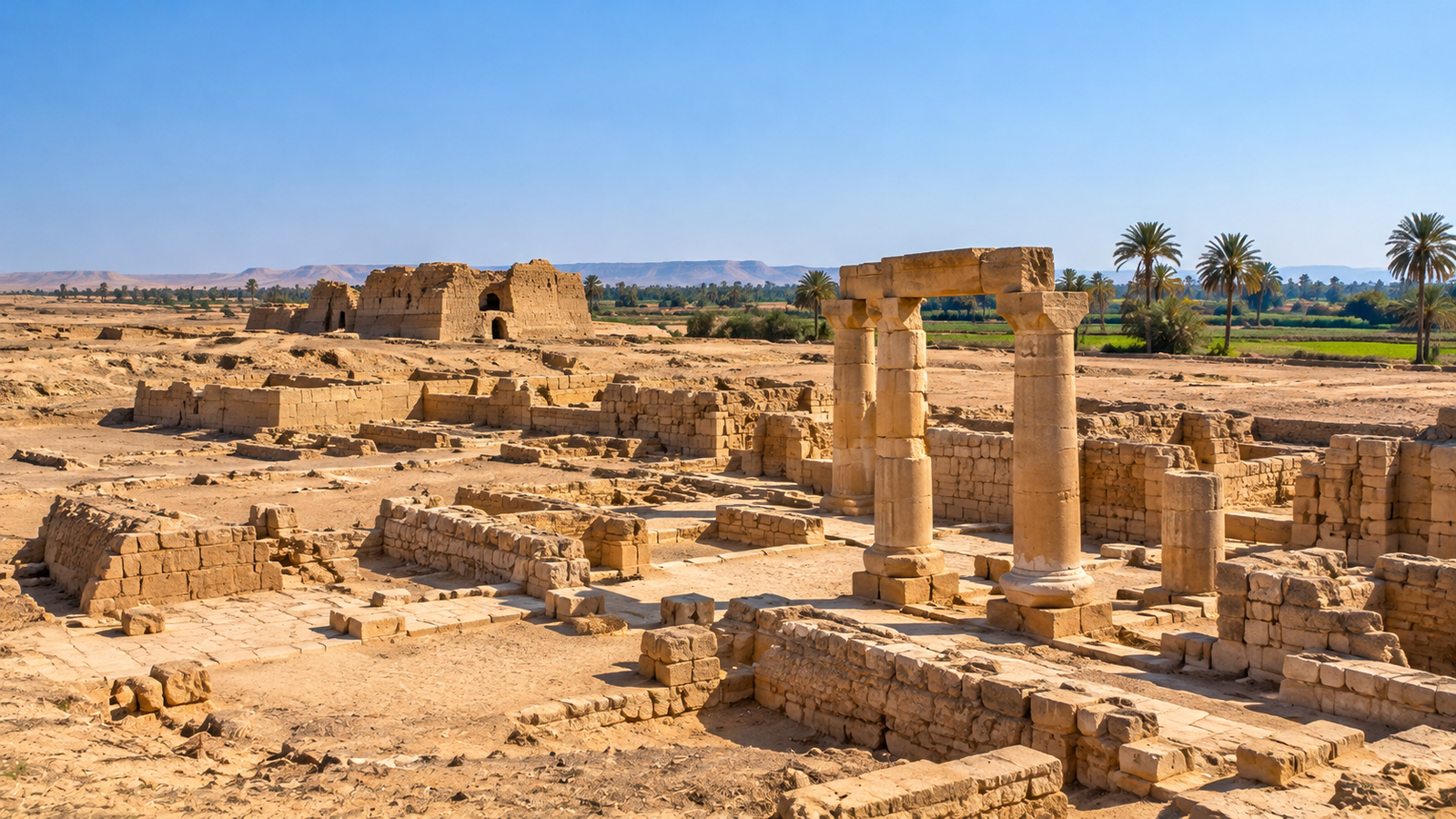
Fayoum is one of Egypt’s most fascinating destinations for travellers interested in ancient history, archaeological sites, and landscapes beyond the traditional attractions of Cairo and Luxor. Among its lesser-known historical treasures is Karanis, an ancient Greco-Roman settlement located near Kom Aushim in Fayoum Governorate.
Unlike Egypt’s monumental royal tombs and towering pyramids, Karanis offers a different kind of historical experience. Its surviving houses, temple remains, and archaeological discoveries help reveal how ordinary people lived, worshipped, worked, and raised their families thousands of years ago.
The ancient settlement was established during the Ptolemaic period and continued to develop under Roman rule. Its archaeological remains provide valuable insights into agriculture, religion, domestic architecture, and the diverse communities that inhabited the Fayoum region.
Whether you are planning a cultural excursion from Cairo or exploring Fayoum over several days, Karanis is a worthwhile destination for visitors who want to discover another side of ancient Egyptian history.
Karanis at a Glance
- Location: Near Kom Aushim, Fayoum Governorate, Egypt.
- Historical period: Ptolemaic and Roman periods.
- Foundation: Established during the reign of Ptolemy II.
- Main attractions: The northern and southern temples, remains of ancient houses, and archaeological structures.
- Religious significance: Associated with the worship of Sobek, the crocodile god.
- Archaeological importance: Evidence of agriculture, domestic life, religious practices, and trade.
- Nearby attraction: Kom Aushim Museum.
- Best for: History lovers, archaeology enthusiasts, cultural travellers, and visitors exploring Fayoum.
1. What Is Karanis Ancient City?
Karanis was an ancient agricultural settlement in the northeastern part of the Fayoum region. Today, its remains are located near the modern settlement of Kom Aushim, making it an interesting stop for travellers exploring the area’s archaeological heritage.
The ancient town developed during the Ptolemaic period, when the Greek-Macedonian dynasty ruled Egypt after the conquest of Alexander the Great. It continued to play a role in local life under Roman rule, when Fayoum was an important agricultural region.
Karanis is especially valuable because it was not simply a religious centre or a royal monument. It was a community where people lived in houses, stored grain, prepared food, participated in religious ceremonies, and managed the practical demands of everyday life.
Archaeologists have uncovered remains of homes, temples, baths, and other structures, alongside objects that help reconstruct the settlement’s history.
Walking through the archaeological area allows visitors to imagine a town that once contained streets, residential buildings, religious spaces, and working areas. Although many structures have deteriorated over the centuries, the surviving remains still provide clues about the organisation of an ancient Egyptian community.
2. The History of Karanis During the Ptolemaic Period
Karanis was established around the third century BC, during the Ptolemaic dynasty. Ptolemy II Philadelphus is associated with the development of several settlements in the Fayoum region as part of wider efforts to improve agricultural production and support communities in the area.
Fayoum was especially important because its agricultural land depended on irrigation and the management of water resources. When water was distributed effectively, the region could support farming communities and contribute to the wider Egyptian economy.
Karanis benefited from this agricultural environment. Its residents depended on the surrounding countryside for food and other essential resources, while the settlement provided a place for domestic life, religious activity, and local exchange.
The town’s history also reflects the cultural diversity of Ptolemaic Egypt. Greek traditions existed alongside Egyptian religious practices and local customs. Rather than replacing every earlier tradition, these cultural influences often interacted in complex ways.
This mixture is one reason why Karanis is interesting to historians. The settlement offers evidence of how life in Egypt changed when different political powers governed the country.
3. Karanis Under Roman Rule
When Rome took control of Egypt in 30 BC, Karanis continued to be inhabited and developed through the Roman period.
The settlement’s agricultural character remained important. Farming supported families and contributed to the wider economic networks of Roman Egypt. Archaeological evidence from Karanis indicates that residents were involved in the practical activities necessary to maintain a rural community.
The remains discovered at the site and the objects recovered during excavations provide evidence of everyday activities, including food preparation, storage, personal care, writing, and religious practice.
The discoveries are particularly important because written and material evidence can reveal details of life that are rarely recorded in royal monuments.
For example, documentary papyri and inscribed pottery fragments can preserve information about transactions, administration, personal matters, and other aspects of daily life. Household objects help researchers understand the materials people used and the activities they performed.
Karanis continued to change over several centuries. Like many ancient settlements, it experienced periods of growth and decline before eventually being abandoned. The exact combination of factors behind its decline remains a subject for historical investigation, so it is best not to attribute its disappearance to a single cause.
4. The Northern and Southern Temples of Karanis
Two of the site’s most notable archaeological features are the remains known as the Northern Temple and the Southern Temple.
These religious structures demonstrate the importance of worship in the community and provide an opportunity to examine the architectural remains of temples from Egypt’s Greco-Roman period.
The Northern Temple
The Northern Temple is one of the best-known structures at Karanis. Its surviving remains reveal sections of walls, chambers, and architectural features that once formed part of a religious complex.
Although the temple is now incomplete, its layout helps visitors understand how ancient sacred buildings were organised. Religious spaces were distinct from ordinary domestic buildings and served important ceremonial functions within the community.
When exploring the remains, pay attention to the arrangement of rooms, surviving stone elements, and the relationship between different sections of the structure.
The site should not be expected to resemble a fully restored monumental temple. Much of its historical value lies in the surviving archaeological evidence and what that evidence tells us about religious life in an ancient provincial town.
The Southern Temple
The Southern Temple provides another example of the religious architecture associated with Karanis.
Together, the two temples illustrate the significance of local religious traditions during the Ptolemaic and Roman periods. They also help researchers understand how communities in Fayoum maintained places of worship while adapting to changes in political administration and cultural influence.
Both temple areas are best appreciated as part of the larger settlement rather than as isolated monuments. Their position within Karanis helps visitors imagine the relationship between religious buildings, residential areas, and the wider town.
Access to individual structures may vary, so visitors should follow site regulations and avoid entering restricted or fragile areas.
5. Sobek: The Crocodile God of Fayoum
One of the most important religious traditions associated with ancient Fayoum was the worship of Sobek, a deity represented with crocodile features or in crocodile form.
Sobek was associated with the Nile, water, fertility, and aspects of royal power. In a region where agriculture depended on water management, a deity connected with water and fertility held considerable religious significance.
At Karanis, religious worship included forms of Sobek associated with the local community, including deities known as Pnepheros and Petesouchos.
This local religious tradition formed part of the wider diversity of worship in ancient Egypt. During the Ptolemaic and Roman periods, Egyptian religious beliefs continued alongside Greek cultural influences and other traditions.
The temples at Karanis therefore offer more than architectural interest. They also provide a way to understand how religion connected people to the natural environment and to the identity of their community.
Visitors interested in ancient Egyptian mythology may find Karanis especially rewarding because it illustrates religious practices outside the best-known temple centres of southern Egypt.
6. Daily Life in Ancient Karanis
One of the most fascinating aspects of Karanis is the evidence it preserves about ordinary people.
Egypt’s most famous ancient monuments were often built for kings, high-ranking officials, and religious institutions. Karanis offers a different perspective by focusing attention on the homes and activities of a community whose livelihood depended largely on agriculture.
Houses and Domestic Spaces
Archaeological investigations have uncovered the remains of residential buildings. Their layouts provide clues about how families organised living spaces, stored possessions, and carried out everyday activities.
Although the original appearance of many buildings has been lost, surviving walls and room arrangements help researchers reconstruct aspects of the settlement’s domestic architecture.
Farming and Food Production
Agriculture was central to Karanis. The surrounding land supported farming, while storage facilities and grinding equipment discovered at the site demonstrate the importance of handling and processing crops.
Food production required more than planting and harvesting. It also involved storing supplies, processing grain, maintaining tools, and organising labour throughout the year.
Household Objects
Excavations at Karanis have yielded a wide range of objects associated with everyday life. Such discoveries can help archaeologists study cooking, eating, clothing, personal care, domestic work, and economic activity.
Objects that might appear ordinary today can be historically important because they reveal how people lived beyond the world of rulers and elite monuments.
Writing and Documentary Evidence
Papyri and inscribed pottery fragments have helped researchers investigate the administrative and social life of the settlement.
These materials provide an especially valuable historical record because written documents can preserve names, transactions, and other details that buildings alone cannot reveal.
The combination of architecture, artefacts, and written evidence makes Karanis an important archaeological site for understanding life in Greco-Roman Egypt.
7. The Archaeological Excavations at Karanis
Karanis attracted archaeological attention during the late nineteenth century. Excavations later became particularly important through the work of the University of Michigan expedition, which investigated the site between 1924 and 1935.
The excavations uncovered substantial evidence of the settlement’s architecture and material culture. Researchers documented buildings, household objects, and written materials that helped reconstruct aspects of life during the Ptolemaic and Roman periods.
Many discoveries from Karanis were transferred to collections in the United States for research and study. These collections, together with excavation records and photographs, continue to support archaeological investigations.
The site’s dry environmental conditions contributed to the preservation of certain objects that would normally deteriorate more quickly in wetter climates. This has made Karanis particularly significant for research into ancient rural communities.
The continuing study of archaeological collections also demonstrates that an excavation does not necessarily end when objects are removed from the ground. Researchers can revisit previously excavated material using new questions, methods, and scientific techniques.
8. Kom Aushim Museum: A Useful Stop Near Karanis
A visit to Karanis can be combined with the Kom Aushim Museum, which is located near the entrance to the archaeological area.
The museum presents aspects of Fayoum’s wider history and heritage, with collections covering different periods of the region’s past.
Visiting a museum alongside an archaeological site can help put the surviving ruins into context. While the remains at Karanis show the structure of an ancient settlement, museum collections can illustrate the objects, traditions, and material culture associated with life in the region.
For visitors interested in archaeology, the combination provides a broader understanding of how historians and archaeologists study the past.
Before your visit, check current museum opening arrangements and access conditions, as these can change.
9. Where Is Karanis Located?
Karanis is located near Kom Aushim in Fayoum Governorate, northwest of Cairo and northeast of Fayoum city. The archaeological remains are situated in the northeastern part of the Fayoum region, east of Lake Qarun.
The location makes Karanis suitable for travellers interested in combining archaeological exploration with other attractions in Fayoum.
If you are visiting from Cairo, planning transportation in advance is recommended, especially if you intend to visit several sites during the same day.
Read our guide on how to get from Cairo to Fayoum for an overview of the journey and transportation considerations.
For a broader introduction to the region, explore our complete Fayoum travel guide.
10. How to Get to Karanis from Cairo
The most convenient approach for many visitors is to travel by private car or arrange a private excursion from Cairo.
A private vehicle offers greater flexibility if you want to visit Karanis, the Kom Aushim Museum, and additional archaeological or natural attractions in Fayoum on the same day.
Public transportation options may require additional planning, particularly for reaching the archaeological area and travelling between separate attractions.
Before departing, confirm your intended route, transportation arrangements, expected journey time, and opening hours for the sites you wish to visit.
If you prefer a more flexible experience, a custom private Fayoum tour can help you organise a day around your historical interests and preferred stops.
11. What to See Near Karanis
Fayoum offers a mixture of archaeological remains, lakes, desert landscapes, and traditional settlements. Depending on your interests and available time, you can combine Karanis with other destinations in the region.
Lake Qarun
Lake Qarun is one of Fayoum’s best-known natural landmarks. Its landscapes provide a contrast to the archaeological structures at Karanis, making it an interesting addition to a cultural itinerary.
Learn more in our guide to Lake Qarun, Egypt.
Qasr Qarun Temple
Travellers interested in ancient Egyptian religious architecture can consider visiting Qasr Qarun, another important archaeological attraction in Fayoum.
The temple offers a different historical setting and can complement a visit to Karanis for travellers exploring the region’s ancient heritage.
Read our article on Qasr Qarun Temple before planning your route.
Wadi El Rayan Waterfalls
If you want to include a natural attraction in your trip, consider Wadi El Rayan Waterfalls.
The area offers a very different experience from the ancient settlement, combining open landscapes with water and scenic viewpoints.
Fayoum Desert Safari
Travellers who enjoy outdoor experiences may wish to add a desert excursion to their itinerary. Our Fayoum safari from Cairo provides information about exploring the region’s desert landscapes.
A safari is a separate activity and should be planned according to the available time, road conditions, and the locations you want to visit.
12. Best Time to Visit Karanis
The cooler months, generally from autumn through spring, are often more comfortable for exploring archaeological sites in Fayoum.
During warmer months, temperatures can rise considerably, and exposed archaeological areas may offer little shade. If you visit during summer, consider an early start and bring enough drinking water.
For a more comfortable experience:
- Wear lightweight clothing suitable for walking outdoors.
- Use sun protection, including a hat and sunscreen.
- Wear comfortable shoes for uneven ground.
- Bring drinking water.
- Avoid climbing on walls or touching fragile archaeological remains.
- Check opening hours and entry arrangements before travelling.
Conditions at the site may vary, so it is best to confirm current visitor information before departure.
13. How Much Time Should You Spend at Karanis?
The amount of time you need depends on your interest in archaeology and whether you plan to visit nearby attractions.
Travellers mainly interested in seeing the main ruins may prefer a shorter visit. Visitors who want to examine the temple remains, learn about the history, and explore the archaeological surroundings may wish to allow more time.
If you also plan to visit the Kom Aushim Museum or travel to other parts of Fayoum, it is sensible to organise the itinerary in advance rather than trying to fit every attraction into a rushed schedule.
A licensed Egyptologist guide can add context by explaining the historical setting, religious traditions, and archaeological discoveries associated with the site.
14. Is Karanis Worth Visiting?
Karanis is worth considering if you want to explore an aspect of Egypt’s history that differs from the grand royal monuments.
Its main appeal lies in the opportunity to understand an ancient community through the remains of its houses, temples, and everyday objects. The site provides a valuable glimpse into the agricultural and social life of Greco-Roman Egypt.
Karanis may be especially suitable for travellers who have already visited Cairo’s most famous attractions and want to discover a less familiar archaeological destination.
However, visitors should set realistic expectations. Karanis consists largely of archaeological remains rather than fully reconstructed buildings, so its appeal depends on an interest in history and the interpretation of ancient ruins.
For those interested in the daily lives of ordinary people in ancient Egypt, it can be a rewarding addition to a Fayoum itinerary.
Frequently Asked Questions About Karanis Ancient City
1. Where is Karanis Ancient City located?
Karanis is located near Kom Aushim in Fayoum Governorate, Egypt, in the northeastern part of the Fayoum region.
2. How old is Karanis?
Karanis was established during the Ptolemaic period, around the third century BC, and continued to be inhabited through much of the Roman period.
3. Who founded Karanis?
The settlement was established during the reign of Ptolemy II Philadelphus as part of the development of the Fayoum region.
4. What is Karanis famous for?
Karanis is known for its Greco-Roman archaeological remains, including two temples, residential structures, and discoveries that provide evidence of agriculture and daily life in ancient Egypt.
5. Which god was worshipped at Karanis?
Karanis was associated with the worship of Sobek, the crocodile god, including local forms known as Pnepheros and Petesouchos.
6. Can Karanis be visited on a day trip from Cairo?
Yes. Karanis can be included in a day trip from Cairo, although transportation and the number of other attractions you want to visit should be considered when planning the schedule.
7. Is there a museum near Karanis?
Yes. The Kom Aushim Museum is located near the archaeological area and can be a useful addition to a visit.
8. What other attractions can I visit near Karanis?
Depending on your route and available time, you may consider Lake Qarun, Qasr Qarun Temple, and other archaeological or natural attractions across Fayoum.
9. Is Karanis suitable for children?
It may be interesting for families whose children enjoy history and exploring outdoor sites. Parents should supervise children closely around uneven surfaces and fragile ruins.
10. What should I bring when visiting Karanis?
Bring drinking water, comfortable walking shoes, sun protection, and a camera. Check current access rules and opening arrangements before your trip.
Explore More of Fayoum with Let’s Explore Egypt
Karanis reveals a fascinating side of Egypt’s past, from ancient religious traditions to the daily routines of people who lived in the Fayoum countryside during the Ptolemaic and Roman periods.
Its archaeological remains provide an opportunity to look beyond royal monuments and discover how ancient communities developed, worshipped, and supported themselves through agriculture.
Make your visit part of a wider exploration of the region by discovering our Fayoum travel guide or planning a private Fayoum tour.
With its combination of archaeological heritage, natural scenery, and lesser-known historical sites, Fayoum offers a rewarding experience for travellers who want to discover more of Egypt beyond the traditional tourist route.
Recommended Egypt Tours

Why You Can Trust Let's Explore Egypt
This article was written and reviewed by the Let's Explore Egypt Editorial Team, a licensed Egyptian tour operator specializing in private Egypt tours, Nile cruises, and tailor-made travel experiences since 2009.
- 🏛 Licensed Egyptian Tour Operator Since 2009
- ⭐ Trusted by Thousands of Travelers Worldwide
- 👨🏫 Written & Reviewed by Local Egypt Travel Experts
- 🚐 Private Tours & Tailor-Made Travel Experiences
- 📞 24/7 Customer Support