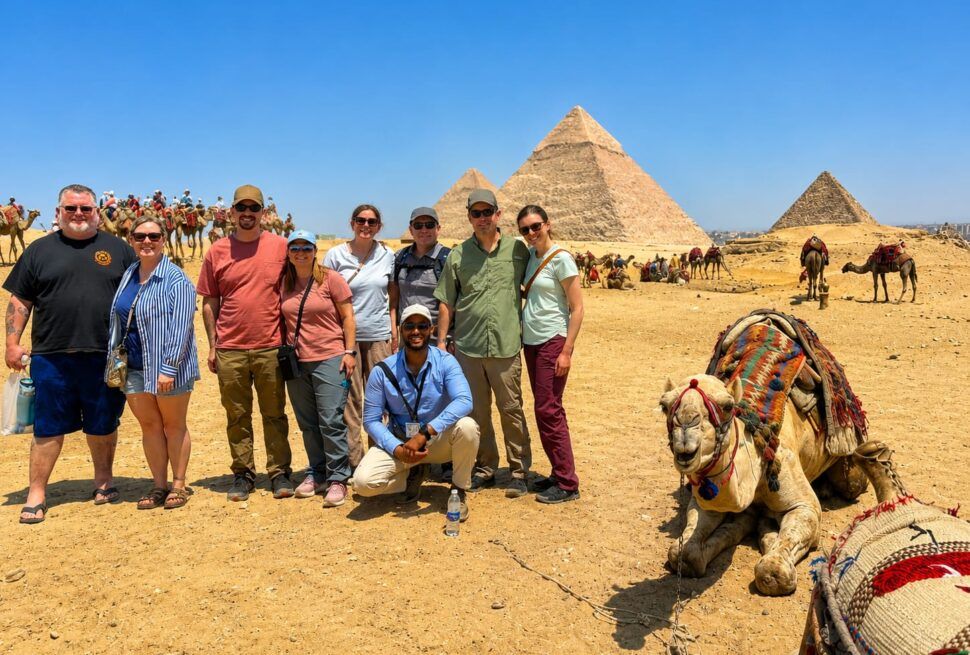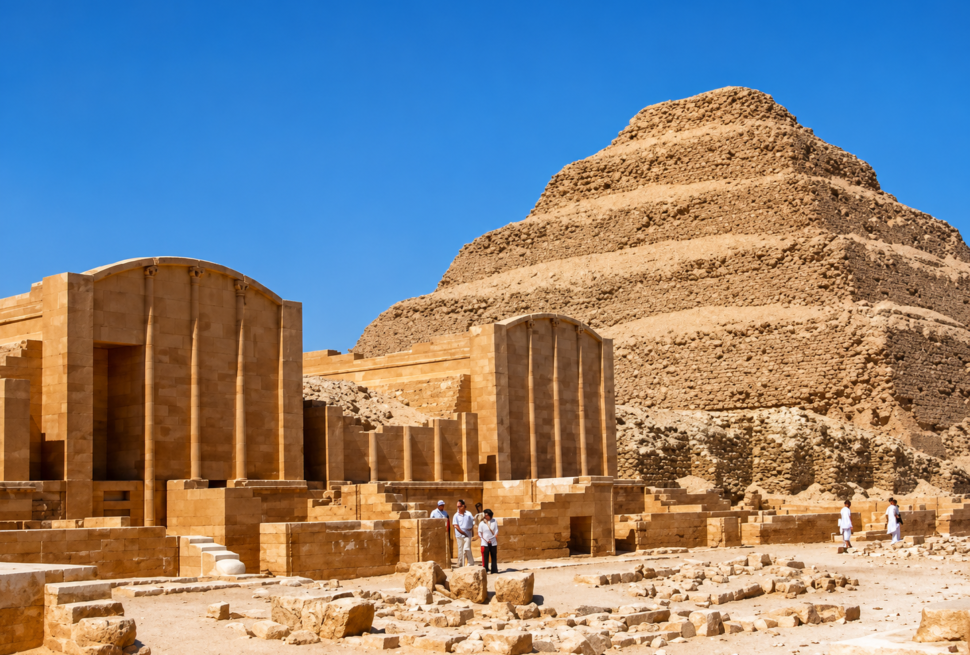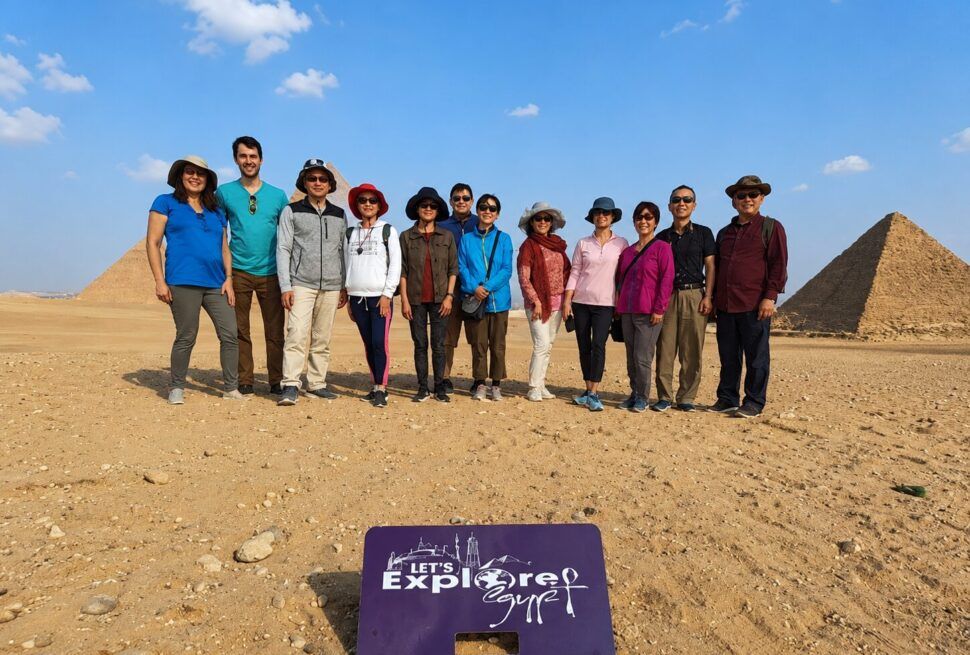



Welcome to the Pyramid of Khafre
Standing proudly on the Giza Plateau, the Pyramid of Khafre is one of the most iconic monuments in Egypt and the second-largest pyramid ever built. Although it is slightly smaller than the Great Pyramid of Khufu, many visitors believe it is the tallest pyramid at Giza. This fascinating optical illusion has intrigued travelers for centuries.
The Pyramid of Khafre is more than just an impressive structure. It forms the heart of an extraordinary royal complex that includes the Great Sphinx of Giza, the Valley Temple, a mortuary temple, a causeway, and several satellite tombs. Together, these monuments offer one of the best-preserved examples of an ancient Egyptian funerary complex.
Built more than 4,500 years ago, the pyramid reflects the remarkable engineering, architectural precision, and religious beliefs of Egypt’s Fourth Dynasty. It remains one of the highlights of any visit to the Giza Plateau and continues to inspire historians, archaeologists, architects, and travellers from around the world.
Whether you’re planning to explore its interior, photograph its impressive exterior, or simply learn about its fascinating history, this guide will help you discover everything you need to know about the Pyramid of Khafre.
Quick Facts About the Pyramid of Khafre
| Feature | Details |
|---|---|
| Official Name | Pyramid of Khafre |
| Greek Name | Pyramid of Chephren |
| Builder | Pharaoh Khafre |
| Dynasty | Fourth Dynasty |
| Construction Date | c. 2558–2532 BCE |
| Location | Giza Plateau, Cairo, Egypt |
| Original Height | 143.5 meters (471 ft) |
| Current Height | Approximately 136.4 meters (448 ft) |
| Base Length | Approximately 215.5 meters (707 ft) |
| Material | Limestone with granite elements |
| UNESCO Status | Part of the Giza Necropolis World Heritage Site |
Who Was Pharaoh Khafre?
The Pyramid of Khafre was built for Pharaoh Khafre, one of the most powerful rulers of Egypt’s Fourth Dynasty.
Khafre was the son of Pharaoh Khufu, the builder of the Great Pyramid, and continued his father’s ambitious building program on the Giza Plateau.
Although fewer historical records survive compared with some later pharaohs, Khafre’s legacy is preserved through the monumental complex he commissioned. His pyramid, temples, and the Great Sphinx demonstrate the wealth, organization, and engineering capabilities of Old Kingdom Egypt.
Many Egyptologists believe the face of the Great Sphinx represents Khafre himself, reinforcing his connection to the royal necropolis.
Pharaoh Khafre at a Glance
| Fact | Information |
|---|---|
| Royal Name | Khafre |
| Greek Name | Chephren |
| Dynasty | Fourth Dynasty |
| Father | Pharaoh Khufu |
| Reign | Approximately 2558–2532 BCE |
| Famous Monument | Pyramid of Khafre |
| Associated Monuments | Great Sphinx, Valley Temple, Causeway |
Why Does the Pyramid of Khafre Look Taller?
One of the most common questions visitors ask is:
“If Khufu’s pyramid is larger, why does Khafre’s pyramid appear taller?”
The answer lies in geography rather than architecture.
The Pyramid of Khafre was built on higher natural bedrock, giving it a more commanding appearance. In addition, it still retains some of its original smooth white limestone casing near the summit, making it appear sharper and more complete than the Great Pyramid.
In reality, the Great Pyramid remains the tallest of the three pyramids at Giza.
Great Pyramid vs. Pyramid of Khafre
| Feature | Great Pyramid (Khufu) | Pyramid of Khafre |
|---|---|---|
| Builder | Khufu | Khafre |
| Original Height | 146.6 m | 143.5 m |
| Current Height | 138.8 m | 136.4 m |
| Base Length | 230.4 m | 215.5 m |
| Built On | Lower ground | Higher ground |
| Casing Stones | Mostly lost | Partially preserved at the top |
| Largest Pyramid? | ✅ Yes | No |
Construction of the Pyramid
Like the Great Pyramid, the Pyramid of Khafre was built using millions of carefully cut limestone blocks.
The builders quarried most of the limestone locally from the Giza Plateau, while granite used for parts of the temple complex came from Aswan, hundreds of kilometers to the south.
Ancient engineers achieved remarkable precision using simple tools, skilled labor, and careful planning. Although researchers continue to debate exactly how the blocks were raised, there is broad agreement that ramps, sledges, and a highly organized workforce played key roles.
Modern archaeological discoveries have shown that the pyramid was built by skilled workers, not enslaved people. Excavations have uncovered workers’ villages, bakeries, workshops, and cemeteries, revealing a well-organized community that supported one of history’s greatest construction projects.
Table: Construction Facts
| Feature | Details |
|---|---|
| Main Building Material | Limestone |
| Temple Material | Limestone and Aswan granite |
| Estimated Construction Time | Around 20 years |
| Workforce | Skilled workers and craftsmen |
| Construction Method | Stone blocks transported and raised using organized engineering techniques |
Original Appearance
When the Pyramid of Khafre was completed, it looked dramatically different from what visitors see today.
The monument was covered with highly polished white limestone casing stones that reflected the Egyptian sun, making the pyramid visible from great distances.
Near the summit, some of these original casing stones still survive.
This makes the Pyramid of Khafre unique among the three main pyramids and offers visitors a glimpse of how the pyramids once appeared in antiquity.
Many scholars also believe the pyramid originally ended with a polished pyramidion, possibly covered with electrum (a natural alloy of gold and silver), creating a brilliant focal point that sparkled in the sunlight.
Original vs. Modern Appearance
| Feature | Around 2500 BCE | Today |
|---|---|---|
| Exterior | Smooth white limestone | Stepped limestone core visible |
| Summit | Complete pyramidion | Missing |
| Casing Stones | Covered the entire pyramid | Only upper courses remain |
| Surface | Bright and reflective | Weathered limestone |
Architectural Design
The Pyramid of Khafre demonstrates extraordinary architectural skill.
Its sides are aligned very closely with the four cardinal directions, reflecting the advanced surveying techniques of ancient Egyptian engineers.
The pyramid consists of:
- A square base.
- Four triangular faces.
- Internal passages leading to the burial chamber.
- Granite structural elements.
- Carefully planned entrance corridors.
Although simpler inside than many later royal tombs, its overall design reflects remarkable engineering precision.
Amazing Facts About the Pyramid of Khafre
Here are some fascinating facts many visitors don’t know:
- It is the second-largest pyramid in Egypt.
- It appears taller than the Great Pyramid because it stands on higher ground.
- It still preserves some of its original casing stones.
- It forms part of one of the most complete pyramid complexes in Egypt.
- It is closely associated with the Great Sphinx.
- Its Valley Temple is among the best-preserved Old Kingdom temples.
- The pyramid has stood for more than 4,500 years.
Fascinating Facts
| Fact | Details |
|---|---|
| Rank | Second-largest pyramid in Egypt |
| Age | Approximately 4,500 years |
| Most Recognizable Feature | Original casing stones near the summit |
| Associated Monument | Great Sphinx of Giza |
| UNESCO Site | Yes |
| Construction Period | Fourth Dynasty |
Why Visit the Pyramid of Khafre?
Although many visitors focus on the Great Pyramid, the Pyramid of Khafre offers a unique perspective on the Giza Plateau.
Its impressive height, preserved casing stones, and close connection to the Great Sphinx make it an essential stop for anyone interested in ancient Egypt.
Whether viewed from Panorama Point, explored from the surrounding pathways, or visited as part of a guided tour, the Pyramid of Khafre remains one of the greatest architectural achievements of the ancient world.
Inside the Pyramid of Khafre – Exploring the King’s Burial Chamber
What Is It Like Inside the Pyramid of Khafre?
While millions of visitors admire the Pyramid of Khafre from the outside every year, far fewer choose to explore its interior. Stepping inside this ancient monument offers a unique opportunity to experience the engineering brilliance of the Old Kingdom firsthand.
Unlike modern buildings, the pyramid’s interior is intentionally simple. There are no colorful wall paintings, no elaborate hieroglyphics, and no decorative statues. Instead, visitors walk through narrow limestone passages leading to a granite burial chamber that has remained largely unchanged for more than 4,500 years.
Although the Pyramid of Khafre is smaller than the Great Pyramid of Khufu, the experience inside is equally fascinating for anyone interested in archaeology and ancient Egyptian history.
Can You Go Inside the Pyramid of Khafre?
Yes.
Visitors can enter the Pyramid of Khafre by purchasing the appropriate interior admission ticket, subject to current opening schedules and conservation policies.
The interior route is relatively short compared with the Great Pyramid, making it a good option for visitors who want to experience the inside of an Egyptian pyramid without a lengthy climb.
Before entering, keep in mind:
- The passages are narrow.
- The ceilings are low.
- The air inside can feel warm.
- Comfortable walking shoes are recommended.
Visitor Information
| Feature | Information |
|---|---|
| Interior Access | Available with the appropriate ticket |
| Average Visit Time | 20–30 minutes |
| Walking Difficulty | Moderate |
| Claustrophobic Spaces | Yes |
| Photography | Subject to current site regulations |
| Suitable for Children | Yes, with supervision |
The Entrance
The entrance to the Pyramid of Khafre is located on the north face, following the traditional orientation used for most royal pyramids of the Old Kingdom.
Visitors descend through an ancient passage that gradually leads toward the burial chamber.
The entrance itself reflects the practical engineering of ancient Egyptian builders.
Unlike later royal tombs, which feature richly decorated corridors, Khafre’s pyramid emphasizes structural simplicity.
The Descending Passage
After entering the pyramid, visitors walk down a descending corridor carved through limestone.
This passage was designed to guide the funeral procession toward the king’s burial chamber.
Characteristics include:
- Smooth limestone walls.
- Low ceiling.
- Gentle slope.
- Original masonry preserved in many sections.
Although simple in appearance, the passage demonstrates remarkable precision considering it was constructed more than four millennia ago.
Descending Passage Facts
| Feature | Details |
|---|---|
| Direction | Downward toward the burial chamber |
| Material | Limestone |
| Ceiling Height | Low |
| Lighting Today | Artificial |
| Original Function | Access to the royal burial chamber |
The Burial Chamber
The burial chamber is the most important room inside the pyramid.
Unlike the King’s Chamber in the Great Pyramid, Khafre’s burial chamber is relatively simple.
The room contains:
- Massive limestone walls.
- A flat ceiling.
- Granite flooring in some areas.
- The king’s granite sarcophagus.
There are no painted decorations or hieroglyphics.
This simplicity reflects the architectural style of Old Kingdom royal pyramids.
Standing inside the chamber creates a remarkable feeling of connection with Egypt’s ancient past.
The Granite Sarcophagus
One of the highlights of the interior is the granite sarcophagus believed to have been prepared for Pharaoh Khafre.
Carved from a single block of granite, it remains inside the burial chamber today.
Although the king’s mummy and treasures disappeared long ago, the sarcophagus continues to demonstrate the extraordinary craftsmanship of ancient Egyptian stoneworkers.
Researchers believe it was placed inside the chamber before the pyramid was fully completed, as it would have been difficult to move through the finished passages.
Burial Chamber Highlights
| Feature | Description |
|---|---|
| Chamber Type | Royal Burial Chamber |
| Main Material | Limestone |
| Sarcophagus | Granite |
| Decorations | None |
| Historical Purpose | Burial place of Pharaoh Khafre |
Interior Architecture
Although the Pyramid of Khafre appears less complicated than the Great Pyramid, its architecture remains impressive.
Key design features include:
Precision Masonry
The limestone blocks fit together with exceptional accuracy, helping the structure survive for thousands of years.
Structural Stability
The chamber’s design distributes the enormous weight of the pyramid above it while maintaining stability.
Minimal Decoration
Instead of artistic decoration, the emphasis is on engineering and durability.
This practical approach reflects the architectural traditions of Egypt’s Fourth Dynasty.
Comparing the Interior to the Great Pyramid
Many visitors wonder which pyramid offers the better interior experience.
Each has unique characteristics.
Great Pyramid vs. Pyramid of Khafre Interior
| Feature | Great Pyramid | Pyramid of Khafre |
|---|---|---|
| Interior Size | Larger | Smaller |
| Grand Gallery | Yes | No |
| King’s Chamber | Large granite chamber | Simpler burial chamber |
| Granite Sarcophagus | Yes | Yes |
| Walking Distance | Longer | Shorter |
| Physical Difficulty | Higher | Moderate |
| Time Required | 30–45 minutes | 20–30 minutes |
Visitor Experience
Most visitors describe the experience as quiet, mysterious, and memorable.
Unlike museums filled with artifacts, the Pyramid of Khafre allows travelers to experience the monument itself as the main exhibit.
The cool stone walls, narrow corridors, and ancient burial chamber create an atmosphere unlike anywhere else in Egypt.
For many visitors, imagining the funeral ceremonies that once took place here adds an emotional connection to the site.
Accessibility
The interior presents several physical challenges.
Visitors should be prepared for:
- Narrow corridors.
- Low ceilings.
- Moderate walking.
- Sloping passages.
Those with mobility limitations or severe claustrophobia may prefer to admire the pyramid from the outside.
Accessibility Guide
| Visitor Type | Recommendation |
|---|---|
| Families | ✅ Suitable |
| Children | ✅ With supervision |
| Seniors | ✅ Moderate walking required |
| Wheelchair Users | ❌ Interior not accessible |
| Claustrophobic Visitors | ⚠️ May find passages uncomfortable |
Photography Tips
Photography rules inside the pyramid may change over time.
Always follow the latest regulations.
Exterior photography offers outstanding opportunities.
Recommended locations include:
- South side of the pyramid.
- Panorama Point.
- Great Sphinx viewing area.
- Valley Temple.
- Sunset viewpoints.
The remaining casing stones near the summit create some of the most recognizable pyramid photographs in Egypt.
Interesting Facts About the Interior
- The burial chamber is cut partly into the natural bedrock.
- The granite sarcophagus remains in its original location.
- The interior is much simpler than many people expect.
- Most original architectural features have survived.
- The pyramid has been explored by archaeologists for centuries.
Why Visit the Interior?
Entering the Pyramid of Khafre provides an entirely different appreciation of ancient Egyptian engineering.
Instead of simply admiring the monument from outside, visitors experience the carefully planned corridors, the burial chamber, and the granite sarcophagus that formed the heart of one of Egypt’s greatest royal monuments.
Combined with the nearby Great Sphinx and Valley Temple, the interior visit creates one of the most rewarding archaeological experiences on the Giza Plateau.
Coming Up in Part 3
In the next chapter, you’ll discover:
- The Valley Temple of Khafre
- The Causeway
- The Great Sphinx connection
- The Mortuary Temple
- Queens’ Pyramids
- Archaeological discoveries
- Construction techniques
- Best photography locations
Quick Visitor Checklist
| Item | Recommended |
|---|---|
| Comfortable Walking Shoes | ✅ |
| Water Bottle | ✅ (follow site rules) |
| Camera | ✅ Exterior photography |
| Hat | ✅ |
| Sunscreen | ✅ |
| Egyptologist Guide | Highly Recommended |
| Morning Visit | Best experience |
| Allow 20–30 Minutes | Ideal for the interior exploration |
Beyond the Pyramid: Exploring Khafre’s Royal Complex
The Pyramid of Khafre is much more than a single monument. It stands at the heart of one of the best-preserved royal funerary complexes from Ancient Egypt. While the pyramid itself dominates the skyline, the surrounding temples, causeway, Great Sphinx, and satellite pyramids tell the complete story of Pharaoh Khafre’s journey into the afterlife.
Unlike many ancient sites where only fragments remain, Khafre’s complex allows visitors to understand how an Old Kingdom royal burial complex originally functioned. Every structure had a purpose—from preparing the king’s body for burial to performing ceremonies that honored him for eternity.
The Valley Temple of Khafre
One of the most remarkable buildings on the Giza Plateau is the Valley Temple of Khafre, located near the Great Sphinx.
Constructed from enormous limestone blocks and lined with polished Aswan granite, the Valley Temple is considered one of the best-preserved temples from Egypt’s Old Kingdom.
Archaeologists believe it served as the place where Khafre’s body underwent purification and mummification rituals before being transported to the pyramid.
Inside the temple, visitors can still admire:
- Massive granite pillars
- Precision-cut limestone walls
- Ancient stone floors
- Original architectural layout
The simplicity and scale of the Valley Temple reflect the extraordinary craftsmanship of Fourth Dynasty builders.
Valley Temple at a Glance
| Feature | Details |
|---|---|
| Builder | Pharaoh Khafre |
| Date | c. 2558–2532 BCE |
| Construction Material | Limestone & Aswan Granite |
| Purpose | Royal funerary rituals |
| Current Condition | One of the best-preserved Old Kingdom temples |
| Distance from Pyramid | Approximately 500 meters |
The Causeway
Connecting the Valley Temple to the Mortuary Temple is the Causeway of Khafre.
This long stone passage once served as the ceremonial route used during the king’s funeral procession.
The causeway was originally roofed in sections and decorated with reliefs depicting royal ceremonies and offerings.
Although much of its decoration has disappeared, its path remains visible and illustrates the careful planning of the entire complex.
Causeway Facts
| Feature | Description |
|---|---|
| Function | Connected the Valley Temple to the Mortuary Temple |
| Construction | Limestone |
| Original Decoration | Relief carvings and painted scenes |
| Historical Role | Funeral processions and ceremonial rituals |
The Mortuary Temple
Located directly beside the Pyramid of Khafre, the Mortuary Temple was the religious center of the complex.
Here, priests performed daily offerings to honor the deceased king and ensure his eternal life in the afterworld.
The temple originally included:
- Offering halls
- Storerooms
- Courtyards
- Shrines
- Priest quarters
Although only ruins survive today, archaeologists have reconstructed much of its original layout through excavations.
Table: Mortuary Temple Highlights
| Feature | Description |
|---|---|
| Location | East side of the Pyramid |
| Purpose | Daily royal cult rituals |
| Main Material | Limestone |
| Connected To | Causeway & Valley Temple |
| Historical Importance | Center of the king’s funerary cult |
The Great Sphinx Connection
Many Egyptologists believe the Great Sphinx of Giza was built during Khafre’s reign.
Several factors support this theory:
- The Sphinx lies within Khafre’s pyramid complex.
- Limestone quarried while carving the Sphinx was used in the Valley Temple.
- The architectural style closely matches Khafre’s monuments.
- The face of the Sphinx may represent Pharaoh Khafre.
Although absolute proof has not been found, this remains the most widely accepted theory among scholars.
Evidence Linking Khafre to the Sphinx
| Evidence | Explanation |
|---|---|
| Geographic Location | Sphinx is part of Khafre’s complex |
| Valley Temple | Built using stone from the Sphinx enclosure |
| Architectural Style | Consistent with Fourth Dynasty monuments |
| Facial Features | Believed by many scholars to resemble Khafre |
| Archaeological Context | Strongly associated with Khafre’s building program |
Satellite Pyramids
Near Khafre’s main pyramid are several smaller structures often called satellite pyramids or queens’ pyramids.
These monuments were likely built for members of the royal family or served symbolic religious functions.
Although smaller than the main pyramid, they provide valuable insight into the planning of royal burial complexes during the Old Kingdom.
Khafre Complex Components
| Structure | Purpose |
|---|---|
| Pyramid of Khafre | Royal tomb |
| Valley Temple | Preparation of the king’s body |
| Causeway | Connected temples |
| Mortuary Temple | Daily religious ceremonies |
| Satellite Pyramids | Royal family burials and symbolic functions |
| Great Sphinx | Guardian of the necropolis |
Construction Techniques
The Pyramid of Khafre demonstrates remarkable engineering.
Ancient builders:
- Carefully surveyed the plateau.
- Cut millions of limestone blocks.
- Transported granite from Aswan.
- Used ramps and sledges.
- Achieved extraordinary alignment with the cardinal directions.
Even after thousands of years, the monument remains one of the finest examples of ancient engineering.
Table: Engineering Achievements
| Achievement | Why It Matters |
|---|---|
| Precise Orientation | Closely aligned with the cardinal directions |
| Stable Foundation | Built on solid limestone bedrock |
| Granite Construction | Massive granite blocks transported over long distances |
| Durable Masonry | Survived more than 4,500 years |
| Complex Planning | Integrated pyramid, temples, and causeway into one unified design |
Archaeological Discoveries
Excavations around Khafre’s complex have revealed important evidence about life in Ancient Egypt.
Researchers have uncovered:
- Workers’ settlements
- Stone tools
- Ceremonial statues
- Temple foundations
- Ancient drainage systems
- Quarry marks
These discoveries continue to improve our understanding of pyramid construction and Old Kingdom society.
Important Discoveries
| Discovery | Significance |
|---|---|
| Valley Temple | Preserved royal architecture |
| Diorite Statues of Khafre | Masterpieces of Egyptian sculpture |
| Quarry Marks | Evidence of construction methods |
| Workers’ Villages | Show skilled labor organization |
| Granite Flooring | Demonstrates advanced craftsmanship |
Best Photography Locations
The Pyramid of Khafre is one of Egypt’s most photogenic monuments.
Top photography spots include:
Panorama Point
Capture all three pyramids together.
Great Sphinx Plaza
Photograph the Sphinx with Khafre’s pyramid in the background.
South Side
Excellent for showing the remaining casing stones.
Sunset Viewpoint
Golden light highlights the limestone and creates dramatic shadows.
Best Photography Spots
| Location | Best Time | Highlights |
|---|---|---|
| Panorama Point | Sunrise & Sunset | Three pyramids together |
| Great Sphinx Plaza | Morning | Sphinx with Khafre’s Pyramid |
| South Side | Afternoon | Original casing stones |
| Valley Temple | Late Afternoon | Ancient architecture |
| Desert Edge | Sunset | Wide panoramic landscape |
Fun Facts About the Pyramid of Khafre
- It still preserves original casing stones near the summit.
- It appears taller than the Great Pyramid because of its higher location.
- Its Valley Temple is one of the best-preserved buildings from Ancient Egypt.
- The Great Sphinx is closely linked to Khafre’s pyramid complex.
- The entire complex was designed as a single architectural masterpiece.
Why the Pyramid Complex Matters
Khafre’s pyramid complex offers one of the clearest examples of how ancient Egyptians combined architecture, religion, engineering, and royal ideology into a unified design.
Rather than viewing the pyramid alone, visitors who explore the Valley Temple, Causeway, Mortuary Temple, and Great Sphinx gain a much deeper appreciation of how the ancient Egyptians prepared their kings for eternity.
Complete Visitor Guide, Travel Tips, FAQs & Expert Advice
Planning Your Visit to the Pyramid of Khafre
The Pyramid of Khafre is one of the most rewarding monuments to visit on the Giza Plateau. While many travelers head straight to the Great Pyramid of Khufu, those who also explore Khafre’s pyramid gain a deeper understanding of Egypt’s Old Kingdom and the evolution of pyramid construction.
Its impressive architecture, remarkably preserved casing stones, nearby temples, and close association with the Great Sphinx make it an essential stop for history lovers, photographers, and first-time visitors to Egypt.
A visit to the Pyramid of Khafre can easily be combined with the Great Pyramid, the Great Sphinx, the Valley Temple, and the Grand Egyptian Museum for a memorable full-day experience.
How to Get to the Pyramid of Khafre
The Pyramid of Khafre is located within the Giza Plateau, about 15–18 kilometres (9–11 miles) southwest of downtown Cairo.
Visitors can reach the site by:
- Private guided tour
- Taxi
- Ride-hailing services
- Organized tour buses
For the most convenient experience, many travelers choose a private tour with hotel pickup, air-conditioned transportation, and a licensed Egyptologist guide.
Transportation Options
| Transportation | Comfort | Flexibility | Best For |
|---|---|---|---|
| Private Tour | ⭐⭐⭐⭐⭐ | ⭐⭐⭐⭐⭐ | Couples, families, luxury travelers |
| Taxi | ⭐⭐⭐⭐☆ | ⭐⭐⭐⭐☆ | Independent travelers |
| Ride-Hailing App | ⭐⭐⭐⭐☆ | ⭐⭐⭐⭐☆ | Budget-conscious visitors |
| Tour Bus | ⭐⭐⭐☆☆ | ⭐⭐☆☆☆ | Large groups |
Best Time to Visit
The Giza Plateau is open year-round, but weather conditions vary by season.
October to April
This is generally considered the best time to visit because of pleasant temperatures and comfortable walking conditions.
Advantages include:
- Cooler weather
- Better visibility
- Comfortable exploration
- Excellent photography
May to September
Summer offers longer daylight hours but much higher temperatures.
Morning visits are strongly recommended.
Table 2: Best Time to Visit
| Season | Weather | Crowd Level | Rating |
|---|---|---|---|
| October | Pleasant | Moderate | ⭐⭐⭐⭐⭐ |
| November | Mild | Moderate | ⭐⭐⭐⭐⭐ |
| December | Cool | High | ⭐⭐⭐⭐⭐ |
| January | Cool | High | ⭐⭐⭐⭐⭐ |
| February | Mild | High | ⭐⭐⭐⭐⭐ |
| March | Warm | Moderate | ⭐⭐⭐⭐☆ |
| April | Warm | Moderate | ⭐⭐⭐⭐☆ |
| May–September | Hot | Lower during some periods | ⭐⭐⭐☆☆ |
What Should You Wear?
Comfortable clothing is important for exploring the Giza Plateau.
Recommended items include:
- Comfortable walking shoes
- Lightweight clothing
- Hat
- Sunglasses
- Sunscreen
- Reusable water bottle (where permitted)
The site involves walking over uneven stone surfaces, so sturdy footwear is strongly recommended.
Visitor Checklist
| Item | Recommended |
|---|---|
| Comfortable Shoes | ✅ |
| Hat | ✅ |
| Sunglasses | ✅ |
| Sunscreen | ✅ |
| Camera | ✅ |
| Portable Charger | ✅ |
| Water Bottle | ✅ |
| Small Backpack | ✅ |
Photography Tips
The Pyramid of Khafre offers some of the best photography opportunities in Egypt.
Recommended locations include:
- Panorama Point
- Great Sphinx Plaza
- South side of the pyramid
- Valley Temple
- Desert edge overlooking all three pyramids
The preserved casing stones near the summit make Khafre’s pyramid especially distinctive in photographs.
Golden hour—shortly after sunrise or before sunset—is ideal for capturing warm colors and dramatic shadows.
Best Photography Spots
| Location | Best Time | Highlights |
|---|---|---|
| Panorama Point | Sunrise & Sunset | Three pyramids together |
| Great Sphinx Plaza | Morning | Sphinx with Khafre’s Pyramid |
| South Side | Afternoon | Original casing stones |
| Valley Temple | Late Afternoon | Historic architecture |
| Desert Viewpoint | Sunset | Wide panoramic scenery |
Nearby Attractions
The Pyramid of Khafre is surrounded by some of Egypt’s most famous archaeological sites.
Don’t miss:
- Great Pyramid of Khufu
- Great Sphinx of Giza
- Valley Temple of Khafre
- Pyramid of Menkaure
- Queens’ Pyramids
- Grand Egyptian Museum
- Saqqara
- Memphis
Many travelers combine these attractions into a single day with a private guide.
Nearby Attractions
| Attraction | Distance | Suggested Visit Time |
|---|---|---|
| Great Pyramid | About 300 m | 1–2 hours |
| Great Sphinx | About 500 m | 45–60 minutes |
| Valley Temple | Adjacent | 20–30 minutes |
| Pyramid of Menkaure | About 700 m | 30 minutes |
| Grand Egyptian Museum | About 2 km | 2–4 hours |
| Saqqara | About 30 km | Half day |
| Memphis | About 35 km | 1–2 hours |
Expert Tips for Your Visit
To make the most of your experience:
- Arrive early to avoid the midday heat.
- Wear comfortable shoes for walking on uneven terrain.
- Allow enough time to explore the surrounding temples.
- Bring a camera with extra battery power.
- Hire a licensed Egyptologist guide for historical context.
- Respect the site’s preservation rules and stay within designated visitor areas.
Expert Tips
| Tip | Benefit |
|---|---|
| Arrive Early | Cooler weather and fewer crowds |
| Hire a Guide | Better understanding of the site’s history |
| Wear Comfortable Shoes | Easier exploration |
| Stay Hydrated | Important during warmer months |
| Visit Panorama Point | Best overall views of the Giza Plateau |
Frequently Asked Questions
Can visitors enter the Pyramid of Khafre?
Yes. Interior access is available with the appropriate ticket, subject to current opening schedules and conservation policies.
Is the Pyramid of Khafre larger than the Great Pyramid?
No. It only appears taller because it stands on higher ground and still preserves some original casing stones.
Can you see the original casing stones?
Yes. The Pyramid of Khafre is famous for retaining a section of its smooth white limestone casing near the top.
How long should I spend at the Pyramid of Khafre?
Most visitors spend 45–90 minutes exploring the pyramid and its surrounding complex. If you plan to enter the interior and visit the nearby temples, allow 1.5–2 hours.
Is the interior difficult to explore?
The interior includes narrow passages and low ceilings, but the route is shorter and generally less physically demanding than the interior of the Great Pyramid.
Is photography allowed?
Photography is generally allowed in the outdoor areas. Interior photography is subject to current site regulations, so always follow instructions from site staff.
Is the Pyramid of Khafre suitable for children?
Yes. Families with children often enjoy visiting, although younger children should be supervised, especially inside the pyramid.
Fast Facts
| Feature | Information |
|---|---|
| Builder | Pharaoh Khafre |
| Dynasty | Fourth Dynasty |
| Original Height | 143.5 meters |
| Current Height | Approximately 136.4 meters |
| Base Length | Approximately 215.5 meters |
| Material | Limestone and granite |
| Age | Around 4,500 years |
| UNESCO Status | Part of the Giza Necropolis |
Why Visit the Pyramid of Khafre?
| Reason | Experience |
|---|---|
| Ancient History | Explore one of Egypt’s best-preserved royal pyramids |
| Architecture | See original casing stones still in place |
| Engineering | Learn about Fourth Dynasty construction techniques |
| Photography | Capture iconic views of the pyramid and the Sphinx |
| Cultural Heritage | Visit part of a UNESCO World Heritage Site |
Suggested Half-Day Itinerary
| Time | Activity |
|---|---|
| 8:00 AM | Arrive at the Giza Plateau |
| 8:30 AM | Visit the Great Pyramid |
| 9:30 AM | Explore the Pyramid of Khafre |
| 10:15 AM | Visit the Valley Temple |
| 10:45 AM | See the Great Sphinx |
| 11:30 AM | Stop at Panorama Point |
| 12:30 PM | Lunch with pyramid views |
Pyramid of Khafre Timeline
| Year | Event |
|---|---|
| c. 2558 BCE | Construction of the Pyramid of Khafre begins during the Fourth Dynasty. |
| c. 2532 BCE | The pyramid complex, including the Valley Temple and Causeway, is completed. |
| c. 1400 BCE | The Great Sphinx is restored by Pharaoh Thutmose IV, highlighting the continued importance of Khafre’s complex. |
| 1818 | Italian explorer Giovanni Battista Belzoni enters the pyramid and documents the burial chamber. |
| 1837 | Colonel Richard William Howard Vyse conducts detailed surveys of the pyramid. |
| 1920s–1930s | Major archaeological excavations around the pyramid complex. |
| 1979 | The Giza Necropolis is inscribed as a UNESCO World Heritage Site. |
| Today | One of Egypt’s most visited archaeological monuments. |
Pyramid of Khafre vs. Pyramid of Menkaure
| Feature | Pyramid of Khafre | Pyramid of Menkaure |
|---|---|---|
| Builder | Pharaoh Khafre | Pharaoh Menkaure |
| Dynasty | Fourth Dynasty | Fourth Dynasty |
| Original Height | 143.5 m | 65.5 m |
| Current Height | 136.4 m | 61 m |
| Base Length | 215.5 m | 102.2 m |
| Original Casing Stones | Partially preserved | Mostly lost |
| Interior | One burial chamber | Smaller burial chamber |
| Nearby Monument | Great Sphinx | Three Queens’ Pyramids |
Why the Pyramid of Khafre Looks Taller
| Reason | Explanation |
|---|---|
| Higher Ground | Built on elevated bedrock, making it appear taller. |
| Steeper Visual Profile | The higher foundation creates a stronger visual impact. |
| Remaining Casing Stones | The original limestone casing near the summit enhances its appearance. |
| Viewing Angle | From many locations on the Giza Plateau, Khafre’s pyramid appears to dominate the skyline. |
Original Appearance vs Today
| Feature | Around 2500 BCE | Today |
|---|---|---|
| Exterior | Smooth polished white limestone | Weathered limestone core |
| Pyramidion | Present | Missing |
| Surface Finish | Highly reflective | Rough stepped appearance |
| Color | Bright white | Sandy beige |
| Visibility | Could be seen from great distances | Still dominates the Giza skyline |
Best Visitors for the Pyramid of Khafre
| Traveler Type | Recommendation |
|---|---|
| Families | ⭐⭐⭐⭐⭐ |
| Couples | ⭐⭐⭐⭐⭐ |
| Solo Travelers | ⭐⭐⭐⭐⭐ |
| History Enthusiasts | ⭐⭐⭐⭐⭐ |
| Photographers | ⭐⭐⭐⭐⭐ |
| Architecture Lovers | ⭐⭐⭐⭐⭐ |
| Luxury Travelers | ⭐⭐⭐⭐⭐ |
Photography Guide
| Location | Best Time | Difficulty | Best For |
|---|---|---|---|
| Panorama Point | Sunrise | Easy | Three pyramids together |
| Great Sphinx Plaza | Morning | Easy | Sphinx with Khafre Pyramid |
| South Side | Afternoon | Easy | Original casing stones |
| Desert Edge | Sunset | Moderate | Panoramic landscape |
| Valley Temple | Late Afternoon | Easy | Ancient architecture |
What You’ll See During Your Visit
| Attraction | Approximate Visit Time |
|---|---|
| Pyramid Exterior | 20–30 min |
| Interior (if open) | 20–30 min |
| Valley Temple | 20 min |
| Great Sphinx | 30–45 min |
| Causeway | 15 min |
| Panorama Point | 20 min |
| Photography Stops | 20–30 min |
Engineering Achievements
| Achievement | Why It’s Impressive |
|---|---|
| Precise Alignment | Closely aligned with the cardinal directions. |
| Elevated Foundation | Built on naturally higher bedrock. |
| Massive Stone Blocks | Millions of limestone blocks precisely placed. |
| Granite Construction | Granite transported from Aswan, over 800 km away. |
| Structural Durability | The pyramid has survived more than 4,500 years. |
Visitor Do’s and Don’ts
| Do | Don’t |
|---|---|
| Wear comfortable walking shoes | Climb on the pyramid stones |
| Carry water (where permitted) | Touch or damage ancient surfaces |
| Follow marked visitor routes | Enter restricted areas |
| Respect local guides and staff | Leave litter behind |
| Arrive early for cooler weather | Ignore safety instructions |
Complete Giza Plateau Experience
| Attraction | Included in a Typical Tour |
|---|---|
| Great Pyramid of Khufu | ✅ |
| Pyramid of Khafre | ✅ |
| Pyramid of Menkaure | ✅ |
| Great Sphinx | ✅ |
| Valley Temple | ✅ |
| Panorama Point | ✅ |
| Camel Ride (Optional) | ⭐ Optional |
| Grand Egyptian Museum | ⭐ Optional |
Why Choose a Private Tour?
| Benefit | Description |
|---|---|
| Flexible Schedule | Explore at your own pace without rushing. |
| Licensed Egyptologist | Learn the history behind every monument. |
| Private Transportation | Comfortable, air-conditioned travel. |
| Personalized Experience | Tailored itinerary based on your interests. |
| Better Photography Opportunities | Stop at the best viewpoints without time pressure. |
| Hotel Pickup & Drop-off | Convenient and hassle-free service. |
Pyramid Comparison (Excellent for SEO Featured Snippets)
| Pyramid | Builder | Original Height | Built Around |
|---|---|---|---|
| Great Pyramid of Khufu | Khufu | 146.6 m | c. 2580 BCE |
| Pyramid of Khafre | Khafre | 143.5 m | c. 2558 BCE |
| Pyramid of Menkaure | Menkaure | 65.5 m | c. 2510 BCE |
Final Thoughts
The Pyramid of Khafre is often overshadowed by the Great Pyramid, but it offers an equally fascinating glimpse into the brilliance of ancient Egyptian civilization. Its preserved casing stones, elegant proportions, and connection to the Great Sphinx make it one of the most impressive monuments on the Giza Plateau.
By exploring not only the pyramid but also its temples, causeway, and surrounding archaeological complex, visitors gain a richer understanding of how the ancient Egyptians honored their kings and built monuments that have survived for more than four millennia.
Whether you’re a history enthusiast, photographer, or first-time traveler to Egypt, the Pyramid of Khafre deserves a prominent place on your itinerary.
Ready to Explore the Pyramid of Khafre?
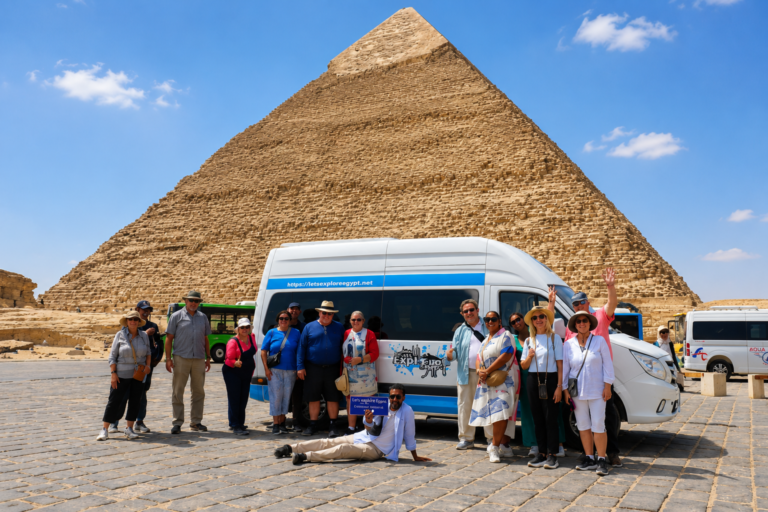
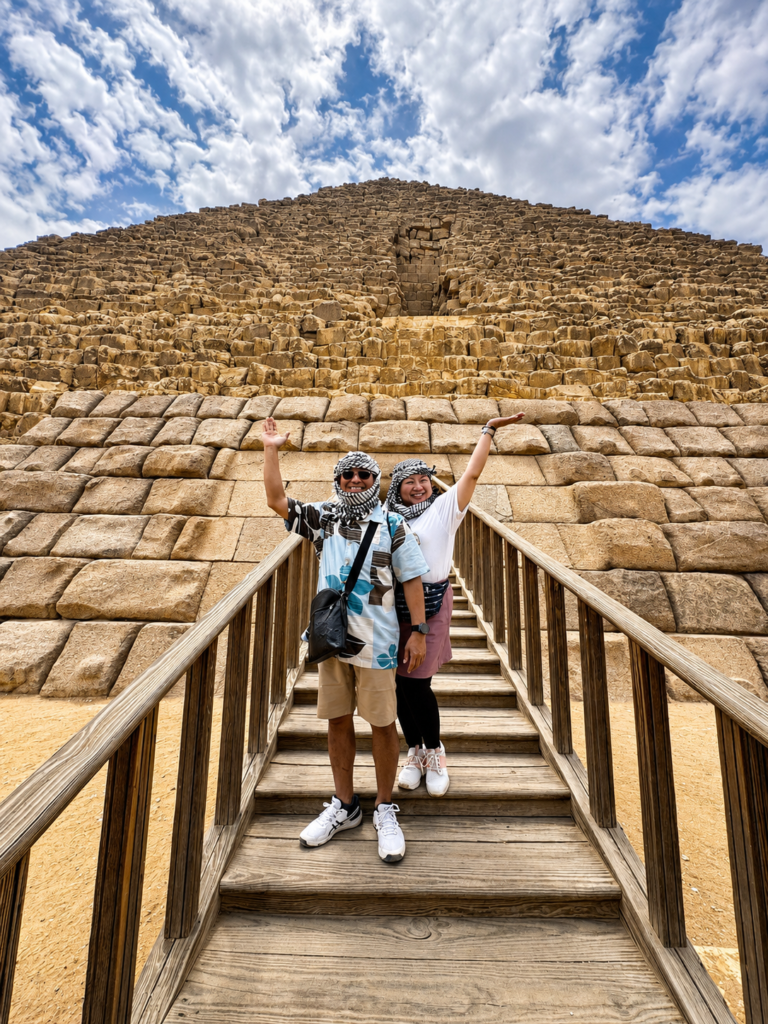
Turn your visit into an unforgettable experience with Let’s Explore Egypt.
Our private tours include:
- 🏛️ Licensed Egyptologist guides
- 🚗 Private air-conditioned transportation
- 📸 Plenty of time for photography
- 🎟️ Assistance with planning your visit
- 🌅 Sunrise and sunset tour options
- 👨👩👧 Private experiences for couples, families, and small groups
- 💬 24/7 WhatsApp support before and during your trip
Book your private Giza Pyramids tour today and discover the Pyramid of Khafre with local experts who bring Ancient Egypt to life.
Get in Touch
📱 WhatsApp: +20 1203233365
📧 Email: info@lets-explore-egypt.com
Recommended Egypt Tours
Why You Can Trust Let's Explore Egypt
This article was written and reviewed by the Let's Explore Egypt Editorial Team, a licensed Egyptian tour operator specializing in private Egypt tours, Nile cruises, and tailor-made travel experiences since 2009.
- 🏛 Licensed Egyptian Tour Operator Since 2009
- ⭐ Trusted by Thousands of Travelers Worldwide
- 👨🏫 Written & Reviewed by Local Egypt Travel Experts
- 🚐 Private Tours & Tailor-Made Travel Experiences
- 📞 24/7 Customer Support