

Introduction

Long before the Great Pyramid of Giza dominated the Egyptian skyline, another monument changed the course of architectural history forever. Hidden on the edge of the Western Desert, about 30 kilometres south of Cairo, lies Saqqara, the world’s oldest large-scale stone monument and one of the most significant archaeological sites ever discovered.
For over three thousand years, Saqqara served as the principal burial ground of Memphis, the first capital of Ancient Egypt. Kings, queens, nobles, priests, military commanders, sacred animals, and high officials were buried here, creating an enormous necropolis that stretches for more than 7 kilometres along the desert plateau.
Today, visitors to Saqqara experience much more than a single pyramid. The site is an open-air museum filled with royal tombs, magnificent temples, colourful wall paintings, underground burial chambers, ancient inscriptions, and monuments that continue to reveal new secrets every year through ongoing archaeological excavations.
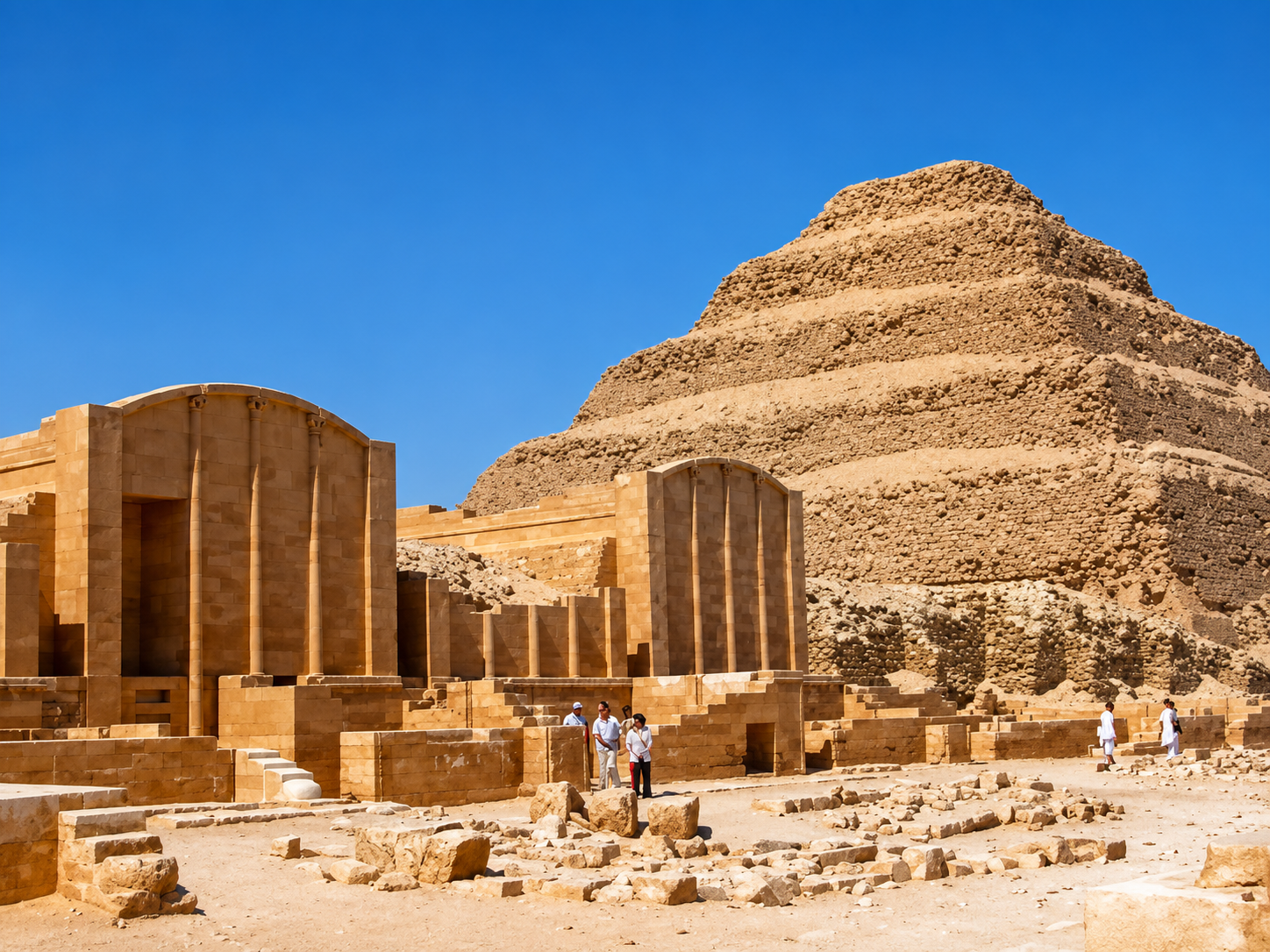
Unlike the busy atmosphere surrounding the Giza Pyramids, Saqqara offers a quieter and more immersive journey into Ancient Egypt. Visitors can walk through courtyards once reserved for pharaohs, enter beautifully preserved tombs decorated with scenes of everyday life, and stand before the revolutionary Step Pyramid of King Djoser—the monument that inspired every pyramid built after it.
Whether you are a history enthusiast, an archaeology lover, a photographer, or simply someone eager to experience one of Egypt’s greatest UNESCO World Heritage Sites, Saqqara offers an unforgettable adventure that reveals the origins of one of humanity’s greatest civilisations.
This comprehensive guide explores everything you need to know before visiting Saqqara, including its fascinating history, major attractions, practical travel tips, ticket information, and the remarkable discoveries that continue to make headlines around the world.
Quick Facts About Saqqara
| Information | Details |
|---|---|
| Location | Giza Governorate, Egypt |
| Distance from Cairo | Approximately 30 km |
| Distance from Giza Pyramids | Approximately 20 km |
| UNESCO Status | Part of Memphis and its Necropolis |
| Most Famous Monument | Step Pyramid of Djoser |
| Construction Date | Around 2667 BC |
| Architect | Imhotep |
| Best Visit Duration | 3–5 Hours |
| Best Time to Visit | October–April |
| Suitable For | Families, History Lovers, Photographers, Private Tours |
Where Is Saqqara?
Saqqara is located on the west bank of the Nile River, approximately 30 kilometres (19 miles) south of central Cairo and just a short drive from the famous Giza Pyramids.
The archaeological site sits on the edge of the desert overlooking the fertile Nile Valley. In ancient times, this elevated plateau was considered the perfect location for royal and noble burials because Egyptians believed the west represented the land of the dead, where the sun disappeared each evening before being reborn the following morning.
Saqqara formed part of the vast necropolis belonging to Memphis, Egypt’s first capital after the unification of Upper and Lower Egypt around 3100 BC.
Today, the site occupies several square kilometres and remains one of the largest archaeological areas in the country.
Distances from Major Attractions
| Destination | Distance | Approximate Travel Time |
|---|---|---|
| Downtown Cairo | 30 km | 45–60 Minutes |
| Giza Pyramids | 20 km | 30 Minutes |
| Grand Egyptian Museum | 25 km | 35 Minutes |
| Cairo International Airport | 45 km | 60 Minutes |
| Memphis Museum | 5 km | 10 Minutes |
| Dahshur | 10 km | 20 Minutes |
Because these attractions are located relatively close together, many visitors combine Saqqara with Memphis and Dahshur during a single full-day excursion.
Why Visit Saqqara?
Many first-time visitors to Egypt assume that the Giza Pyramids are the country’s most important archaeological site. While Giza is undoubtedly iconic, Saqqara offers an experience that many historians and seasoned travellers consider even more rewarding.
Instead of overwhelming crowds and busy tourist areas, Saqqara provides a peaceful setting where visitors can truly appreciate the remarkable achievements of Ancient Egyptian civilisation.
Here, history feels alive.
Walking through Saqqara is like stepping into an enormous outdoor museum where every monument tells another chapter in Egypt’s story.
Reasons to Visit Saqqara
1. Home to the World’s First Pyramid
The Step Pyramid of Djoser represents one of humanity’s greatest architectural breakthroughs.
Before its construction, Egyptian kings were buried beneath flat rectangular structures known as mastabas.
Imhotep’s revolutionary design transformed these simple tombs into the world’s first pyramid, changing architecture forever.
2. Incredible Ancient Tombs
Many visitors are surprised to discover that the beautifully decorated tombs of Saqqara often leave a stronger impression than the pyramids themselves.
Inside these tombs are vibrant carvings depicting:
- Farming
- Hunting
- Fishing
- Music
- Dancing
- Religious ceremonies
- Family life
- Ancient Egyptian professions
- Animal care
- Boat building
These scenes provide an extraordinary glimpse into everyday life over four thousand years ago.
3. Fewer Crowds
Unlike Giza, Saqqara rarely feels overcrowded.
Visitors can:
- Take uninterrupted photographs
- Explore peacefully
- Spend more time inside tombs
- Enjoy a relaxed atmosphere
- Listen easily to their guide
This makes Saqqara ideal for travellers seeking a more authentic experience.
4. Archaeology in Action
Saqqara continues to produce remarkable discoveries every year.
Recent excavations have uncovered:
- Hundreds of sealed coffins
- Painted sarcophagi
- Golden funerary masks
- Ancient papyri
- Colourful statues
- Mummies
- Animal cemeteries
- Burial shafts over 30 metres deep
Many of these discoveries have transformed historians’ understanding of Ancient Egyptian burial traditions.
5. Extraordinary Photography
Saqqara offers some of Egypt’s most spectacular photography opportunities.
Popular viewpoints include:
- The Step Pyramid
- Desert panoramas
- Ancient columns
- Tomb entrances
- Temple courtyards
- Limestone walls glowing at sunset
Because visitor numbers are generally lower, photographers often capture clean compositions without large crowds.
6. UNESCO World Heritage Site
Saqqara forms part of the UNESCO World Heritage Site known as Memphis and its Necropolis, recognising its immense historical and cultural importance.
This designation protects one of the world’s greatest archaeological landscapes for future generations.
A Brief History of Saqqara
The history of Saqqara spans more than three millennia, making it one of the longest continuously used burial grounds anywhere in the world.
Its story begins shortly after Egypt became a unified kingdom under King Narmer around 3100 BC.
As Memphis grew into Egypt’s political and administrative centre, the nearby desert plateau became the preferred burial place for royalty and high-ranking officials.
Over the centuries, Saqqara expanded into an enormous necropolis filled with mastabas, pyramids, temples, chapels, burial shafts, and ceremonial buildings.
Unlike many archaeological sites that represent only one historical period, Saqqara evolved continuously throughout Ancient Egyptian history.
Historical Timeline
| Period | Approximate Dates | Significance |
|---|---|---|
| Early Dynastic Period | 3100–2686 BC | First royal burials |
| Old Kingdom | 2686–2181 BC | Construction of the Step Pyramid and royal pyramids |
| First Intermediate Period | 2181–2055 BC | Continued use by nobles |
| Middle Kingdom | 2055–1650 BC | Restoration and new burials |
| New Kingdom | 1550–1070 BC | Tombs of high officials and priests |
| Late Period | 664–332 BC | Animal catacombs and temples |
| Greek & Roman Period | 332 BC onwards | Continued religious importance |
This extraordinary timeline illustrates why Saqqara remains one of Egypt’s richest archaeological landscapes.
The Birthplace of Pyramid Building
Before Saqqara, no civilisation had ever constructed a monumental stone building on such a scale.
The Step Pyramid changed everything.
It introduced entirely new engineering principles, massive limestone construction, sophisticated planning, and architectural techniques that would later culminate in the Great Pyramid of Giza.
For this reason, historians often describe Saqqara as the birthplace of monumental architecture.
Everything that followed—from the Bent Pyramid to the Red Pyramid and eventually the Great Pyramid—owes its origins to the revolutionary ideas first tested at Saqqara.
Saqqara Travel Guide
The Step Pyramid of Djoser: The Monument That Changed the World
The Step Pyramid of Djoser is not only the most famous monument in Saqqara—it is one of the greatest architectural achievements in human history. Constructed around 2667–2648 BC during Egypt’s Third Dynasty, it represents the world’s first monumental building made entirely from stone.
Before Djoser’s reign, Egyptian rulers were buried beneath rectangular mud-brick tombs called mastabas. Although impressive for their time, these structures were relatively simple and lacked the monumental scale that later came to define Ancient Egyptian architecture.
Everything changed when King Djoser appointed his brilliant architect, Imhotep, to design a royal tomb unlike anything ever built before.
The result was revolutionary.
Instead of constructing a single mastaba, Imhotep gradually enlarged the structure several times, stacking smaller mastabas on top of one another until it became the distinctive six-tiered pyramid we see today.
This innovation marked the beginning of pyramid construction in Egypt and inspired every pyramid built over the following centuries, including the Bent Pyramid, the Red Pyramid, and ultimately the Great Pyramid of Giza.
King Djoser
King Djoser ruled Egypt during the Third Dynasty of the Old Kingdom, approximately 2667 BC.
Although relatively little is known about his personal life, historians regard him as one of Ancient Egypt’s most influential pharaohs because his reign introduced monumental stone architecture on an unprecedented scale.
His government enjoyed political stability, economic prosperity, and ambitious building projects that reflected Egypt’s growing power.
The Step Pyramid became both his eternal resting place and a lasting symbol of royal authority.
Today, more than 4,600 years later, Djoser’s monument continues to dominate the Saqqara plateau.
Quick Facts About the Step Pyramid
| Feature | Details |
|---|---|
| Builder | King Djoser |
| Dynasty | Third Dynasty |
| Date | Around 2667 BC |
| Architect | Imhotep |
| Height | Approximately 62 metres |
| Base Dimensions | 121 × 109 metres |
| Material | Limestone |
| Number of Steps | Six |
| Historical Importance | World’s first large-scale stone building |
How the Pyramid Was Built
One of the most fascinating aspects of the Step Pyramid is that it was not built in a single phase.
Archaeological evidence shows that Imhotep repeatedly modified the design as construction progressed.
Stage One
Construction began with a traditional square mastaba built from limestone rather than mud bricks.
This alone represented an important innovation because previous royal tombs had been built primarily using mud bricks.
Stage Two
Rather than finishing the project, Imhotep expanded the mastaba, making it considerably larger.
The king’s tomb was becoming increasingly ambitious.
Stage Three
Additional layers were added on top of the original structure.
Instead of remaining flat, the monument gradually evolved into a stepped design.
Final Stage
Eventually, six enormous terraces were stacked one above another.
The finished monument reached approximately 62 metres in height and became visible for kilometres across the Nile Valley.
No civilisation had ever attempted anything comparable.
Why the Step Pyramid Was Revolutionary
The Step Pyramid introduced numerous architectural innovations.
1. First Monumental Stone Construction
Before Djoser, large public buildings were generally constructed using mud bricks.
Stone was typically reserved for smaller architectural elements.
Imhotep transformed this tradition by designing an enormous monument entirely from carefully cut limestone blocks.
This dramatically increased durability and permanence.
2. Birth of Pyramid Architecture
The Step Pyramid established the concept of pyramidal royal tombs.
Future architects improved the design over several generations until pyramid construction reached perfection during the Fourth Dynasty.
Without Saqqara, there would have been no Great Pyramid.
3. Advanced Engineering
Building a monument of this size required:
- Precise surveying
- Quarry management
- Transportation systems
- Skilled stone cutting
- Workforce organisation
- Structural planning
The project demonstrated an astonishing level of engineering for its time.
4. Monumental Symbolism
The pyramid symbolised the king’s ascent to the heavens after death.
Each ascending level represented the pharaoh’s journey toward eternal life among the gods.
This concept became central to Egyptian royal ideology.
Imhotep: The Genius Behind the Pyramid
Few individuals in history have influenced architecture as profoundly as Imhotep.
Although he lived over 4,600 years ago, his name remains famous because of his extraordinary achievements.
Unlike most architects of the ancient world, Imhotep’s identity survived through inscriptions and later historical traditions.
He eventually became so respected that Egyptians worshipped him as a god centuries after his death.
Titles Held by Imhotep
Historical inscriptions describe him as:
- Chancellor of Egypt
- High Priest of Heliopolis
- Royal Architect
- Chief Builder
- Physician
- Scholar
- Astronomer
- Engineer
- Adviser to King Djoser
Such a combination of responsibilities illustrates his exceptional status within Egyptian society.
Imhotep’s Legacy
Historians consider Imhotep one of history’s earliest known architects whose name has survived.
His innovations influenced:
- Egyptian architecture
- Monumental engineering
- Stone construction
- Temple planning
- Royal funerary complexes
Over two thousand years after his death, Greeks identified him with their healing god Asclepius because of his reputation as a physician.
Very few historical figures have remained admired for such an extraordinary length of time.
Exploring the Step Pyramid Complex
Although the pyramid itself attracts most attention, it stands within an enormous ceremonial complex covering approximately 15 hectares (37 acres).
The entire enclosure was designed to serve the king during the afterlife.
Everything inside had symbolic meaning.
Visitors entering the complex discover one of the world’s earliest examples of monumental urban planning.
The Massive Enclosure Wall
The complex is surrounded by an enormous limestone wall.
Dimensions
- Length: Approximately 1.6 kilometres
- Height: Around 10 metres
- Constructed from fine limestone
- Decorated with recessed palace-style panels
The wall contains numerous false doors.
Only one entrance was intended for actual use.
This symbolic design reflected ancient religious beliefs regarding access to the afterlife.
The Entrance Colonnade
After entering the complex, visitors walk through one of Egypt’s earliest monumental corridors.
The Entrance Colonnade contains rows of elegant limestone columns carved to imitate bundled reeds.
Although they appear delicate, these columns are carved from solid stone.
This remarkable design demonstrates how Egyptian architects translated traditional wooden architecture into permanent stone.
Walking through this passage today provides a powerful impression of how visitors may have approached the king’s ceremonial complex over four millennia ago.
The Heb-Sed Courtyard
Beyond the entrance lies one of the most fascinating spaces in the complex.
The Heb-Sed Court was designed for the Heb-Sed Festival, a royal ceremony celebrating the pharaoh’s continued ability to rule.
Traditionally, kings celebrated this festival after thirty years on the throne.
The event included ritual races, religious ceremonies, and symbolic demonstrations of strength.
Even after death, Djoser was believed to continue participating in these ceremonies for eternity.
The courtyard therefore formed an essential part of his funerary complex.
Symbolic Buildings
Surrounding the courtyard are numerous ceremonial structures.
Many were not functional buildings.
Instead, they served symbolic purposes, allowing the king’s spirit to perform rituals forever.
Architects reproduced shrines from throughout Egypt, creating an eternal ceremonial landscape.
This remarkable attention to religious symbolism highlights the sophistication of Old Kingdom beliefs.
Underground Tunnels
Beneath the pyramid lies an extraordinary underground world.
The network extends for more than five kilometres, making it one of the largest ancient underground complexes ever created.
These tunnels include:
- Burial chambers
- Storage rooms
- Corridors
- Decorative chambers
- Ritual spaces
- Family burial rooms
The scale of the underground construction is almost as impressive as the pyramid itself.
The Royal Burial Chamber
Deep beneath the pyramid lies King Djoser’s burial chamber.
Originally protected by enormous granite blocks, the chamber housed the king’s sarcophagus along with treasures intended for his eternal journey.
Although ancient tomb robbers removed many valuable objects thousands of years ago, the chamber remains one of the most important archaeological spaces in Egypt.
Blue Faience Chambers
Among the most beautiful discoveries beneath the pyramid are the famous Blue Faience Chambers.
Their walls were decorated with thousands of brilliant blue ceramic tiles designed to imitate woven reed mats used inside royal palaces.
The vivid blue colour symbolised:
- Water
- Rebirth
- Protection
- Eternal life
These chambers demonstrate the remarkable artistic achievements of Old Kingdom craftsmen.
Restoration of the Step Pyramid
Over thousands of years, earthquakes, weathering, and structural instability threatened the survival of the monument.
A major conservation project lasting more than a decade carefully reinforced the pyramid using modern engineering techniques while preserving its original appearance.
The restoration stabilised internal corridors, strengthened weakened sections, improved visitor safety, and allowed controlled public access to parts of the monument once again.
Today, visitors can appreciate the Step Pyramid as both an ancient wonder and a carefully preserved archaeological treasure.
Quick Facts About the Step Pyramid
| Feature | Details |
|---|---|
| Ancient Name | Pyramid of Netjerykhet (Djoser) |
| Pharaoh | King Djoser |
| Dynasty | Third Dynasty |
| Construction Date | c. 2667–2648 BC |
| Architect | Imhotep |
| Height | Approximately 62 metres (204 ft) |
| Base Dimensions | 121 × 109 metres |
| Material | Limestone |
| Number of Levels | Six Steps |
| Historical Importance | World’s first stone pyramid |
King Djoser: The Pharaoh Behind the Revolution
King Djoser ruled Egypt during the early Old Kingdom, a period marked by political stability, economic prosperity, and ambitious construction projects.
Rather than building another traditional mastaba like his predecessors, Djoser envisioned a monument that would symbolise his divine power for eternity. His decision to commission a completely new style of royal tomb changed the history of architecture forever.
Although little is known about his personal life, his legacy survives through the magnificent complex that still dominates the Saqqara plateau today.
How the Step Pyramid Was Built
One of the most fascinating discoveries made by archaeologists is that the Step Pyramid was not constructed in a single phase.
Instead, it evolved gradually through several redesigns.
| Construction Phase | Description |
|---|---|
| Phase 1 | A square limestone mastaba was constructed. |
| Phase 2 | The mastaba was enlarged considerably. |
| Phase 3 | Additional layers were added, creating four steps. |
| Phase 4 | Two more levels completed the six-step pyramid. |
This gradual evolution shows how Egyptian architects experimented with increasingly ambitious ideas until creating the world’s first pyramid.
From Mastaba to Pyramid
Before Djoser’s reign, elite Egyptians were buried inside mastabas.
Mastaba Characteristics
- Flat roof
- Rectangular shape
- Mud-brick construction
- Underground burial chamber
- Simple superstructure
Imhotep transformed this traditional design by stacking mastabas of decreasing size on top of one another.
The result became known as the Step Pyramid, introducing an entirely new architectural form that would dominate Egyptian royal burials for centuries.
Why the Step Pyramid Was Revolutionary
The monument represented several firsts in world history.
1. The First Monumental Stone Building
Large public buildings had previously been constructed mainly from mud bricks.
For the first time, enormous limestone blocks were cut, transported, and assembled to create a permanent royal monument.
This innovation dramatically increased durability and established stone as the preferred material for monumental architecture.
2. Birth of Pyramid Architecture
Every famous pyramid built later—including those at Dahshur and Giza—owed its inspiration to Djoser’s Step Pyramid.
Without Saqqara, there would likely have been no Great Pyramid of Khufu.
3. Engineering Breakthrough
Building such an enormous structure required advances in nearly every field of construction.
Ancient engineers developed:
- Large-scale quarrying
- Precision stone cutting
- Surveying techniques
- Workforce organisation
- Transport systems
- Structural planning
These achievements demonstrated an extraordinary level of engineering for the 27th century BC.
4. Religious Symbolism
The stepped design represented the king’s journey toward the heavens.
Egyptians believed the pharaoh became divine after death.
The pyramid therefore functioned not only as a tomb but also as a symbolic staircase connecting Earth and the gods.
Imhotep: Egypt’s Greatest Architect

Few people have influenced architecture as profoundly as Imhotep.
He served not only as Djoser’s architect but also as one of the most respected officials in Ancient Egypt.
Titles Held by Imhotep
| Position | Role |
|---|---|
| Chancellor | Senior government official |
| High Priest | Religious leader |
| Architect | Designer of the Step Pyramid |
| Physician | Royal doctor |
| Engineer | Construction supervisor |
| Astronomer | Calendar and ceremonial adviser |
Centuries after his death, Egyptians worshipped Imhotep as a god of wisdom and medicine, while the Greeks later associated him with Asclepius, their god of healing.
The Step Pyramid Complex
The pyramid itself is only one part of an enormous ceremonial complex covering approximately 15 hectares (37 acres).
The complex was designed to provide everything King Djoser would need during eternity.
Main Areas of the Complex
| Monument | Purpose |
|---|---|
| Step Pyramid | Royal tomb |
| Entrance Colonnade | Ceremonial entrance |
| Heb-Sed Court | Royal jubilee festival |
| South Court | Religious ceremonies |
| Serdab | Statue chamber |
| Southern Tomb | Symbolic royal burial |
| Temples | Religious rituals |
| Underground Galleries | Burial chambers and storage |
The scale of the complex was unprecedented for its time and influenced later royal funerary architecture throughout Egypt.
The Entrance Colonnade
One of the first features visitors encounter is the magnificent Entrance Colonnade.
This long corridor contains rows of limestone columns carved to imitate bundled reeds, reflecting earlier wooden architecture translated into permanent stone.
Walking through the passage today offers an impressive introduction to the ceremonial grandeur of the complex.
The Heb-Sed Court

The Heb-Sed Court played an important role in one of Ancient Egypt’s most significant royal ceremonies.
The Heb-Sed Festival celebrated the pharaoh’s continued strength and legitimacy after thirty years of rule.
The king would symbolically run between markers representing Upper and Lower Egypt, demonstrating his ability to govern the united kingdom.
Even after death, Djoser was believed to continue performing these ceremonies for eternity.
The Massive Enclosure Wall
The entire complex is enclosed by an enormous limestone wall.
| Feature | Measurement |
|---|---|
| Total Length | Approximately 1.6 km |
| Height | Around 10 metres |
| Material | Fine limestone |
| False Doors | 14 |
| Functional Entrance | 1 |
The many false doors symbolised spiritual gateways, while only one real entrance allowed ceremonial access.
Underground Tunnels
One of Saqqara’s greatest hidden wonders lies beneath the pyramid.
The underground network extends for more than 5 kilometres, containing:
- Royal burial chambers
- Storage magazines
- Long corridors
- Family burial shafts
- Ritual rooms
- Decorative chambers
These passages remain among the most complex underground funerary systems ever created in the ancient world.
The Blue Faience Chambers
Among the most beautiful discoveries inside the complex are the famous Blue Faience Chambers.
Their walls were covered with thousands of brilliant blue ceramic tiles designed to imitate woven reed mats found inside royal palaces.
Blue symbolised:
- Eternal life
- Water
- Protection
- Rebirth
- Creation
These chambers demonstrate the extraordinary artistic skill achieved during Egypt’s Third Dynasty.
Restoration of the Step Pyramid
After surviving more than four millennia, the Step Pyramid required extensive conservation.
Modern restoration projects strengthened weakened stone blocks, stabilised internal passages, improved drainage, and enhanced visitor safety while preserving the monument’s historical integrity. These efforts have allowed visitors to appreciate one of the world’s oldest monumental buildings while helping ensure its survival for future generations.
Saqqara Travel Guide
Royal Tombs, Pyramid Texts & Hidden Treasures of Saqqara
While the Step Pyramid attracts most visitors, the royal tombs and noble mastabas scattered across Saqqara are among the finest examples of Ancient Egyptian art. Their beautifully carved walls, colourful reliefs, and detailed inscriptions provide an extraordinary record of life more than 4,000 years ago.
Unlike temples, which focus on the gods, these tombs tell the stories of real people—their families, occupations, beliefs, and hopes for the afterlife.
Many Egyptologists consider the decorated tombs of Saqqara to be even more impressive than the pyramids themselves because of their remarkable state of preservation.
The Tomb of Mereruka
he Tomb of Mereruka is the largest and most elaborate private tomb in Saqqara.
Mereruka served as the Vizier (chief minister) under King Teti during Egypt’s Sixth Dynasty and held numerous important government positions.
His magnificent tomb contains more than 30 rooms, each decorated with detailed reliefs illustrating daily life during the Old Kingdom.
Quick Facts
| Feature | Details |
|---|---|
| Owner | Mereruka |
| Position | Vizier of King Teti |
| Dynasty | Sixth Dynasty |
| Date | c. 2345 BC |
| Number of Rooms | More than 30 |
| Famous For | Daily life scenes |
Highlights Inside the Tomb
Visitors will discover remarkable carvings showing:
- Farmers harvesting grain
- Fishermen catching Nile fish
- Boat builders constructing vessels
- Hunters pursuing hippopotamuses
- Goldsmiths at work
- Musicians entertaining guests
- Priests performing rituals
- Family banquets
- Animal husbandry
- Textile production
These scenes offer historians valuable insight into Egyptian society, economy, and culture.
Artistic Masterpieces
The reliefs inside Mereruka’s tomb remain astonishingly detailed.
Artists carefully carved:
- Facial expressions
- Animal anatomy
- Clothing styles
- Jewellery
- Hairstyles
- Agricultural tools
- Boats
- Furniture
Although over four thousand years old, many carvings still appear remarkably sharp.
The Tomb of Ti


One of the most famous tombs in all of Egypt belongs to Ti, a wealthy royal official who lived during the Fifth Dynasty.
Although Ti was not a king, his influence at court allowed him to construct one of the finest decorated mastabas ever discovered.
About Ti
| Information | Details |
|---|---|
| Name | Ti |
| Dynasty | Fifth Dynasty |
| Occupation | Royal Administrator |
| Date | Around 2450 BC |
| Tomb Type | Mastaba |
Famous Wall Scenes
The Tomb of Ti is celebrated for its extraordinary reliefs.
Among the highlights are:
- Hippopotamus hunting
- Crocodiles attacking prey
- Papyrus marshes
- Bird hunting
- Fishing expeditions
- Boat construction
- Cattle counting
- Agricultural harvests
- Servants preparing food
- Family celebrations
These scenes demonstrate the incredible artistic skill achieved during the Old Kingdom.
The Pyramid of Unas


Although modest in size compared with earlier pyramids, the Pyramid of King Unas is one of the most historically important monuments in Egypt.
Its greatest significance lies inside.
The burial chamber contains the world’s oldest known collection of royal religious inscriptions.
Pyramid of Unas Facts
| Feature | Details |
|---|---|
| Pharaoh | Unas |
| Dynasty | Fifth Dynasty |
| Built | Around 2350 BC |
| Famous For | Pyramid Texts |
The Pyramid Texts
The walls of Unas’s burial chamber are completely covered with finely carved hieroglyphs.
Known today as the Pyramid Texts, these inscriptions contain hundreds of magical spells intended to help the king safely reach the afterlife.
They include prayers, hymns, protective formulas, and guidance for navigating the spiritual world.
Why Are the Pyramid Texts Important?
The Pyramid Texts became the foundation for later Egyptian religious literature.
| Religious Text | Developed From |
|---|---|
| Pyramid Texts | Original royal spells |
| Coffin Texts | Expanded for nobles |
| Book of the Dead | Later funerary guide |
These writings reveal how Ancient Egyptians understood death, resurrection, divine judgment, and eternal life.
The Pyramid of Teti
Near the Tomb of Mereruka stands the Pyramid of King Teti, the first ruler of Egypt’s Sixth Dynasty.
Although its exterior appears heavily weathered today, the interior still preserves remarkable inscriptions.
Like Unas’s pyramid, Teti’s burial chamber contains Pyramid Texts that continue to provide valuable evidence for Egyptologists studying Old Kingdom religion.
Quick Facts
| Feature | Details |
|---|---|
| Pharaoh | Teti |
| Dynasty | Sixth Dynasty |
| Date | Around 2345 BC |
| Interior | Pyramid Texts |
| Nearby | Tomb of Mereruka |
The Serapeum of Saqqara


Hidden beneath the desert lies one of Saqqara’s most mysterious monuments—the Serapeum.
Discovered in the nineteenth century by French archaeologist Auguste Mariette, this underground complex served as the burial place of the sacred Apis Bulls, animals believed to be earthly manifestations of the god Ptah.
Massive Granite Sarcophagi
The Serapeum contains enormous granite coffins unlike anything else in Egypt.
| Feature | Measurement |
|---|---|
| Weight | Up to 70 tonnes |
| Material | Granite |
| Surface | Highly polished |
| Purpose | Burial of sacred Apis Bulls |
The precision with which these sarcophagi were carved continues to impress engineers today.
The Sacred Apis Bull
Ancient Egyptians believed certain bulls possessed divine qualities.
When an Apis Bull died:
- It was carefully mummified.
- Elaborate funeral ceremonies were held.
- The body was placed inside a granite sarcophagus.
- Priests searched for the next sacred bull.
This tradition continued for more than one thousand years.
Noble Tombs Throughout Saqqara
Besides the famous tombs of Mereruka and Ti, visitors can explore dozens of beautifully decorated mastabas belonging to:
- Priests
- Military commanders
- Treasury officials
- Judges
- Royal scribes
- Architects
- High administrators
Each tomb tells a unique story through its inscriptions and artwork.
Daily Life Preserved in Stone
One of Saqqara’s greatest treasures is its record of everyday Egyptian life.
Visitors can see scenes depicting:
| Theme | Examples |
|---|---|
| Agriculture | Harvesting wheat, ploughing fields |
| Fishing | Nile boats and nets |
| Hunting | Birds, gazelles and hippos |
| Music | Harps, flutes and dancers |
| Crafts | Pottery, carpentry and metalworking |
| Food | Bread making, brewing beer, butchery |
| Religion | Offerings and funerary rituals |
These reliefs provide one of the world’s richest visual records of an ancient civilisation.
Recent Archaeological Discoveries


Saqqara remains one of the most active archaeological sites in the world.
Recent excavations have uncovered:
- Hundreds of sealed wooden coffins
- Colourfully painted sarcophagi
- Golden funerary masks
- Bronze statues of ancient gods
- Thousands of ushabti figurines
- Mummified cats, birds and crocodiles
- Ancient papyrus scrolls
- Burial shafts more than 30 metres deep
These discoveries continue to reshape historians’ understanding of Egyptian religion and burial customs.
Why History Lovers Shouldn’t Miss Saqqara
Saqqara offers something unique that few archaeological sites can match.
Rather than focusing solely on kings and monuments, it reveals the lives of ordinary officials, craftsmen, priests, and families who helped build one of history’s greatest civilisations.
Every carved wall, painted relief, and hieroglyphic inscription tells another chapter in the remarkable story of Ancient Egypt.
Planning Your Visit: Tickets, Opening Hours, Transportation & Essential Travel Tips


Planning your visit to Saqqara is just as important as understanding its fascinating history. Although the archaeological site is only a short drive from Cairo, it covers a vast area filled with pyramids, temples, tombs, underground passages, and museums.
Unlike the Giza Plateau, where many attractions are concentrated in one area, Saqqara requires more walking and thoughtful planning to make the most of your visit.
Whether you’re travelling independently or joining a private guided tour, this section covers everything you need to know before arriving.
Best Time to Visit Saqqara
Egypt is a year-round destination, but the experience at Saqqara varies significantly depending on the season.
Because much of the archaeological site is exposed to the desert sun, cooler months provide the most comfortable conditions.
Weather by Season
| Season | Months | Temperature | Recommendation |
|---|---|---|---|
| Autumn | October – November | 22–30°C | ⭐⭐⭐⭐⭐ Excellent |
| Winter | December – February | 16–24°C | ⭐⭐⭐⭐⭐ Best Time |
| Spring | March – April | 22–32°C | ⭐⭐⭐⭐ Very Good |
| Summer | May – September | 32–42°C | ⭐⭐ Very Hot |
Winter is considered the ideal season because temperatures remain comfortable for several hours of walking.
Best Time of Day
The time you arrive can dramatically affect your experience.
| Time | Advantages | Rating |
|---|---|---|
| 8:00–10:00 AM | Cool weather, soft light, fewer visitors | ⭐⭐⭐⭐⭐ |
| 10:00 AM–12:00 PM | Pleasant conditions | ⭐⭐⭐⭐ |
| 12:00–2:00 PM | Bright but hot | ⭐⭐⭐ |
| 2:00–5:00 PM | Beautiful afternoon light | ⭐⭐⭐⭐ |
Early mornings are particularly recommended for photographers.
Opening Hours
Saqqara is generally open every day of the week.
| Day | Opening Hours |
|---|---|
| Monday | 8:00 AM – 5:00 PM |
| Tuesday | 8:00 AM – 5:00 PM |
| Wednesday | 8:00 AM – 5:00 PM |
| Thursday | 8:00 AM – 5:00 PM |
| Friday | 8:00 AM – 5:00 PM |
| Saturday | 8:00 AM – 5:00 PM |
| Sunday | 8:00 AM – 5:00 PM |
Note: Opening hours may vary during public holidays, Ramadan, or due to conservation work. Some tombs may also close temporarily for restoration.
Entrance Tickets
Ticket prices are periodically updated by the Egyptian authorities.
General admission usually includes access to the main archaeological area, while certain tombs or monuments may require additional tickets depending on current regulations.
Before travelling, it’s advisable to check the latest ticket prices through the official channels or with your tour operator.
How Long Should You Spend at Saqqara?
The amount of time depends on your interest in Ancient Egyptian history.
| Visitor Type | Recommended Duration |
|---|---|
| Quick Visit | 1.5–2 Hours |
| Standard Visit | 3–4 Hours |
| History Enthusiast | 5–6 Hours |
| Professional Photographer | Full Day |
Most visitors spend around three to four hours exploring the major attractions.
How to Get to Saqqara
From Cairo
Saqqara is approximately 30 kilometres south of Cairo.
Travel Options
| Transport | Travel Time | Convenience |
|---|---|---|
| Private Tour | 45–60 minutes | ⭐⭐⭐⭐⭐ |
| Private Car with Driver | 45–60 minutes | ⭐⭐⭐⭐⭐ |
| Taxi | 50–70 minutes | ⭐⭐⭐⭐ |
| Uber | Around 1 hour | ⭐⭐⭐⭐ |
| Public Transport | 2+ hours | ⭐⭐ |
Private transport is generally the easiest and most efficient option because public transport does not stop directly at the archaeological entrance.
From the Giza Pyramids
Many visitors combine both sites on the same day.
| Route | Distance | Travel Time |
|---|---|---|
| Giza Plateau → Saqqara | Approximately 20 km | 30–40 Minutes |
This route is one of the most popular day-trip combinations in Egypt.
Visiting with a Guide vs Visiting Independently
| Guided Tour | Independent Visit |
|---|---|
| Detailed historical explanations | Explore at your own pace |
| Easier navigation | Greater flexibility |
| Local knowledge | Less structured |
| Efficient itinerary | Requires more planning |
| Opportunity to ask questions | Good for repeat visitors |
For first-time visitors, a licensed Egyptologist guide can provide valuable historical context that greatly enriches the experience.
What to Wear
Comfort is essential when exploring Saqqara.
Recommended Clothing
- Lightweight breathable clothing
- Comfortable walking shoes
- Wide-brimmed hat or cap
- Sunglasses
- Light jacket during winter mornings
- Modest clothing suitable for cultural sites
Avoid high heels or shoes with poor grip, as some areas have uneven stone surfaces.
What to Bring
Packing the right items can make your visit much more enjoyable.
| Item | Recommended |
|---|---|
| Passport or ID | ✔ |
| Camera | ✔ |
| Sunglasses | ✔ |
| Sunscreen | ✔ |
| Hat | ✔ |
| Water Bottle | ✔ |
| Comfortable Backpack | ✔ |
| Power Bank | ✔ |
| Cash for Small Purchases | ✔ |
Staying hydrated is particularly important during the warmer months.
Photography Tips


Saqqara is one of Egypt’s best destinations for photography thanks to its open desert landscapes and relatively small crowds.
Best Photography Locations
| Location | Best Time |
|---|---|
| Step Pyramid | Morning |
| Entrance Colonnade | Early Morning |
| Heb-Sed Court | Morning |
| Desert Plateau | Sunset |
| Pyramid Panorama | Late Afternoon |
| Tomb Entrances | Mid-Morning |
Golden hour lighting creates beautiful contrasts between the pale limestone monuments and the surrounding desert.
Accessibility
Although restoration work has improved visitor access in many areas, Saqqara remains an ancient archaeological site with uneven paths, stairs, and sandy terrain.
Visitors with limited mobility should check in advance which areas are currently accessible.
Facilities at Saqqara
Visitors will generally find:
- Visitor entrance
- Ticket office
- Restrooms
- Parking area
- Small souvenir shops
- Refreshment kiosks
- Tourist police
- Information signs
Facilities may vary depending on ongoing archaeological work.
Combining Saqqara with Other Attractions
One of the greatest advantages of visiting Saqqara is its proximity to several other world-famous archaeological sites.
Suggested Half-Day Tour
| Time | Activity |
|---|---|
| 8:00 AM | Depart Cairo |
| 9:00 AM | Arrive at Saqqara |
| 9:00–12:00 PM | Explore the Step Pyramid and tombs |
| 12:15 PM | Return to Cairo |
Suggested Full-Day Tour
| Time | Activity |
|---|---|
| 8:00 AM | Depart Cairo |
| 9:00 AM | Visit Saqqara |
| 12:00 PM | Lunch at a local restaurant |
| 1:30 PM | Explore Memphis |
| 3:00 PM | Visit Dahshur (Bent Pyramid & Red Pyramid) |
| 5:30 PM | Return to Cairo |
This itinerary offers a fascinating overview of the evolution of pyramid building in Ancient Egypt.
Nearby Attractions


| Attraction | Distance from Saqqara | Why Visit? |
|---|---|---|
| Memphis | 5 km | Egypt’s first capital and home to the Colossus of Ramses II |
| Dahshur | 10 km | See the Bent Pyramid and Red Pyramid |
| Giza Plateau | 20 km | Visit the Great Pyramid and the Sphinx |
| Grand Egyptian Museum | 25 km | Discover thousands of ancient artefacts |
Together, these sites provide a complete picture of Egypt’s architectural development from the earliest pyramids to the masterpieces of Giza.
Essential Visitor Tips
✔ Arrive early to avoid the midday heat.
✔ Wear comfortable walking shoes, as you’ll cover considerable distances.
✔ Bring plenty of drinking water, especially in summer.
✔ Respect barriers and avoid climbing on ancient monuments.
✔ Take your time inside the decorated tombs to appreciate the remarkable artwork.
✔ Consider hiring a licensed Egyptologist guide for a richer understanding of the site’s history.
✔ Combine Saqqara with Memphis and Dahshur for one of Egypt’s most rewarding day trips.
Frequently Asked Questions, Travel Tips & Why Saqqara Should Be on Every Egypt Itinerary


After exploring the incredible monuments, royal tombs, and ancient pyramids of Saqqara, many visitors leave with the same thought: “Why isn’t this place as famous as the Giza Pyramids?”
The answer is simple. Giza is the world’s most iconic pyramid site, but Saqqara tells the complete story of how pyramid building began. Without Saqqara, there would be no Bent Pyramid, no Red Pyramid, and no Great Pyramid of Khufu.
For travellers interested in history, architecture, archaeology, or photography, Saqqara is one of Egypt’s most rewarding destinations.
Why Saqqara Is a UNESCO World Heritage Site
In 1979, UNESCO inscribed Memphis and its Necropolis – the Pyramid Fields from Giza to Dahshur on the World Heritage List.
Saqqara forms one of the most important sections of this protected archaeological landscape because it contains:
- The world’s first monumental stone building
- Egypt’s earliest pyramid complex
- Royal pyramids from several dynasties
- Hundreds of decorated noble tombs
- Ancient religious monuments
- Underground burial complexes
- Continuous archaeological discoveries
This recognition highlights Saqqara’s exceptional importance to human history.
Interesting Facts About Saqqara
| Fact | Description |
|---|---|
| World’s First Pyramid | The Step Pyramid of Djoser is the oldest pyramid ever built. |
| First Stone Monument | It is the earliest known large-scale stone building in history. |
| Architect | Designed by the famous Imhotep. |
| Ancient Cemetery | Used for more than 3,000 years. |
| Royal Burials | Multiple kings built pyramids at Saqqara. |
| Pyramid Texts | The oldest religious inscriptions in the world were discovered here. |
| Active Excavations | Archaeologists continue making major discoveries almost every year. |
| UNESCO Site | Protected as part of Memphis and its Necropolis. |
20 Frequently Asked Questions
1. Is Saqqara worth visiting?
Absolutely. Saqqara is one of Egypt’s most important archaeological sites and offers a quieter, more immersive experience than many other attractions.
2. How far is Saqqara from Cairo?
Approximately 30 kilometres (19 miles) south of central Cairo, depending on your starting point.
3. Can I visit Saqqara and Giza in one day?
Yes. Many visitors combine:
- Giza Pyramids
- Great Sphinx
- Saqqara
- Memphis
into a full-day itinerary.
4. How much time should I spend at Saqqara?
Allow at least 3–4 hours to explore the main highlights comfortably.
5. Is a guide necessary?
A guide is not required, but a licensed Egyptologist greatly enhances the experience by explaining the history, symbolism, and artwork throughout the site.
6. Is Saqqara suitable for children?
Yes. Families often enjoy the open spaces, fascinating monuments, and the opportunity to learn about Ancient Egyptian civilisation.
7. Can I enter the Step Pyramid?
Access may be available depending on conservation work and current visitor regulations.
8. What is the oldest monument at Saqqara?
The Step Pyramid of King Djoser is considered the world’s oldest monumental stone building.
9. Is Saqqara crowded?
Generally, it is much quieter than the Giza Plateau, making it ideal for visitors who prefer a more relaxed atmosphere.
10. What should I wear?
Lightweight clothing, comfortable walking shoes, a hat, sunglasses, and sunscreen are highly recommended.
11. Can I take photographs?
Photography is generally permitted in outdoor areas. Some indoor tombs may have specific restrictions.
12. Are there restaurants nearby?
Yes. Restaurants can be found on the route between Giza and Saqqara, and many private tours include lunch at a local Egyptian restaurant.
13. What is the best season to visit?
October through April offers the most comfortable weather for sightseeing.
14. How old is the Step Pyramid?
It is more than 4,600 years old, dating to the Third Dynasty of Ancient Egypt.
15. Who built the Step Pyramid?
It was commissioned by King Djoser and designed by his architect Imhotep.
16. Is Saqqara a desert?
Yes. The archaeological site sits on the edge of Egypt’s Western Desert, overlooking the fertile Nile Valley.
17. Can I visit without a tour?
Yes. Independent visitors can reach Saqqara by taxi or private car, though organised tours often provide transportation and expert guidance.
18. What is the Serapeum?
The Serapeum is an underground burial complex containing massive granite sarcophagi for the sacred Apis Bulls.
19. Why is Saqqara important?
Saqqara marks the beginning of pyramid construction and preserves some of the oldest surviving monuments of Ancient Egypt.
20. Is Saqqara still being excavated?
Yes. Archaeologists continue uncovering tombs, statues, coffins, inscriptions, and other remarkable artefacts, making Saqqara one of the world’s most active archaeological sites.
Suggested Day Trip Itinerary
| Time | Activity |
|---|---|
| 8:00 AM | Pick-up from your hotel in Cairo or Giza |
| 9:00 AM | Explore the Step Pyramid Complex |
| 10:30 AM | Visit the Tomb of Mereruka |
| 11:15 AM | Explore the Pyramid of Unas |
| 12:00 PM | Visit the Serapeum |
| 1:00 PM | Lunch at a local restaurant |
| 2:30 PM | Visit Memphis |
| 3:30 PM | Explore Dahshur |
| 5:30 PM | Return to your hotel |
Who Should Visit Saqqara?
Saqqara is an excellent destination for:
- History enthusiasts
- Archaeology lovers
- Families
- Photographers
- Students
- Solo travellers
- Couples
- Small private groups
- Cruise passengers with extra time in Cairo
Whether it’s your first trip to Egypt or your fifth, Saqqara offers a unique perspective on the origins of one of the world’s greatest civilisations.
Travel Tips Before You Go
| Tip | Why It Matters |
|---|---|
| Arrive early | Cooler temperatures and softer light |
| Wear walking shoes | Uneven terrain and sandy paths |
| Carry water | The desert climate can be hot and dry |
| Bring a camera | Excellent photography opportunities |
| Hire a guide | Gain deeper historical insight |
| Combine nearby sites | Save travel time and enjoy a fuller experience |
| Check opening hours | Some tombs may close for restoration |
Nearby Attractions


After visiting Saqqara, consider exploring these nearby attractions:
| Attraction | Distance | Highlights |
|---|---|---|
| Giza Pyramids | 20 km | Great Pyramid, Sphinx, panoramic viewpoints |
| Grand Egyptian Museum | 25 km | Thousands of ancient artefacts and royal treasures |
| Memphis | 5 km | Colossus of Ramses II, Alabaster Sphinx |
| Dahshur | 10 km | Bent Pyramid and Red Pyramid |
Final Thoughts
Saqqara is much more than an ancient cemetery—it’s the birthplace of pyramid construction and one of the most significant archaeological sites on Earth. From the revolutionary Step Pyramid of Djoser to the richly decorated tombs of nobles, every monument reveals another chapter in the story of Ancient Egypt.
Unlike more crowded attractions, Saqqara offers a peaceful atmosphere where visitors can truly appreciate the scale, artistry, and innovation of one of history’s greatest civilisations. The site’s ongoing archaeological discoveries ensure that every visit has the potential to uncover something new, making it a destination that continues to fascinate historians and travellers alike.
Whether you’re visiting Egypt for the first time or returning to explore beyond the famous landmarks, Saqqara deserves a place at the top of your itinerary.
Book Your Private Saqqara Tour with Let’s Explore Egypt
Experience Saqqara with a licensed Egyptologist guide and discover stories that bring the ancient necropolis to life.
Our private tours can include:
- ✅ Step Pyramid of Djoser
- ✅ Tomb of Mereruka
- ✅ Pyramid of Unas
- ✅ Serapeum
- ✅ Memphis Open-Air Museum
- ✅ Dahshur (Bent & Red Pyramids)
- ✅ Hotel pick-up and drop-off
- ✅ Air-conditioned private transportation
- ✅ Flexible departure times
- ✅ Optional lunch at a local Egyptian restaurant
Whether you’re interested in archaeology, photography, or a deeper understanding of Ancient Egypt, a private guided experience allows you to explore Saqqara at your own pace with expert insights every step of the way.
Ready to Explore Saqqara?
Discover the birthplace of pyramid building with a private, fully customizable Saqqara tour led by a licensed Egyptologist. Whether you’re passionate about ancient history or simply want to experience one of Egypt’s most remarkable UNESCO World Heritage Sites, we’ll make your visit comfortable, informative, and unforgettable.
Our Private Saqqara Tours Include
- ✅ Private air-conditioned vehicle
- ✅ Hotel pick-up & drop-off from Cairo or Giza
- ✅ Licensed Egyptologist guide
- ✅ Visit the Step Pyramid of Djoser
- ✅ Explore the Tomb of Mereruka & Tomb of Ti
- ✅ Visit the Pyramid of Unas and the Pyramid Texts
- ✅ Optional Serapeum visit
- ✅ Combine with Memphis & Dahshur
- ✅ Flexible departure times
- ✅ No forced shopping stops
Why Book with Let’s Explore Egypt?
| Feature | Benefit |
|---|---|
| 100% Private Tours | Explore at your own pace |
| Licensed Local Guides | Accurate historical insights |
| Modern Air-Conditioned Vehicles | Comfortable travel |
| Flexible Itineraries | Customize your experience |
| Transparent Pricing | No hidden fees |
| Excellent Customer Support | Assistance before and during your trip |
Make Your Journey Even More Special
Enhance your experience by combining Saqqara with:
- 🏛️ Giza Pyramids & the Great Sphinx
- 🏺 Memphis Open-Air Museum
- 🔺 Dahshur (Bent Pyramid & Red Pyramid)
- 🏛️ Grand Egyptian Museum
- 🍽️ Traditional Egyptian lunch at a carefully selected local restaurant
Book Your Private Saqqara Tour Today
Step back more than 4,600 years and discover where pyramid building began. Walk through the world’s oldest stone monument, admire beautifully decorated tombs, and uncover the secrets of Ancient Egypt with expert guidance.
Contact Let’s Explore Egypt
📞 WhatsApp: +20 120 323 3365
📧 Email: info@lets-explore-egypt.com
🌐 Website: https://lets-explore-egypt.com
Reserve your private Saqqara tour today and experience Ancient Egypt beyond the ordinary!
Recommended Egypt Tours

Why You Can Trust Let's Explore Egypt
This article was written and reviewed by the Let's Explore Egypt Editorial Team, a licensed Egyptian tour operator specializing in private Egypt tours, Nile cruises, and tailor-made travel experiences since 2009.
- 🏛 Licensed Egyptian Tour Operator Since 2009
- ⭐ Trusted by Thousands of Travelers Worldwide
- 👨🏫 Written & Reviewed by Local Egypt Travel Experts
- 🚐 Private Tours & Tailor-Made Travel Experiences
- 📞 24/7 Customer Support